Could a Higher Bank Tax Push Up Mortgage Rates?
October 16, 2026
By Mark Parham · Source video published 16 October 2026 · Context checked 19 October 2026
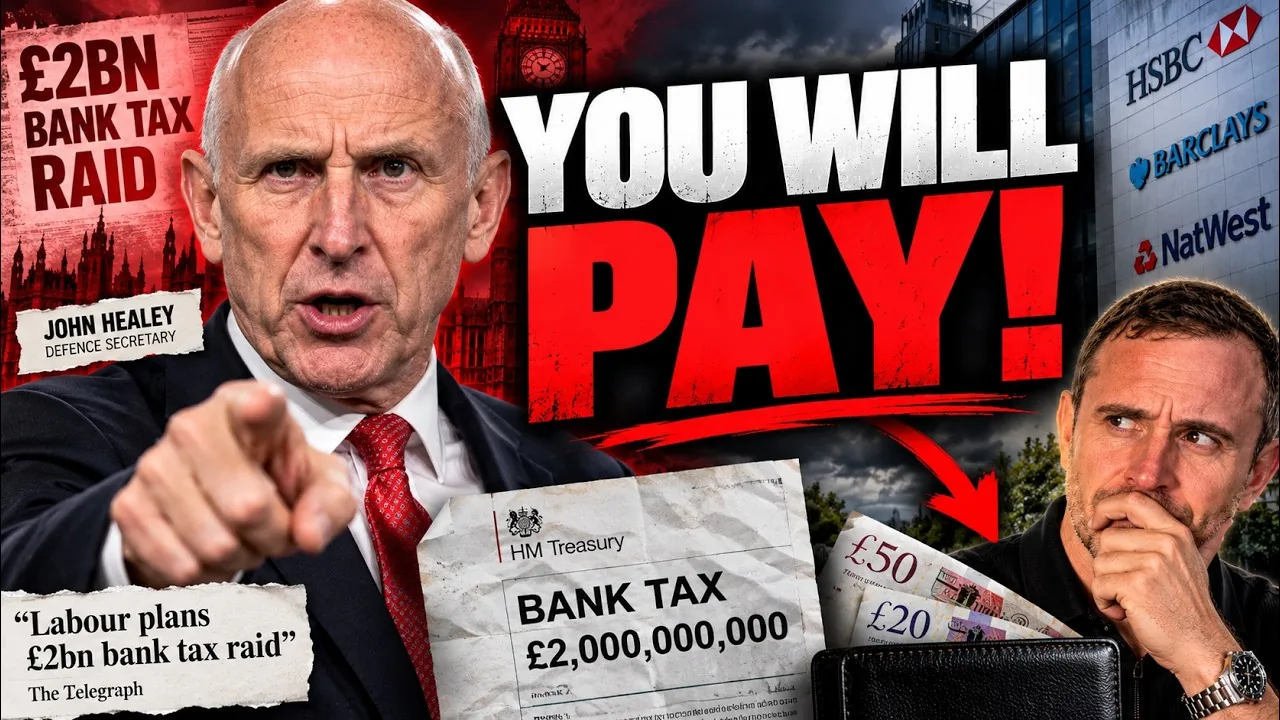
Original YouTube thumbnail, including an outdated job title for John Healey. Its headline expresses the video’s argument, rather than a confirmed mortgage-rate increase.
If the government increases the tax paid by banks, who actually carries the cost? That is the question I ask in my video of 16 October 2026. A bank might accept lower profits, find savings or change its lending. For anyone buying or refinancing property, the response matters more than the headline.
I have been investing in UK property for about 15 years. In the video, I describe owning more than £3.5 million of property with close to £2 million of borrowing. Those are my own reported portfolio figures. They explain why even a small change in financing costs gets my attention.
What bank tax change is being discussed?
The proposal discussed in the video would increase the additional bank corporation tax surcharge from 3% to 8%. This is a tax on qualifying bank profits, alongside ordinary corporation tax. It is not a five-percentage-point addition to a homeowner’s mortgage rate.
HMRC’s explanation of the existing framework sets out the 3% surcharge and £100 million annual allowance introduced from April 2023. The allowance is subject to group allocation rules. This is a UK banking-tax issue, rather than a change to tenancy law in one UK nation.
In the video I refer to a Trades Union Congress estimate that restoring an 8% surcharge could raise approximately £2.25 billion a year. The TUC’s published position supports higher bank taxation. That number is its revenue estimate, not a confirmed Budget costing and certainly not an amount already added to borrowers’ bills.
There is also a historical detail worth keeping straight. The surcharge reduction in 2023 coincided with a rise in the main corporation tax rate. Looking at the surcharge alone does not describe the entire tax change faced by banks. For this article, the important question is the possible effect of a further increase from the present framework.
Would banks simply put mortgage rates up?
My concern is that increasing the cost of doing business puts pressure on the return a business needs. Banks have shareholders, funding costs, capital tied up in loans and risks to price. I would not assume that an additional tax bill disappears without affecting any decisions.
But there are several possible responses. A bank could accept a lower return, reduce costs or change the mix of business it pursues. It could look for higher revenue from some customers. Competition also matters: a lender cannot assume borrowers will accept any price it chooses.
As I explain in the video, mortgage pricing depends heavily on wholesale funding costs, swap rates, competition and risk. Tax is part of that wider picture. A change in tax on profits does not mechanically translate into the same change in the interest rate on each mortgage.
UK Finance’s Autumn Budget submission warns that further sector-specific taxation could reduce the industry’s ability to lend and invest. That is the position of the banking industry’s representative body. It is useful evidence of its argument, but not independent proof of how every lender would respond.
I can understand the other side too. If profitable banks can contribute more without significantly reducing lending or investment, there is a case for the government considering it. My question is whether the benefits and the effects on borrowers have both been properly examined.
Why dividing £2.25 billion by mortgage borrowers does not work
It is tempting to take the estimated tax revenue, divide it by the number of mortgages and announce an extra annual bill for each household. I specifically reject that calculation in the video. Banks have different businesses, customers and profit positions. They would not necessarily respond in the same way.
Nor does today’s discussion establish that the proposal has already pushed rates higher. To make that claim, we would need evidence separating its effect from everything else changing in funding markets and lender pricing. The sources checked for this article do not establish that.
A better use of the uncertainty is to check how sensitive your own borrowing is to a small rate movement. That gives you a practical number without pretending to predict the government’s decision or the banks’ response.
What a small rate change means in pounds
My video uses £1 million and £2 million of interest-only debt. An increase of 0.10 percentage points adds £1,000 a year to the first balance and £2,000 to the second. The calculation is debt multiplied by 0.001. It assumes the entire balance carries the higher rate for a full year.
| Interest-only debt | Rate increase | Extra per year | Monthly equivalent |
|---|---|---|---|
| £150,000 | 0.10 percentage points | £150 | £12.50 |
| £150,000 | 0.25 percentage points | £375 | £31.25 |
| £1,000,000 | 0.10 percentage points | £1,000 | £83.33 |
| £2,000,000 | 0.10 percentage points | £2,000 | £166.67 |
The £150,000 rows are supplementary illustrations added for readers with one loan. None of these rate movements is a predicted consequence of the bank-tax proposal. Repayment mortgages need a different payment calculation because each payment also repays capital.
Use the free mortgage and rate stress calculator beside your actual mortgage balance. Compare interest-only and repayment payments, then add rent if you are checking a buy-to-let. Keep the term, fees and mortgage type visible when comparing options.
Why I take financing costs seriously
Across my own portfolio, I describe average mortgage costs moving from roughly 3% towards 6%. On approximately £2 million of borrowing, that is around £60,000 a year in additional interest. It is a rounded account of my experience, not a claim about the average landlord.
The arithmetic is straightforward: £2 million multiplied by a three-percentage-point difference is £60,000. That is £5,000 a month on a simple full-year comparison. The timing of individual mortgage changes matters in a real portfolio, so this is not a reconstruction of each payment I made.
This is why a headline about higher rents does not settle the investment question for me. I want to know what remains after borrowing and running costs. A property can have a respectable gross yield while the money left each month is much less comfortable.
What I would check before making a property decision
I would start with the actual financing position. What is the outstanding balance, when does the current deal end, and what would the replacement cost? A political headline is not a mortgage offer. Your broker can check the products and criteria available for your circumstances.
Next, I would run the numbers at today’s terms and at a less comfortable rate. Keep realistic allowances for management, insurance, repairs and periods without rent. If a small change removes the entire monthly surplus, that is useful information before committing more money.
The Buy-to-Let Deal Analyser brings the purchase cash, borrowing, operating costs and stress tests together. You can use the on-screen results first. If useful, its optional personalised PDF report gives you a record of the scenario and assumptions to work through afterwards.
For an existing property, the property refinance calculator helps compare usable equity, fees, rent coverage and the extra borrowing cost. Money released by refinancing is more debt. It should not be counted as extra investment profit.
Finally, separate confirmed policy from the possible response. Read what is actually announced at the Budget, including any start date and detailed rules. Then assess the borrowing terms available to you. I would not build a deal around an assumption that tax must rise, rates must fall or property values must increase.
The question I want answered
I understand why the government looks at bank profits when it needs revenue. I also understand why borrowers worry about another pressure on the cost of lending. The useful debate is about what changes in practice, rather than assuming either that banks absorb everything or that every pound automatically reaches a mortgage customer.
My concern remains the same as in the video: policies intended to raise revenue can affect the people they are meant to help. That is my argument about the risk, not evidence that a particular mortgage increase has already happened. I want to see the final policy and the banks’ response.
If you want to discuss your first or next property, start with the figures and request a free property strategy call. The initial call has no charge and no obligation to join. Bring the scenario you have tested so the conversation starts with your actual position.
Frequently asked questions
Has the bank surcharge increase to 8% been confirmed?
Not in the sources checked on 19 October 2026. The video discusses a reported possibility ahead of the 28 October Budget. Any later announcement needs checking for its final rate, scope and commencement date.
Does a five-percentage-point bank tax increase mean mortgage rates rise by five points?
No. A tax on qualifying bank profits and the interest rate charged on a mortgage are different measures. Lender responses depend on funding, competition, risk and business decisions. There is no automatic one-for-one conversion.
How much does a 0.10-percentage-point rise cost on £150,000 of debt?
For unchanged interest-only debt, £150 a year or £12.50 a month. That assumes the higher rate applies for the whole year and excludes fees and tax. It is an illustration, not a prediction.
Will a bank tax announcement change my fixed mortgage payment immediately?
An announcement alone does not rewrite your agreed fixed-rate terms. Check your contract and fixed-period end date. The relevant comparison may be the cost when you next refinance, including fees and any early repayment charge.
Is the £2.25 billion figure a confirmed government forecast?
No. It is the TUC estimate discussed in the video for restoring an 8% surcharge. It should not be presented as a confirmed Budget costing or divided among households to invent a mortgage bill.
What should I do before buying a property while the Budget is uncertain?
Check the deal against available finance and realistic operating costs, then test a weaker outcome. Keep confirmed rules separate from reported proposals. Use a broker and relevant advisers for your own circumstances rather than relying on a predicted policy result.
Watch the original video
Watch my original bank-tax video on YouTube, published 16 October 2026. This article preserves the video’s argument, with separately labelled explanatory examples and a policy-status check dated 19 October. Figures are educational illustrations, not a mortgage quote.