Buy-to-Let Overpayment Allowance: What Does 10% Actually Mean?
October 20, 2026
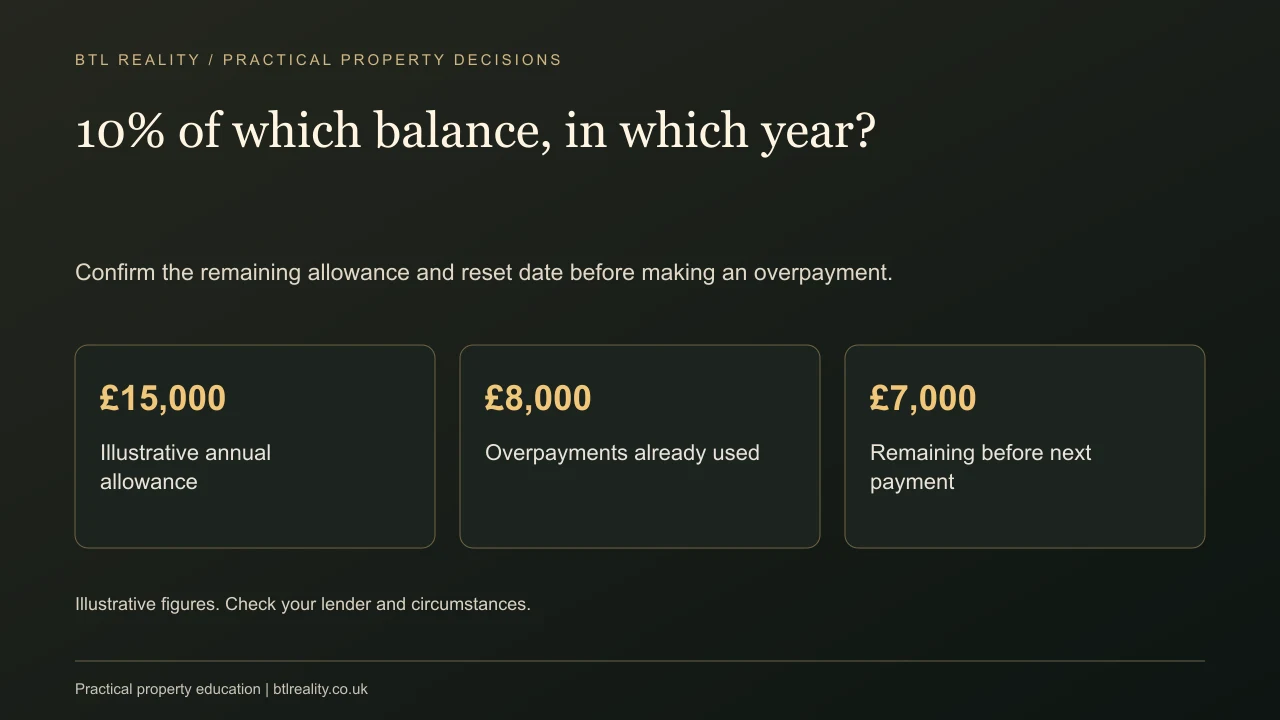
“You can overpay 10% a year” sounds simple until you ask which balance, which year and which payments count. A landlord making monthly overpayments and a later lump sum can accidentally exceed the allowance if those details are not clear.
Before sending money, obtain the remaining charge-free allowance for your actual account and the date it resets. A general percentage is not enough. Your mortgage offer, current statement and lender confirmation should establish the calculation and any early repayment charge.
What is an overpayment allowance?
It is the amount the mortgage terms permit you to repay above the contractual payments without the relevant early repayment charge. Some products allow more than others; some have no charge. Do not assume every buy-to-let uses the familiar 10% figure.
Checked on 19 October 2026, The Mortgage Works’ overpayment guidance says its fixed and lifetime-variable products usually have a 10% annual allowance, with exceptions. It directs borrowers to their offer or statement for the actual allowance.
MoneyHelper’s early-repayment guide also stresses checking charges and keeping cash available. The percentage in a general guide should not replace the contract for a specific loan.
Ask which balance the percentage uses
A 10% allowance based on £150,000 is £15,000. A 10% allowance based on £135,000 is £13,500. Both use the same headline percentage but permit different amounts. The relevant balance might be defined by the original advance, a particular annual date or another contractual basis.
Ask the lender for the amount in pounds. If the mortgage has more than one part, check each part’s basis and allowance separately. A product switch, additional borrowing or prior repayment can complicate assumptions based on an old statement.
Do not use today’s online balance unless the terms say it is the relevant figure. Likewise, do not assume a previous year’s £15,000 allowance remains correct simply because the interest rate has not changed.
Ask when the year starts and ends
A mortgage allowance may use a calendar year, a completion anniversary, a product anniversary or another defined period. There is no safe universal assumption. If it resets on 1 January, a December payment differs from one made after the reset; if it resets in June, the same December plan may be irrelevant.
Confirm how the lender treats the date a payment is received and credited, especially near weekends and bank holidays. A transfer leaving your bank before a deadline does not necessarily establish the date it reaches the mortgage account.
Keep the reset date in your mortgage records alongside the product expiry and early repayment charge schedule. Those dates can differ. The deal-expiry planning guide helps organise them without treating them as one event.
A worked allowance ledger
Assume the lender has confirmed a £15,000 allowance for the current period. You have made £250 of extra payments each month for twelve months and one £5,000 lump sum. All those extra payments count under the assumed terms.
| Item | Amount |
|---|---|
| Confirmed period allowance | £15,000 |
| Regular overpayments: £250 × 12 | Minus £3,000 |
| Previous lump sum | Minus £5,000 |
| Unused allowance | £7,000 |
| Proposed further lump sum | £10,000 |
| Amount above allowance | £3,000 |
If a hypothetical 3% charge applies only to the excess, it would be £90. That is an example, not a statement of your contract. Some charge calculations or redemption rules can differ, so obtain the actual figure before proceeding.
Use the mortgage stress calculator to compare payments at the lower balance, while keeping a separate allowance ledger. A payment calculator does not know which extra payments your lender has already counted.
Do regular payments use the allowance?
Distinguish the normal contractual payment from an extra voluntary payment. On a repayment mortgage, part of the normal payment already reduces capital. That does not automatically mean the whole contractual capital element uses an overpayment allowance.
Extra monthly amounts and lump sums may both count, depending on the terms. Check how your direct debit is set and whether a previous instruction remains active. A £250 recurring overpayment can be easy to forget when planning a year-end lump sum.
Ask about pending payments as well as completed ones. If a regular payment will arrive before the proposed lump sum, subtract it from the remaining allowance where the terms require. Keep the lender’s figure current rather than relying on an old screenshot.
When does the interest saving begin?
Interest treatment matters. Different lenders can calculate or adjust payments at different times. The Mortgage Works’ guidance describes how it applies an overpayment and when interest and monthly payments change under its process.
For a simple full-year illustration, repaying £10,000 on an interest-only balance at 5.5% saves £550 of interest, or £45.83 a month equivalent. The actual first-year saving depends on payment timing and the lender’s calculation method.
Do not compare a one-off charge only with one month’s saving if you will keep the smaller balance for several years. Equally, do not count ten years of savings at today’s fixed rate when that rate ends next year. Make the comparison period explicit.
Check what the lender changes afterwards
An overpayment can affect the balance, payment or expected repayment timetable differently depending on the mortgage. Ask whether the contractual payment is recalculated, whether you can choose to maintain it and whether a formal term change is involved.
For an interest-only rental mortgage, reducing the balance does not convert it to repayment. The remaining capital still needs a repayment plan. Keep that plan updated rather than treating a few overpayments as evidence that the whole loan will disappear by the end.
The interest-only end-of-term guide helps compare the balance you will still owe with the available exit. Record any lump sum separately from the ongoing capital plan.
Cash paid into the mortgage may be hard to retrieve
Unless your product expressly permits drawing money back, do not assume an overpayment can be reversed. Accessing the equity again may require new borrowing, fees, valuation and an affordability assessment.
Keep cash for known work, empty periods, tax and personal needs. A landlord who saves £550 yearly interest by using £10,000 of cash may still regret losing that liquidity if a roof bill appears soon afterwards.
The overpayments versus further investment guide covers the wider allocation choice. Here the immediate task is making any chosen payment within the correct allowance and with the consequences understood.
Which mortgage part should receive the money?
If the account has a low-rate original loan and a higher-rate further advance, the same overpayment may produce different interest savings depending on where it is allocated. Each part may also have a different unused allowance and early repayment charge.
Ask the lender how it will allocate the payment by default and whether you can specify a part. For example, £5,000 paid off at 6.5% saves £325 over a full year, compared with £175 at 3.5%, before charges and timing. The £150 difference is worth checking, but it does not override an expensive charge or a product condition.
Give a clear instruction using the lender’s required process and retain its acknowledgement. A bank-transfer reference alone may not establish that the payment will be allocated as you intended.
A practical payment checklist
Confirm the account and loan part, remaining allowance, period end and payment-reference instructions. Ask for the actual charge if the proposed amount exceeds the allowance. Check whether any planned sale or full redemption changes the calculation.
Then retain payment evidence and reconcile the next mortgage statement. Ensure the money reduced the intended balance and that any payment change matches what you were told. If it does not, query it promptly with the lender using the saved instructions.
For a portfolio, use one line per mortgage part. Separate allowance period, starting basis, used amount, proposed payment and reset date. That simple control is more reliable than remembering that every loan “allows roughly 10%”.
Questions about overpayment allowances
Is a 10% allowance based on my original mortgage or current balance?
The contract determines the basis. Do not assume either. Ask the lender for the current period’s allowance in pounds and the balance date used, especially after a product switch or additional borrowing.
Does the allowance always reset on 1 January?
No. It may use a different defined period. Confirm the reset date and how payments are credited before arranging a transfer near the deadline.
Do monthly overpayments and lump sums both count?
They can. Check the terms and include all relevant extra payments already made or pending. Do not confuse ordinary contractual repayments with voluntary overpayments.
Will I pay a charge on the whole lump sum?
The charge depends on the actual product and transaction. Some examples apply it to the excess over the allowance, but obtain a lender quotation instead of assuming that calculation applies.
Can I get an overpayment back if I need repairs money?
Only if the product specifically allows it. Otherwise accessing the equity can require new borrowing and checks. Preserve an appropriate cash reserve before making an irreversible payment.
Does overpaying an interest-only mortgage repay all the capital?
Only the amount actually paid off is removed. The remaining balance still needs a repayment plan at term end. Update that plan and the lender’s records after each significant payment.