Buying a Rental With an Overage Clause: Check the Trigger
October 20, 2026
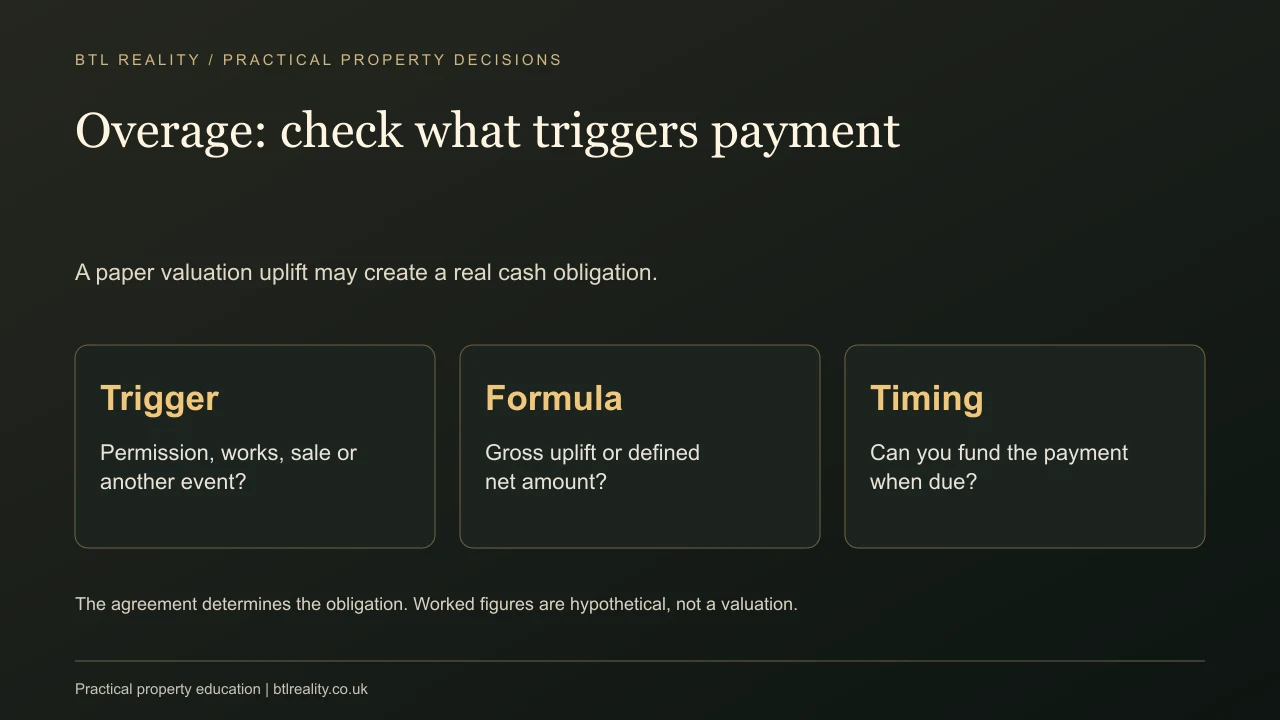
A house with a large garden, an outbuilding or conversion potential can look like an opportunity to create value. Then the legal pack mentions overage: a right for someone else, usually a former seller, to receive an additional payment if a specified event occurs.
It can affect a straightforward rental purchase as well as a development site. You may plan only to let the existing house, while the clause still influences mortgage acceptance, future works and resale. This guide focuses on England and Wales, with sources checked on 19 October 2026. The contract, not the label, determines the actual obligation.
What does overage mean?
HMRC’s introduction to overage payments describes an additional payment after a property purchase where the amount is not determinable at the original sale. It commonly lets the seller share in later value growth linked to an event such as planning permission or completed development.
That is a useful definition, but it does not tell you what your clause requires. Some arrangements focus on planning value; others on development, disposal or a specific change of use. The payment formula, duration and conditions all need to be read together.
The government’s estate-disposal guidance also explains overage and clawback as ways to capture future uplift, while warning that these arrangements can raise complex legal issues. It describes a disposal context, not a template that can safely be applied to every residential purchase.
Find the trigger before calculating the percentage
Ask the conveyancer to identify each event that could create a payment. Is it obtaining planning permission, implementing it, completing works, selling the property, selling part of it or something else? Does a trigger apply to the whole property or only a defined area?
A clause tied to permission can create an obligation before the owner has sold anything or received development proceeds. A clause tied to a completed sale may have different cash timing. Do not assume you can defer payment simply because you have not yet made a profit.
Check whether there are exclusions for ordinary extensions, garages, replacement buildings or works needed to maintain the existing home. The seller saying that routine improvements are fine does not establish an exclusion. Ask the solicitor to explain the actual drafting against the works you might undertake.
Also ask whether an application by another party, a future owner or an associated company could matter. The point is to map the agreed events, not invent a universal rule that every extension, HMO or planning application triggers overage.
How is the amount calculated?
The percentage is meaningless without the base. A share of gross uplift is not the same as a share of net profit. Find out what values are compared, the valuation date, the assumptions and which costs, if any, can be deducted.
Ask whether the starting value is fixed, indexed or reassessed. Check how disputes are decided, who appoints the valuer and who pays their fees. A payment based on an assumed development value may differ materially from the cash you believe a project will actually generate.
Read the timing and repeat-payment rules too. Does one payment end the arrangement, or can later events trigger more payments? Are previous payments credited? How long does the obligation last, and what evidence will be needed to demonstrate that it has expired or been fully discharged?
A worked example: value uplift is not the same as profit
Assume a house is bought for £200,000. A hypothetical clause requires 25% of the increase over that fixed base when specified planning permission is granted. A valuer determines the relevant value with permission is £280,000. The clause in this illustration allows no deduction for the buyer’s planning costs.
| Illustrative calculation | Amount |
|---|---|
| Relevant value after the trigger | £280,000 |
| Contractual base value | £200,000 |
| Uplift under the assumed formula | £80,000 |
| Overage at 25% | £20,000 |
| Separate planning and professional spend | £6,000 |
| Cash spent or payable at that point | £26,000 |
The £20,000 payment is not 25% of the £6,000 spent on planning. Nor is the £80,000 valuation uplift spendable cash in a bank account. If payment is due at that stage, the owner needs a funding route before assuming the project can proceed.
The numbers are invented to explain the mechanics. An actual agreement may use a different base, deductions, valuation assumptions, trigger or rate. Have the solicitor and valuer check the formula before putting it into an investment spreadsheet.
Use the Buy-to-Let Deal Analyser for the rental’s ordinary acquisition and operating position. Keep the contingent project calculation alongside it. Do not add an unreceived valuation uplift to rental income or count a possible refinance as project profit.
Check which land and title entries are affected
Ask for a plan showing the land covered by the agreement. A house with an unaffected garden corner is different from a clause applying across the dwelling and all access. If only part is affected, the boundaries and any resulting title structure still need careful checking.
The obligation may be supported by title restrictions, charges or other legal mechanisms. Ask how those affect a sale, mortgage, transfer or lease, and what certificates or consents would be needed. You need to know who can supply them and how compliance can be demonstrated.
Identify the current beneficiary and whether the benefit can be transferred. An old seller’s name in the original agreement may not be enough. Ask what happens if the beneficiary cannot be located, a company is dissolved or a payment has already been made but the records are incomplete.
Discuss the clause with the proposed lender early
Do not assume an ordinary mortgage offer will automatically accommodate overage. Give the broker the issue early and let the conveyancer report the full terms. The lender’s response can depend on the clause’s scope, security arrangements and effect on the property offered as security.
A statement that other lenders sometimes accept overage does not establish that your lender accepts this agreement. Your own plan not to develop may not settle the lender’s concern about the value and marketability of its security. Obtain a specific answer before exchange.
For a cash purchase, the issue still matters. If future buyers need mortgage finance, a restrictive arrangement can affect your exit. It can also affect your intended refinance, which is why the cash now, mortgage later guide should be read without assuming later borrowing is guaranteed.
Negotiate the parts that matter to your plan
If the seller is proposing a new clause, discuss the trigger, duration, land covered and payment formula before agreeing the price. A clause limited to additional dwellings on a defined plot may be commercially different from one capturing broad value changes across the house.
If the agreement already exists, establish whether a release or variation is possible, who must agree and what it will cost. Do not build the purchase around a release that has only been suggested. Ask who bears legal, valuation and administration costs and what happens if agreement is not reached.
A lower price may compensate for a known, manageable obligation. It does not make an unquantified clause harmless. Compare the property with alternatives that do not have the same constraint, including the amount of cash and professional work needed before you can execute the intended strategy.
Keep the rental case separate from the development story
Test the existing house as a rental without assigning value to an unverified future project. If it works only because you expect to add a dwelling or convert an outbuilding, the overage calculation belongs in the core decision, including payment timing and funding.
If you simply want to add a bedroom, first check whether that specific work touches a trigger. Then use the bedroom-return comparison with any applicable overage and professional costs included. An increase in rent does not prove that a larger works project creates a worthwhile return.
Before exchange, ask for a written summary of the covered land, triggers, formula, expiry, title restrictions and lender response. A good summary points back to the documents. It should make clear what you can do, what could become payable and which decisions still require specialist advice.
Frequently asked questions
What is an overage clause when buying a house?
It is an agreement for an additional future payment if a specified event occurs. It often allows a seller to share in a later increase in property value. The actual trigger, calculation and duration come from the agreement, so the label alone is not enough.
Does getting planning permission always trigger overage?
No. It depends on the wording. Some clauses use planning permission as a trigger, others implementation, sale or another event. Ask your solicitor to apply the actual clause to your proposed steps before submitting an application or commissioning a project.
Can I get a mortgage on a property with overage?
Possibly, but obtain a specific lender response through the broker and conveyancer. The covered land, title arrangements and effect on the lender’s security matter. General examples of lending on overage do not establish acceptance of your property.
Can overage be due before I have sold the property?
Yes, depending on the contract. A payment linked to planning permission or another earlier event can arise before sale proceeds exist. Model the payment date as well as its amount, and establish a realistic funding route.
Does overage mean a percentage of my profit?
Not necessarily. It may be based on value uplift, sale proceeds or another formula, with only specified deductions. In the worked example it is a share of gross uplift over a fixed base. Your agreement may work differently.
Should a buy-and-hold landlord ignore an overage clause?
No. Even if current letting does not trigger payment, the clause may affect finance, alterations or resale. Check the rental strategy against the exact terms, then decide whether the restriction and potential cash requirement fit the price.