Buying a Flat With Doubling Ground Rent: Run the Numbers
October 20, 2026
A flat can have a long lease, an attractive rent and a ground-rent clause that still causes problems. The current annual figure is only the beginning. What matters is how it changes, when the next review falls and whether a lender will accept the terms through your ownership and eventual sale.
This guide concerns leasehold purchases in England and Wales, checked on 19 October 2026. It focuses on an existing lease with an escalating rent. The proposed £250 ground-rent cap is not a current fix you should assume in an acquisition budget.
Ground rent is separate from the service charge
Ground rent is payable under the lease to the relevant landlord. A service charge funds the services and works allowed by the lease. Paying one does not mean the other is covered. A flat can have a low service charge today while still carrying an expensive ground-rent review clause.
The government’s leasehold buying guidance explains that ground rent and its increases can affect mortgage availability. It recommends checking the current amount, frequency and method of review early in the purchase process.
Ask for the actual lease and every relevant deed of variation. Do not rely on a sales listing that rounds the current rent or says it is nominal. Your conveyancer should confirm the amount legally due now and explain the clause governing future changes.
Read the next review date, not just the interval
A clause doubling every ten years does not necessarily give you ten years at the current rent after purchase. The review dates normally follow the lease’s terms. If the next review is in six months, your budget needs to reflect that rather than restart the clock at completion.
Confirm whether the figure doubles, follows an index, takes a percentage of value or uses another formula. A cap, floor or ratchet can change the result. The phrase inflation-linked is not enough to calculate the obligation without the full drafting and review history.
Ask whether previous reviews were correctly applied and whether there are outstanding demands or disputes. An invoice from last year is useful evidence, but it may not establish the correct current amount. The conveyancer should reconcile the documents rather than assume the latest payment settles the position.
You should also understand how any agreed change takes effect. A seller’s promise to seek a variation is not the same as an executed deed that the relevant lender accepts. Make the outstanding steps and responsibility for costs explicit before deciding when to exchange.
A worked example: the cost path over twenty years
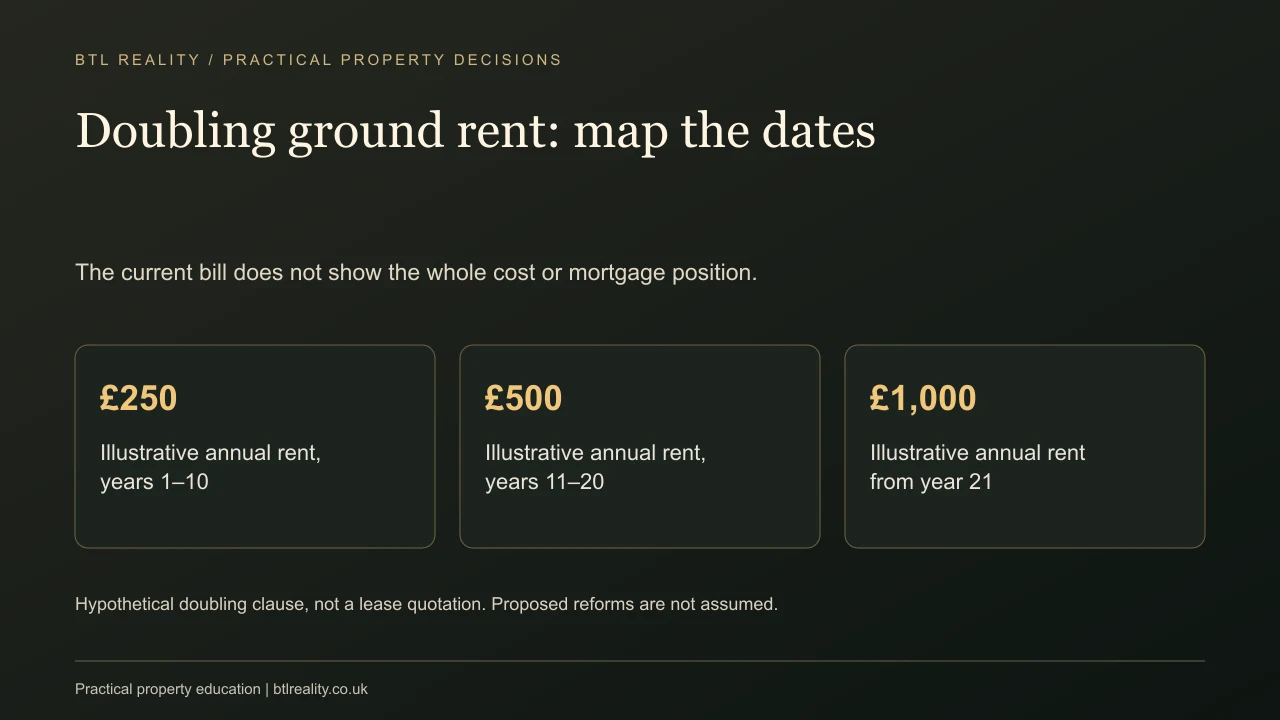
Assume a flat has £250 annual ground rent today, doubling at the start of year eleven and again at the start of year twenty-one. Assume you buy immediately after a review and the clause operates exactly that way. This is a deliberately simplified example, not a reading of anyone’s lease.
| Period | Annual ground rent | Ground rent paid in that period |
|---|---|---|
| Years 1 to 10 | £250 | £2,500 |
| Years 11 to 20 | £500 | £5,000 |
| Total through year 20 | Two payment levels | £7,500 |
| From year 21 | £1,000 | Depends on the holding period |
At a hypothetical £150,000 purchase price, those annual amounts are approximately 0.17%, 0.33% and 0.67% of that price. The percentages describe the illustration; they are not lender acceptance thresholds. Do not build in house-price growth simply to make the later percentages look smaller.
If ordinary annual surplus before ground rent is £2,400, £250 leaves £2,150. A £500 charge leaves £1,900. At £1,000 it leaves £1,400, assuming every other number stays unchanged. In reality rent, interest and other costs may change too, which is why a sensitivity model is useful.
Use the Buy-to-Let Deal Analyser for the current case and a later review case. Keep ground rent and service charges separate, even if collected together. Check the service-charge guide for the other block costs that need their own allowance.
A small annual cost can create a bigger finance problem
The direct cash cost may be less important than whether the lease remains acceptable security. Ask the broker to check the current lender’s requirements on the amount and review mechanism. The conveyancer should report any relevant issue and obtain a clear response before you commit.
Do not assume that one lender’s acceptance proves the whole market will accept the lease. Equally, do not assume every doubling clause is automatically unmortgageable. Review periods, monetary amounts, lease wording, borrower circumstances and lender policy can produce different outcomes.
Your own exit matters. A cash buyer may be able to complete without satisfying a lender now, but future buyers may need mortgages. If you expect to refinance, check how the rent path interacts with that plan. A lower purchase price does not rewrite a clause or guarantee future lending criteria.
Ask your conveyancer about enforcement implications under the law applying to this particular lease and occupation. Avoid relying on a single internet threshold to decide that a lease is safe or unsafe. The lender’s requirements and the legal analysis are related but separate investigations.
What the proposed £250 cap does and does not mean today
The government’s draft Commonhold and Leasehold Reform Bill proposes a £250 annual cap, moving to a peppercorn after forty years. Those are proposals for England and Wales, not a reason to stop paying a rent lawfully due under an existing lease.
The Commons Library’s reform briefing distinguishes measures already commenced from reforms still requiring further legislation. Its explanation describes the proposed cap as subject to parliamentary approval. A political announcement and an operational rule with a confirmed commencement date are different things.
For a purchase checked on 19 October 2026, assess the present lease and obtain up-to-date advice before exchange. Do not price the property as though the proposed cap has already removed the escalating clause. If the law changes, your adviser can then check the final scope, exceptions and start date.
What would a useful deed of variation need to achieve?
Ask what specific feature the lender or conveyancer considers unacceptable and what change would address it. A variation might alter the review mechanism or rent, but the proposed drafting must be assessed rather than accepted because it has that label.
Establish who must agree, whether superior interests or lender consents are involved and who pays the legal and administration costs. Ask whether the change addresses the whole remaining term or only a short period. A concession that postpones the next increase may leave the underlying mortgage issue unresolved.
Do not assume that an informal agreement to accept a lower payment binds future owners in the same way as a properly completed variation. Your conveyancer should confirm the legal effect, registration requirements and the lender’s acceptance of the final documents.
Compare the complete purchase options
Compare proceeding on the current lease, completing an acceptable change before purchase and choosing a different property. Include professional fees, possible delays, funding and the likely resale implications. A cheaper price is useful only if the remaining obligations and restrictions still fit your plan.
For example, if a proposed variation costs £4,000 including all professional costs, a £250 annual saving alone would take sixteen years to equal that cash outlay, ignoring financing, tax and timing. But the principal benefit may be lender acceptance and a cleaner exit rather than the annual saving.
Keep that distinction clear. You are comparing both a cashflow issue and a title issue. Neither should be hidden inside a vague contingency or treated as solved merely because the headline yield remains attractive.
Before exchange, obtain a written ground-rent schedule, the conveyancer’s report, any required lender response and the actual cost of the agreed solution. Then check the lease term, service charges, planned works and letting permissions separately. Ground rent is one important part of the flat, not the whole investment.
Frequently asked questions
Can I buy a flat with ground rent that doubles every ten years?
It depends on the lease, lender and your circumstances. Obtain the exact review wording and dates, then have the broker and conveyancer confirm acceptability for the proposed loan. Do not assume either universal acceptance or universal refusal.
Does the £250 ground-rent cap apply now?
The cap discussed in this guide is a proposal in the draft Commonhold and Leasehold Reform Bill, checked on 19 October 2026. Do not assume it has already altered an existing lease. Check the final law and commencement position before relying on any reform.
Does a long lease remove a ground-rent problem?
No. Lease length and ground rent are separate terms. A flat can have many years remaining but an unacceptable rent-review clause. Your conveyancer and lender need to consider both rather than use a long term as reassurance about every lease condition.
Can the seller simply promise not to collect the increase?
A promise is not necessarily a lasting legal change to the lease. Ask your conveyancer whether a formal variation is needed, who must consent and what will bind future owners. The proposed mortgage lender must accept the completed solution where required.
Should I ignore the clause if I am paying cash?
No. You will still have the contractual cost and relevant legal risks. Your future buyer may need a mortgage, and you may later want to refinance. Assess the title and exit rather than treating cash as a cure.
Is ground rent included in the service charge?
They are different obligations, although payments may be collected together. Check the breakdown and the lease. In your forecast, record each relevant expense once and include the correct review mechanism rather than assuming both stay flat.