Should I Add Buy-to-Let Mortgage Fees to the Loan?
October 19, 2026
Adding a buy-to-let mortgage fee to the loan keeps more cash available at completion, but it normally means paying interest on that fee while it remains outstanding. Paying it upfront avoids that extra borrowing but reduces your available cash. The sensible choice depends on the cost, lender's rules and what you need the retained money for.
This guide separates three things that are often confused: the fee itself, interest on the financed fee and the debt still owed later. It also shows why a lower mortgage rate with a large fee may not be the cheapest product overall. The examples are illustrative, not current mortgage quotations or personalised recommendations.
Start by identifying the exact fee
Mortgage costs can include a product or arrangement fee, valuation costs, broker charges, legal costs and other transaction expenses. Not every fee can be added to the mortgage, and different charges can have different refund rules and payment dates.
Ask the broker for an itemised comparison showing which fees are payable upfront, which may be financed and which remain due if the transaction does not complete. A percentage product fee can be substantial on a large loan, so convert it into pounds before comparing deals.
MoneyHelper's mortgage comparison guidance illustrates why product fees can outweigh an apparently attractive interest rate. Use the total cost over a relevant period rather than choosing from the rate column alone.
Adding the fee changes debt, not the purchase price
Suppose the mortgage advance towards a purchase is £112,500 and a £3,000 product fee is added. The mortgage balance becomes £115,500, subject to the lender's treatment. The property has not become worth £3,000 more and you do not necessarily receive that £3,000 as additional spendable cash.
Instead, you avoid paying the fee from your bank account at that point. You retain £3,000 cash compared with the upfront-payment option, while owing £3,000 more. Treat both sides of that change consistently in the investment appraisal.
Do not count the retained cash as profit or equity created. It is a funding choice. The fee remains a cost, and the extra borrowing remains part of the mortgage balance that eventually needs repaying.
Interest added by financing a £3,000 fee at 5%
Make the example your own
What does financing the fee cost?
Compare a fee added to an interest-only mortgage at a constant rate. The fee remains principal unless repaid.
Assumes no principal repayments and a constant interest rate. The fee is still a cost in either payment option; the interest is additional. Excludes tax, other fees, overpayment rules and changes after the product period. Illustrative only. Inputs stay in this page and are not saved or sent.
The calculator models a fee added to an interest-only mortgage at a constant rate. It shows interest over your selected comparison period and the fee principal still outstanding. It does not assume the fee disappears when a fixed-rate deal ends.
A £3,000 fee at 5%: the simple arithmetic
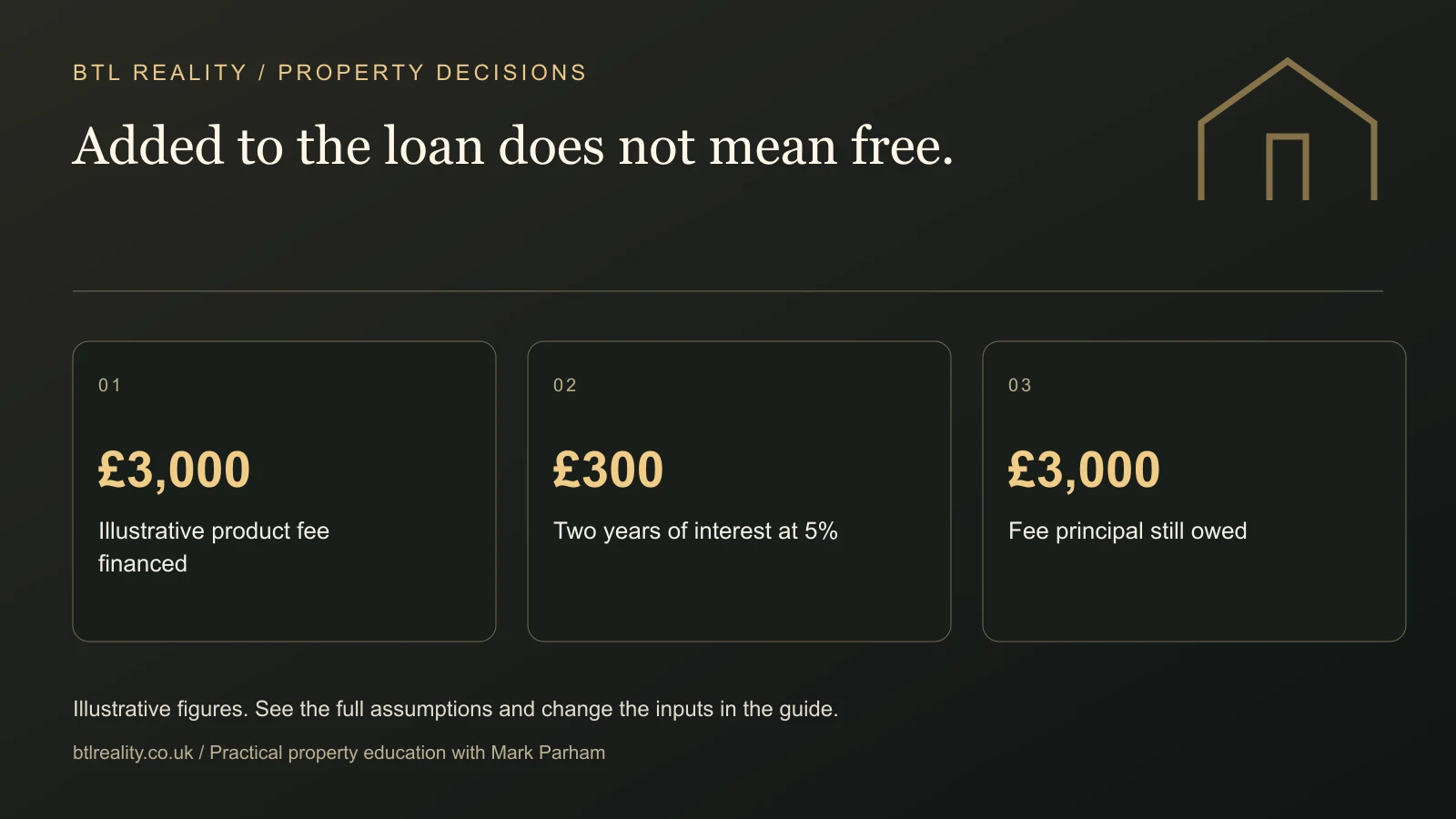
At an illustrative 5% annual interest rate, financing a £3,000 fee adds £150 interest a year, or £12.50 a month, on an interest-only basis. Over a two-year period the extra interest is £300; over five years it is £750.
At the end of either period, the £3,000 fee principal is still part of the loan unless you have repaid it. The two-year cost is not just £300: the fee itself still costs £3,000, with £300 of financing interest in addition.
If the same fee remained outstanding for 25 years at a constant 5%, it would generate £3,750 interest as well as the £3,000 principal repayment. Real rates, terms and repayments change, so that is a long-horizon illustration rather than a forecast.
The distinction matters when refinancing. Moving the debt to another lender does not erase the old fee. Adding a new fee can increase the balance again unless other repayments offset it.
How does it affect loan-to-value?
With a £150,000 property and £112,500 loan, gross loan-to-value is 75%. Adding a £3,000 fee makes the total balance £115,500, or 77% of the property's value by simple division.
Lenders can treat capitalised fees differently for product limits and maximum borrowing. The Mortgage Works' general criteria are one example of policy distinguishing fees added above an LTV limit from other maximum-loan restrictions. Do not assume that approach applies to every lender.
Ask the broker to confirm the amount actually advanced, the opening balance, the lender's product assessment and any effect on eligibility. Your own balance-sheet calculation should still include the full debt, even where a product's rules permit a fee to sit above its headline LTV band.
Compare the same product both ways
For a straightforward fee-payment decision, first compare the same rate and product with the fee paid upfront versus added to borrowing. Keep all other assumptions identical. Then ask whether the cash retained has a worthwhile purpose.
If paying upfront leaves a well-funded reserve intact, the interest saving may be appealing. If it leaves the property unable to cope with a near-term repair or vacancy, preserving liquidity may have value despite the cost. That is a risk and cash-management judgment, not a rule that everyone should borrow fees.
Write down the intended use of the retained amount. “Reserve against a documented £2,500 repair risk” is clearer than “more money for investing”. Do not casually spend the retained cash and then forget the borrowing that preserved it.
Compare different products over the relevant period
Imagine a £100,000 interest-only loan. Product A charges 5% with no product fee. Product B charges 4.5% with a £2,000 fee paid upfront. Over two years, interest is £10,000 for A and £9,000 for B. Adding B's fee gives £11,000, so A is £1,000 cheaper on those limited assumptions.
If B's fee is added to the loan, the £102,000 balance generates £9,180 interest over two years at 4.5%. Including the £2,000 fee, the comparable cost is £11,180. The lower headline rate still does not win.
Over five years on the same unchanged assumptions, A costs £25,000 interest. B with the fee paid upfront costs £22,500 interest plus £2,000, or £24,500. The longer comparison changes the answer.
Real products may have different fixed periods, reversion rates, exit charges and benefits, so do not extend a short introductory rate across five years unless it actually applies. Ask the broker for a like-for-like comparison including the costs relevant to your expected holding and refinance plan.
Repayment mortgages need a different calculation
On a capital-and-interest mortgage, repayments gradually reduce the balance. The interest attributable to a financed fee therefore depends on the repayment schedule, term and rate path. The simple interest-only model here is not a full amortisation calculator.
Use the lender's illustration and a suitable repayment calculation to compare monthly payments and remaining balances. Looking only at the payment difference can miss the amount of principal repaid or still outstanding at the end of your comparison period.
The same principle applies to overpayments. If you plan to repay the fee shortly after completion, confirm the rules, allocation and any charges before relying on that strategy. A planned overpayment is not an actual one until made and reflected in the balance.
Keep the fee visible in your return model
Include the product fee within the acquisition or refinancing costs, even if it is financed. Also include the resulting mortgage payment and full debt. Otherwise the spreadsheet can make borrowing the fee appear to improve returns simply by hiding an expense.
Avoid deducting the fee twice in cashflow: once as an upfront bank payment when it was actually financed, and again through the borrowing. Separate accounting cost, cash paid today and future debt repayment. Your accountant can advise on the relevant tax treatment; financing an expense does not by itself determine deductibility.
Use the buy-to-let deal calculator with the correct cash and finance assumptions. For later borrowing, the property refinance calculator helps show how fees affect the net cash released.
Make the decision with the reserve in view
Before choosing, compare the total product cost, cash left after completion, monthly payments and debt at the next decision point. Then test a repair, vacancy or delayed refinance. A small rate saving is less useful if it creates a cash shortage elsewhere.
Starter Club supports understanding these trade-offs as part of a practical property plan. The product recommendation itself belongs with your qualified mortgage adviser, who can assess the available loans and your circumstances.
The best answer is the one you can explain in pounds, dates and remaining cash. “The fee is free because it is added to the loan” should never be part of that explanation.
Frequently asked questions
Do mortgage fees added to the loan attract interest?
Normally, yes, while they remain part of the outstanding balance. On an interest-only loan, a £3,000 fee at 5% adds £150 annual interest. The fee principal also remains due. Check the product terms and repayment structure rather than treating capitalisation as a fee waiver.
Does adding a fee change my loan-to-value?
It increases the total debt relative to the property value. A lender may treat capitalised fees differently when applying its product limits, but your balance sheet still includes the full loan. Ask the broker to distinguish the headline product band from the actual opening balance.
Can the fee take me over the lender’s borrowing limit?
The answer depends on the lender's rules and the type of limit. Some permit fees above a headline LTV band while still applying other maximum-loan restrictions. Confirm the actual advance and balance with the broker. Do not assume every lender uses the same treatment.
Should I compare costs over the fixed period or whole term?
Start with the period relevant to your realistic plan, including fees and any exit costs, then consider what debt remains afterwards. Do not assume a short fixed rate applies for the whole mortgage term. A broker can compare suitable products on consistent timing and repayment assumptions.
Can I repay the added fee later?
You may be able to make an overpayment, but check allowances, charges and how payments are applied. Do not assume a separate fee balance can be cleared without reference to the mortgage terms. Update the model once the repayment is actually made rather than merely planned.
When might keeping cash available be worth the extra interest?
It may be valuable when paying upfront would leave inadequate reserves for known costs, vacancies or repairs. Compare that liquidity benefit with the financing cost and overall product suitability. Retained cash should have a clear purpose, and the extra debt must remain visible in the plan.
Put the next step into practice
Use the free tools to test your numbers, then choose the level of support that fits your next decision.