Should I Buy a Rental Property With a History of Subsidence?
October 17, 2026
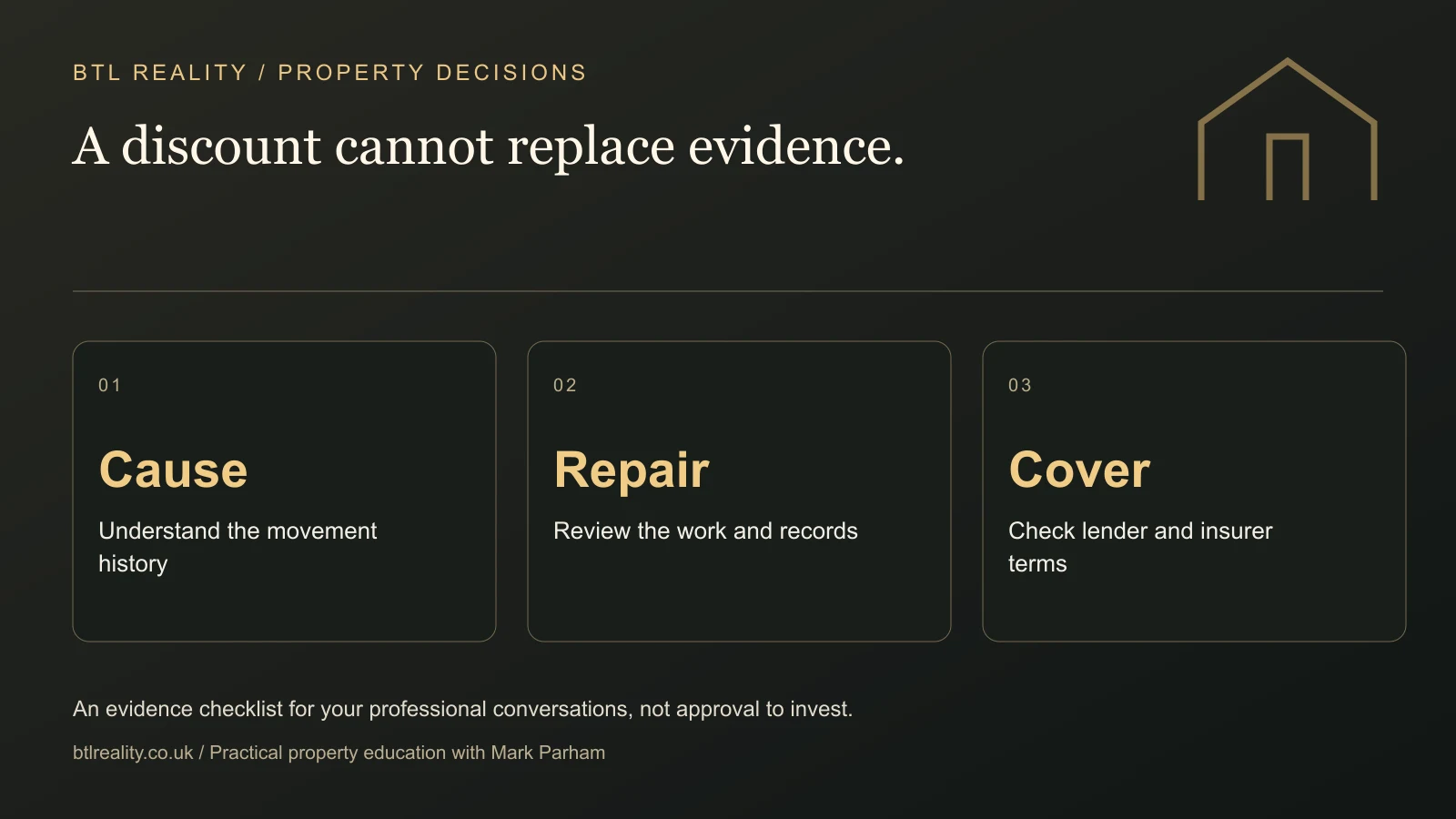
A rental property with a subsidence history is not automatically unbuyable, but it needs a much more specific investigation than “the cracks were fixed”. You need to know what caused the movement, what work was completed, what evidence supports its current condition and whether the mortgage and insurance terms work for you.
A discount can compensate for known costs and limitations. It cannot turn an unidentified structural problem into a predictable investment. This guide helps you organise the evidence and compare the cash consequences before deciding whether to proceed. It is not a way to diagnose movement from photographs or calculate a universal safe discount.
Understand what actually happened
Subsidence concerns downward movement of the ground supporting a building's foundations. It is different from ordinary settlement and from other causes of cracking. RICS explains the distinction and common causes, including changes in ground moisture and leaking drainage. A qualified assessment is needed to establish what happened at an individual property.
Start by asking the seller for the history in chronological order. When was movement first identified? Who investigated? Was an insurer involved? What cause was recorded? Was monitoring undertaken? What repairs or other remedial action followed, and when was the claim closed?
Avoid treating a fresh finish as evidence. Replastering and decorating may make a room look good without telling you whether the underlying cause has been addressed. Equally, an old repaired crack does not prove ongoing movement. The technical history matters more than the emotional reaction to the word subsidence.
Separate previous movement from unresolved movement
A documented historical problem with completed work and appropriate professional evidence is a different purchase from one with continuing movement or an uncertain cause. Both can be described in an advert as a “history of subsidence”, so the label alone is inadequate.
Ask the surveyor what the available evidence establishes and what remains unproven. They may recommend a structural engineer, drainage investigation, further monitoring or another specialist. Agree who will interpret the results and what would need to happen before a purchase decision.
The timescale is part of the deal. If appropriate monitoring cannot be completed before the seller's deadline, the uncertainty has not disappeared. You may need to renegotiate the timetable, accept a different route after advice or walk away. Buying first and asking later can transfer a difficult investigation into your own bank account.
Request the documents that support the story
Useful material may include survey and engineering reports, monitoring records, insurer correspondence, claim-closure information, repair specifications, certificates, guarantees and relevant approvals. The exact list depends on the work and the property's circumstances.
Record who prepared each document, its date, the address and areas covered, and whether you can rely on it. Ask your conveyancer to review the legal position around warranties or rights of reliance. A reassuring report written for someone else can be useful background without giving you enforceable protection.
If the seller says the documents have been lost, do not silently replace the missing evidence with an assumption. Ask what can be obtained from the relevant parties and what further investigation would cost. Missing paperwork may be resolvable, but the resolution belongs before an irreversible commitment wherever possible.
Make the example your own
Has the subsidence history been properly investigated?
Use the documents with your surveyor, engineer, conveyancer, broker and insurer. This is not a structural approval.
0 of 6 checks reviewed
This is an organiser, not approval to invest. Selections stay in this page and are not saved or sent.
The checklist is an evidence organiser. Ticking every item does not certify a building or guarantee lending. The outcome of the professional reviews matters more than the number of documents collected.
Underpinning is not a one-word answer
Underpinning is one possible intervention, not the definition of successful subsidence treatment. The appropriate response depends on the cause. Some problems are addressed through drainage or other remedial work; some need more substantial structural intervention.
If underpinning occurred, ask about its scope, design, supervision and completion evidence. Did it cover the whole relevant structure or only part? Were adjacent areas considered? What does the inspecting professional say about the present condition and residual uncertainty?
Do not conclude that “underpinned” means permanently problem-free, or that a property without underpinning was inadequately repaired. Those are technical judgments that require the actual facts. Your role as an investor is to commission and understand the assessment, then decide whether the remaining risk fits your plan.
Check insurance before treating the deal as financeable
Give potential insurers accurate information about the subsidence history. Review the proposed cover, premium, excess, exclusions, conditions and treatment of the previous movement. Ask for written clarification where wording is unclear.
An existing seller's policy is useful information, but it is not proof that equivalent cover will be available to you on identical terms. Confirm what happens on a change of owner and whether the arrangement satisfies your lender's requirements.
The excess deserves its own cash line. An illustrative £5,000 subsidence excess is a potential cash obligation, not the same thing as an annual premium and not a prediction of a claim. Do not invent a premium to make the yield calculation look complete. Obtain an actual quotation that reflects the disclosed facts.
Our guide to rent guarantee insurance deals with a different risk. Rent protection is not a substitute for buildings insurance or for understanding structural exclusions.
The lender needs the same accurate picture
Ask your broker to present the history and evidence to suitable lenders. A broad statement that a lender “does subsidence” is not approval of the address. The valuation, condition, documentation, insurance and your application still need assessment.
Keep the broker informed if the survey identifies new information. An offer based on incomplete or inaccurate facts is not a reliable foundation for completion. Ask which conditions must be met and when the lender needs updated reports.
Remember the distinction between a mortgage valuation and a buyer's survey. A lender's willingness to advance money is not a substitute for the inspection you need to understand ownership and future expenditure.
Compare the discount with cash, costs and time
Imagine a conventional comparable at £150,000 and a property with a documented subsidence history offered at £130,000. The headline difference is £20,000. That is not automatically £20,000 of profit or a sufficient risk allowance.
Assume, purely for comparison, that the conventional purchase can be financed at 75% loan-to-value while the available route for the other property is 65%. Deposits would be £37,500 and £45,500 respectively. The cheaper property now needs £8,000 more deposit before any difference in other costs.
Add illustrative extra investigation and initial work of £4,000, plus £2,000 of additional holding costs while the transaction and preparation take longer. The extra cash committed versus the conventional deposit is £14,000. Tax and ordinary purchase costs remain to be modelled separately.
This is not a claim that subsidence properties always require 65% lending or £6,000 of extra expenditure. It demonstrates why the price gap and the cash gap can point in opposite directions. Use confirmed terms and estimates in the free buy-to-let deal calculator.
Think through a future sale and refinance
You may be comfortable with the history after advice, but a future buyer will repeat many of the same questions. A smaller mortgage market, missing records or insurance concerns can affect demand and transaction speed.
Keep the evidence file complete during ownership. Record subsequent inspections, repairs and relevant insurance information. Good records cannot guarantee a price, but they help avoid forcing the next buyer to reconstruct a complicated history from scratch.
Stress-test a slower exit and a lower accepted valuation. If the investment depends on refinancing at full comparable value immediately after purchase, challenge that assumption explicitly. A history-related discount may persist even after work has been completed.
Decide what you need from the investment
A technically complex purchase may suit an experienced investor with appropriate specialists, reserves and time. It may be a poor fit for someone who needs a straightforward first rental and cannot fund a prolonged delay.
Write down the unresolved issues, the cost of resolving them and the point at which you will stop spending. This protects you from allowing a discounted asking price or money already spent on reports to dominate the decision.
BTL Reality's Done For You service sources against an agreed brief. If your brief prioritises simplicity and financeability, say so clearly. There is no obligation to take on structural complexity just because the advertised yield looks attractive.
Frequently asked questions
Can I get a buy-to-let mortgage after subsidence repairs?
It may be possible, but the exact history, repair evidence, current condition, insurance and lender's criteria matter. Give a broker the full document pack and ask for a property-specific assessment. An agent's reassurance or another owner's old mortgage does not establish your eligibility.
Does underpinning mean the problem is solved permanently?
No intervention guarantees that a building will never experience another issue. Ask the relevant professional what the work addressed, how completion was evidenced and what risks remain. Underpinning should be understood as part of a documented technical history, not treated as an automatic approval or rejection.
What reports should I request from the seller?
Request the investigation and engineering reports, monitoring records, repair specifications, completion evidence and relevant insurer correspondence. Ask your surveyor and conveyancer what else is needed and whether you can rely on the documents. The appropriate pack depends on the cause and the work undertaken.
Can I insure a property with a subsidence history?
Cover may be available, but terms can differ. Disclose the history accurately and review excesses, exclusions and conditions before committing. Confirm that the proposed arrangement applies to you as the buyer and is acceptable for the mortgage and intended letting use.
How much discount makes subsidence risk worthwhile?
There is no reliable universal percentage. Compare actual lending terms, investigation costs, remedial work, insurance, holding time and likely resale limitations. If a material issue remains unquantified, a price reduction alone does not turn it into a known cost or make the investment suitable for you.
Should I proceed before my lender and insurer review the evidence?
That can expose you to funding and cover problems after you are committed. Obtain the necessary reviews and independent advice before taking an irreversible step. A deadline from a seller or auction timetable does not make missing technical, mortgage or insurance evidence less important.
Put the next step into practice
Use the free tools to test your numbers, then choose the level of support that fits your next decision.