What Rent Do You Need to Break Even on a Buy-to-Let?
October 19, 2026
The rent needed to break even on a buy-to-let is the rent that covers the cash leaving your account. It is not simply the mortgage payment, and it is not necessarily the rent a lender requires for mortgage approval. Confusing those three numbers is an easy way to buy a property with less breathing room than expected.
You can calculate a useful first-pass figure by working backwards from mortgage payments, fixed costs and percentage allowances. Then compare it with rent supported by local evidence. If the required rent is higher than tenants are likely to pay, the spreadsheet has identified a problem; it has not given you permission to advertise an unrealistic rent.
Choose which break-even figure you mean
Operating break-even asks whether rent covers the property's running costs before borrowing. It is useful for understanding the building, management and tenancy costs, but it is incomplete for an investor using a mortgage.
Cash break-even before tax includes the actual mortgage payment. This is usually the most useful starting point when asking whether you will need to support the property from other income. Include principal repayment if you have a repayment mortgage, even though paying down debt also builds equity.
Personal cash break-even after tax includes an appropriate tax cash allowance. That requires your ownership structure and wider circumstances. Do not assume tax is a simple percentage of rent less the mortgage payment. Our worksheet lets you enter a separate allowance rather than pretending to calculate your tax position.
The simple formula
Suppose your monthly mortgage payment plus fixed costs is £800, and 20% of gross rent is reserved for management, maintenance and ordinary voids. You retain 80p of each £1 of headline rent to meet those fixed commitments. Divide £800 by 80% and the required rent is £1,000 a month.
The formula is: required gross rent = fixed monthly cash commitments ÷ (1 minus the variable-cost percentage). Express the percentage as a decimal, so 20% becomes 0.20. A desired monthly surplus can be added to the numerator when working backwards to a target rather than mere break-even.
This is a simplified model. Some costs are fixed, others depend on rent collected, and a void can create additional bills. The formula becomes more useful when you classify those lines correctly instead of putting every expense into one rough percentage.
A worked rental-property example
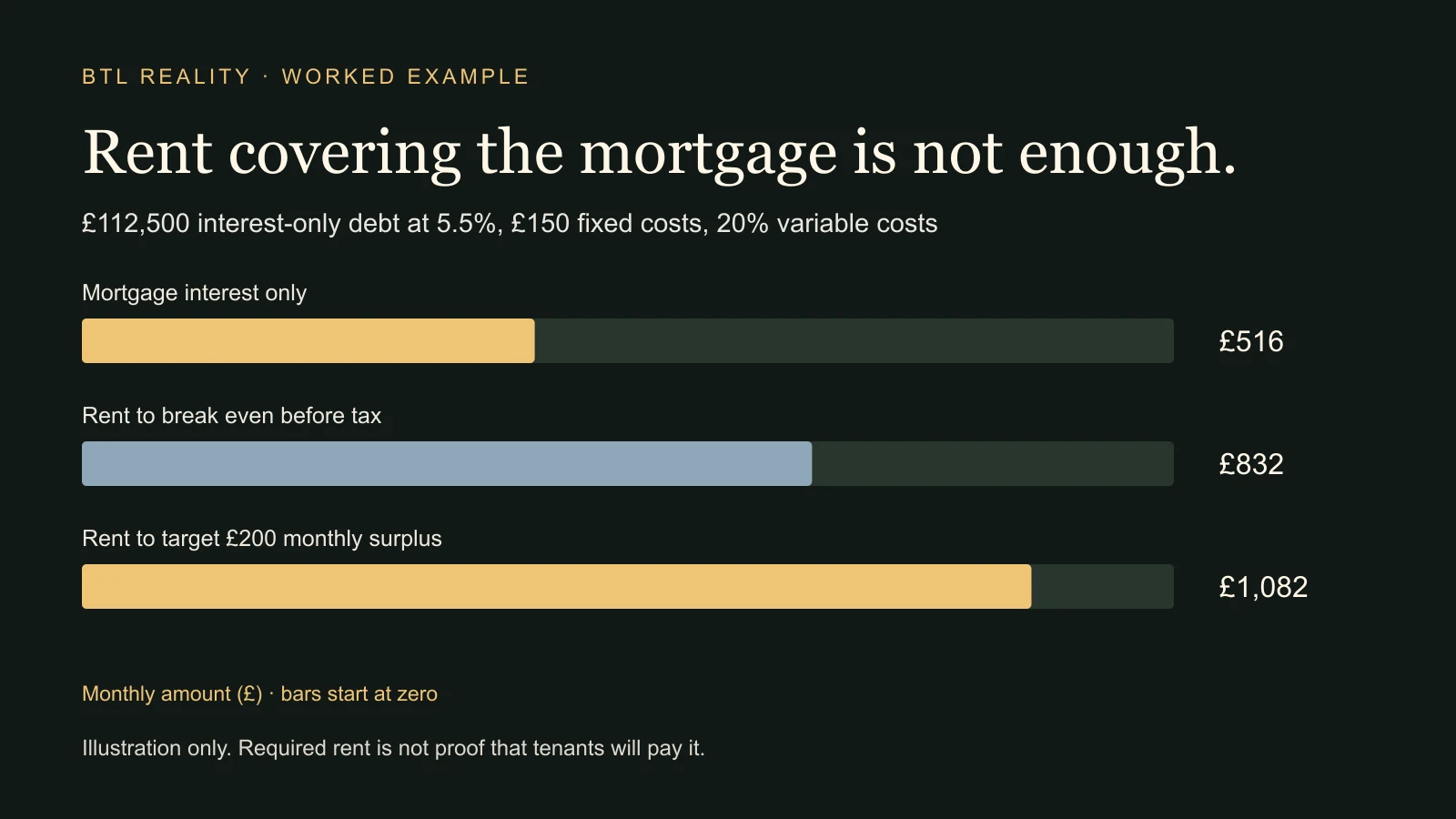
Imagine a £150,000 purchase funded with a £112,500 interest-only mortgage at 5.5%. Monthly interest is approximately £516. Add £150 of fixed monthly costs and a 20% allowance against gross rent. Before tax, required rent is roughly £832 a month.
At £1,000 rent, modelled cashflow is approximately £134: £1,000 less £200 variable costs, £150 fixed costs and £516 interest. That margin is very different from saying the rent covers the mortgage by £484. The second statement leaves out costs the investor still has to pay.
If you want £200 monthly cashflow on those assumptions, required rent rises to about £1,082. That does not establish market demand at £1,082. It tells you what the property would need to produce to meet your target, so you can decide whether to change the price, funding or investment.
Work backwards from your own costs
Use your actual monthly mortgage payment, including principal if applicable. Enter fixed costs and variable allowances separately, and include a tax cash allowance only if you have an appropriate estimate. The target surplus is money above those entries, not an automatic prediction of spendable income.
Find your required monthly rent
Enter full mortgage cash payment, fixed costs and variable allowance without double counting. Tax is a user-entered cash provision, not a tax calculation.
Calculations stay in your browser. Nothing you enter is saved or sent.
Inputs stay in your browser and are not submitted. The calculator assumes the percentage allowance scales with headline rent. It does not calculate acquisition costs, a mortgage offer or the effect of individual repair events. For a complete purchase appraisal, use the buy-to-let deal calculator.
What belongs in fixed costs?
Start with costs that remain due regardless of whether the tenant pays rent that month. These may include mortgage payments, insurance, service charges, ground rent where applicable, licensing or accounting provisions and other contractual commitments. Check your particular arrangements rather than copying every line into every property.
Annual bills can be divided by twelve for a monthly comparison, but keep their actual due dates in your cash plan. A £1,200 annual bill is £100 a month economically; it still needs £1,200 in the bank on the payment date if you have not arranged instalments.
Service charges deserve particular attention because they can be substantial and can change. See our guide to service charges and buy-to-let cashflow before assuming a flat with a healthy gross yield has a healthy monthly surplus.
What belongs in the percentage allowance?
Management fees quoted as a percentage of rent can sit here, using the amount payable including VAT where relevant. Maintenance and ordinary void provisions can also be represented as percentages for a first pass, but they remain estimates. Confirm whether an agent charges on rent collected or another basis.
A simple example is 10% management plus 5% repairs plus 5% ordinary voids, giving 20%. This is an illustration, not a recommended universal budget. A property needing major repairs or a long planned empty period needs specific cash allowances instead of a small average percentage.
Avoid double counting. If fixed costs already contain your maintenance provision, do not add it again as a percentage. If you model an exceptional six-month refurbishment void, explain how that sits alongside ordinary future voids. Our empty-property cost guide helps identify the bills that continue without rent.
Why the lender's rent test gives a different answer
A lender may assess rental coverage using an interest coverage ratio and a stressed interest rate, alongside other eligibility criteria. That is an underwriting test, not your complete household cashflow budget. Passing it does not establish that the investment meets your own required return.
For example, an illustrative 145% interest-coverage test at a 6% stress rate on £112,500 debt gives around £816 monthly required rent. Those figures are selected for explanation, not a current lender quotation or universal rule. Actual products, ownership structures and applicant circumstances can change the criteria.
Compare that with the £832 operating-and-finance break-even above. Neither figure replaces the other. One applies a hypothetical lender formula; the other includes your stated costs. Explore the mortgage stress calculator and confirm product-specific criteria with a broker.
Tax can change the practical answer
An individual residential landlord may have finance costs treated through a tax reduction rather than deducted in the same way as ordinary expenses. The effect depends on the rules and the person's position. HMRC's finance-cost guidance explains why taxable profit and cashflow can differ.
Suppose, purely as a cash sensitivity, you add £100 monthly tax provision to the worked example. With the same 20% variable allowance, the headline rent needed to cover it rises by £125, not £100. You need enough additional rent to cover both the tax allowance and the percentage costs on that rent.
Use an adviser-supported annual estimate and convert it into a saving plan. The worksheet's tax field is a cash input, not a calculation of liability or a substitute for advice on ownership structure.
Stress the required rent before buying
Increase the mortgage payment to reflect a plausible future product, add realistic repair spending and reduce the rent you expect to collect. If a modest change turns the property into a recurring cash commitment, establish whether your reserves and wider income can support it.
In the example, increasing interest from 5.5% to 7.5% adds £187.50 to monthly interest. With 20% variable costs, the required rent rises by about £234. A small-looking rate change can therefore require a much larger rent increase than expected.
Do not assume you can simply increase rent to match your finance costs. Market demand, tenancy terms and applicable rules constrain what you can achieve. Rent growth should be a scenario to test, not the automatic solution to an unaffordable purchase.
A decision framework, not a reason to chase rent
First establish credible market rent from comparable properties and local letting evidence. Next calculate the rent needed to meet costs and your desired surplus. Finally examine the gap. A comfortable gap gives room for uncertainty; a narrow or negative gap needs investigation.
The possible responses include negotiating a lower purchase price, changing the borrowing structure, finding legitimate operational savings or choosing another property. Each has consequences. A larger deposit improves cashflow but ties up more cash, while cheaper management is not better value if the service creates other problems.
If you are building your first investment plan, Starter Club provides a place to work through those decisions. Bring a realistic rental estimate and a complete cost list. Learning to recognise a deal that does not fit is as valuable as finding one that does.
Frequently asked questions
Is rent covering the mortgage enough?
No. You still need to fund running costs, repairs, voids, tax where due and any other commitments. Compare rent with the complete cash budget.
Does breaking even make it a good investment?
Not by itself. You also have acquisition costs, capital tied up, risk and time to consider. Expected growth is uncertain and should not hide an inadequate cash buffer.
Should I include mortgage principal repayments?
Include them when calculating the cash needed each month. Show them separately when analysing profit or changes in equity, because reducing debt has a different economic effect from paying interest.