How to Stress-Test a Property Portfolio Before Expanding
October 19, 2026
A property portfolio stress test asks what happens when the assumptions become less comfortable. It is useful because several apparently profitable rentals can depend on the same mortgage rate, local employer or optimistic repair allowance. Counting properties does not reveal that concentration.
The aim is to identify a decision before cash becomes tight: retain more reserves, adjust borrowing, postpone a purchase, improve maintenance planning or obtain advice. A stress test is not a forecast that something will go wrong. It is a way to establish whether the portfolio can tolerate a plausible change without forcing you into an unwanted decision.
Start with the current cash position
Build a baseline using rent you can reasonably expect to collect, operating costs and the full mortgage payments. Separate contractual figures from estimates. Record vacant properties, arrears and known works explicitly rather than assuming every unit produces a full year's rent at its advertised level.
Keep mortgage interest and principal repayment visible if you have repayment loans. Both use cash, but only the principal repayment reduces the balance. For cash resilience you need the full payment. For equity analysis, you may want to show the two parts separately.
Tax is another separate line. Cashflow before tax is not the amount available for personal spending. Individual landlords' residential finance-cost rules can mean taxable profit differs from rent less mortgage interest. Use an appropriate tax estimate from your adviser. HMRC explains the finance-cost restriction and tax reduction.
Test changes that connect with your actual portfolio
Begin with four pressures: a higher mortgage cost, less rent collected, an unexpected repair and a fall in valuation. They affect different parts of the investment. Higher interest reduces cashflow. Missing rent does the same. A one-off repair uses cash immediately. A lower valuation reduces equity and can make a future refinancing plan harder even if today's rent is unchanged.
Choose figures that are meaningful for your properties and loan terms. An investor with several fixed deals ending together has a different exposure from an investor whose loans expire over several years. Likewise, three homes dependent on a similar local tenant market may be less diversified than the property count suggests.
Do not hide these differences by entering a single average rate without keeping the underlying schedule. An average is useful for a first pass; the follow-up should identify which property and which date creates the pressure.
A worked three-property example
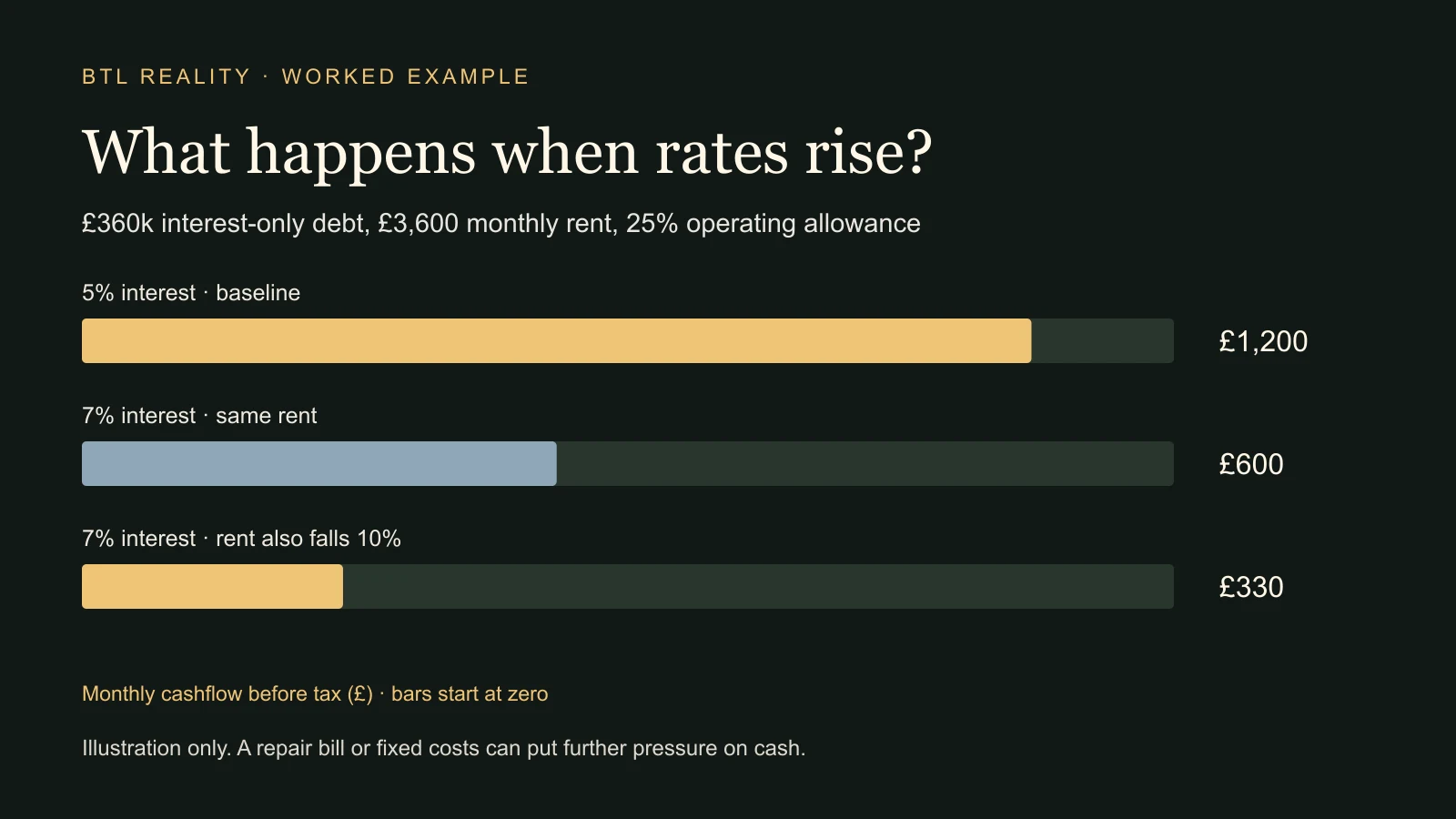
Consider an invented portfolio with £3,600 gross monthly rent and a combined operating and void allowance of 25%. It has £360,000 of interest-only debt at 5%, so monthly interest is £1,500. Modelled cashflow is £1,200 a month before tax: £3,600 less £900 of allowances and £1,500 interest.
If interest rises to 7%, the interest bill becomes £2,100 and the surplus falls to £600. If gross rent is also reduced by 10%, the modelled surplus is £330 with the same percentage cost assumption. The portfolio is still positive in that simplified case, but its margin has fallen substantially.
Now add a £6,000 immediate repair bill. The portfolio's annualised positive cashflow does not mean the bank balance can pay that invoice today. The reserve has to cover the timing. If available cash was £15,000, the repair leaves £9,000 before any other commitments. This is why annual profit and liquidity need separate answers.
Use the portfolio stress worksheet
Change the rent, costs, debt, baseline rate and stressed rate. The worksheet also allows a rent reduction, cash reserve and immediate repair bill. It assumes interest-only borrowing and a percentage operating allowance; it does not calculate your tax or a lender's affordability decision.
Test your portfolio cash buffer
Interest-only illustration, before tax. Fixed costs may not fall when rent falls. The rent reduction is an additional downside, beyond the normal operating and void allowance.
Calculations stay in your browser. Nothing you enter is saved or sent.
The downside rent reduction is additional to the operating allowance. If your normal allowance already includes ordinary voids, use the reduction for a separate downside rather than unknowingly counting the same scenario twice. Some costs remain fixed when rent falls, so a percentage model can understate the damage. Use property-level fixed costs for a final decision.
Understand what the reserve result means
If stressed cashflow is negative, divide the cash left after the immediate repair by the monthly deficit to obtain a simplified runway. For example, £9,000 of remaining cash and a £750 monthly shortfall imply twelve months before that cash is exhausted, assuming nothing else changes.
That is not twelve months of guaranteed safety. Tax, another repair, loan fees or changes in rent can shorten it. If the model shows a positive surplus, do not describe the runway as infinite. It only means this particular scenario does not create a recurring deficit before omitted costs.
Read Mark's cash reserve discussion for the distinction between money committed to an investment and liquidity kept available. Its historical market context should not be treated as a new forecast. The practical habit is to know what your reserve is supposed to cover.
Test the refinancing plan separately
Suppose the portfolio is worth £600,000 and carries £360,000 of debt. Loan-to-value is 60%. If values fall by 15% to £510,000 while the debt stays unchanged, loan-to-value rises to approximately 70.6%. The owners have not borrowed more, but their equity cushion has become smaller.
That may affect the options available when a mortgage deal ends. It does not automatically trigger an immediate cash call on every ordinary mortgage; the actual loan terms and circumstances matter. Review the financing schedule with your broker rather than assuming either that nothing changes or that every valuation fall forces a sale.
Use the portfolio loan-to-value guide and refinance calculator to examine the debt position. Keep available equity distinct from cash that a lender has actually agreed to release.
Look for correlated problems
A roof repair at one property may be manageable. Several properties of similar age requiring major components at the same time can be a larger planning issue. Likewise, an employer contraction or transport disruption can affect more than one rental in the same local market.
Create a short exposure list: location, tenant demand, property age and condition, mortgage expiry, letting arrangements and major scheduled works. Identify where several assets share the same dependency. You do not need a mathematically elaborate model to notice that every fixed rate ends within three months.
Then decide which exposures are acceptable and what you will do about the others. Spreading loan expiries, obtaining repair quotes early or holding a larger reserve may be more useful than buying another superficially different property in the same market.
Turn the result into actions and dates
A useful stress test ends with a short action list. Name the pressure, the amount involved, the person responsible and the decision date. “Talk to broker about three refinancing dates by March” is more useful than “monitor interest rates”. “Obtain a roof assessment before committing deposit funds elsewhere” is more useful than “keep some cash”.
Review the model when something material changes, such as a purchase, a mortgage offer, a significant repair or a shift in rent collection. Keep the previous version so you can see whether the assumptions were realistic. Avoid changing the downside inputs simply to restore a reassuring result.
The property portfolio calculator helps connect the current position with a longer-term plan. For support with more detailed modelling and strategy, Private Mentorship explains its application criteria and scope. Professional mortgage and tax input still belongs in the final decisions.
Frequently asked questions
What interest rate should I stress at?
Use a rate that tests the decision you face and discuss realistic financing assumptions with your broker. There is no single number that proves every portfolio is resilient. The worksheet rate is an illustration, not a prediction or lender requirement.
Should I stress each property or the whole portfolio?
Both are useful. The individual view identifies the source of a problem; the combined view shows whether other cashflow and reserves can absorb it. Do not let a portfolio average conceal one property requiring persistent support.
Does a positive result mean I can buy another property?
No. Add the proposed purchase, acquisition costs, debt and remaining reserve to the model first. A purchase that looks affordable in isolation can reduce the resilience of everything already owned.