Should You Buy a Property at Auction? A £100k Case Study
October 2, 2026
A £100,000 auction house can look cheaper than a £135,000 rental property. But the winning bid is only the beginning. Once you include refurbishment, fees, tax, finance and the time before rent starts, the apparently cheaper property can demand much more of your money.
A recent free call prompted this comparison. An investor described buying a Yorkshire house for £100,000, paying £6,000 in auction fees and expecting to spend £30,000–£40,000 on refurbishment. He hoped it would then be worth £165,000. Those are figures reported in our conversation, not independently verified valuations or completed results. We have kept the case anonymous.
My question was simple: does taking on that project give you enough extra reward for the cash, work and uncertainty involved? Let’s compare it with an illustrative property worth £150,000, negotiated to £135,000 and ready to let, with a £3,500 sourcing fee. Neither route is automatically the winner.
Should you buy a property at auction?
Yes, when you understand the property, can fund the purchase on the required timetable and have a strong enough margin after every cost. An auction can suit an experienced investor with reliable contractors, cash reserves and a clearly evidenced exit. It can be a poor fit for someone who needs predictable spending or assumes every cheap house will refinance easily.
The critical distinction is between a low price and a good investment. You commit to purchase obligations and spending before you know the eventual valuation, repair bill or rental performance. That does not make a loss inevitable. It means the upside must justify the risks you are accepting.
The £100,000 house: where the money goes
We use £40,000 for the works because that is the top of the quoted range. Planning around £30,000 while hoping nothing goes wrong would create a flattering comparison. Even £40,000 is a working estimate, not a fixed contractor commitment.
The example assumes an additional residential purchase in England by a UK resident. Under the current higher SDLT bands, £100,000 attracts £5,000 and £135,000 attracts £6,950. Your position may differ. Non-resident surcharges, reliefs and the treatment of particular auction charges need checking with your conveyancer. See the official additional-property SDLT guidance.
For both routes we add an illustrative £2,000 for legal, survey and initial finance costs. The auction example also includes £1,500 for empty-property bills, separate from mortgage interest. These are budgeting allowances, not quotes. Insurance, council tax, utilities and finance arrangements can change them materially.
| Cost or funding | Auction project | Ready property |
|---|---|---|
| Purchase price | £100,000 | £135,000 |
| Refurbishment | £40,000 | £0 |
| Auction / sourcing fee | £6,000 | £3,500 |
| Illustrative additional-property SDLT | £5,000 | £6,950 |
| Legal, survey and initial finance allowance | £2,000 | £2,000 |
| Initial empty-property bills | £1,500 | £0 |
| Total initial spending | £154,500 | £147,450 |
| Initial debt: 75% of purchase | £75,000 | £101,250 |
| Invested cash, excluding retained reserve | £79,500 | £46,200 |
| Funding including £5,000 retained reserve | £84,500 | £51,200 |
Stress the four-year outcome
Change growth, rent or financing assumptions. Both examples retain a separate £5,000 reserve. Results are illustrations, not a lending or tax calculation.
| Measure | Auction project | Ready property |
|---|---|---|
| Modelled property value | ||
| Accumulated rental cashflow | ||
| New refinance debt | ||
| Net cash released after £2,000 fee | ||
| Rental cashflow plus net refinance cash | ||
| Surplus / shortfall against original invested cash |
Fixed assumptions: auction completion after six months; no earlier refinance; 3.75% annual rent growth; interest-only initial debt £75,000 / £101,250. Property growth starts on completion for the auction. Refinance figures use LTV only: rental coverage and lender eligibility may reduce or prevent the loan. Negative release means cash must be added. Rental cashflow assumes it is retained. Inputs stay in this browser; nothing is submitted.
The auction project therefore totals £154,500 before ongoing borrowing costs and any additional contingency. Against a hoped-for £165,000 finished value, the initial paper margin is £10,500. That is not £10,500 in the bank, and it is not a realised profit after selling fees, finance and tax.
An extra £10,000 of work would almost consume that margin. A valuation of £155,000 would do much the same. A combination of delays, higher finance costs and a lower valuation could remove it altogether. This is why I want the downside written down before the excitement of bidding takes over.
The ready-to-let alternative
Our alternative is an illustration of the brief we could seek through property sourcing, not a claim that a particular £135,000 purchase is currently available. The £150,000 value still needs support from comparable completed sales and an independent valuation where required.
At £135,000 plus a £3,500 sourcing fee, £6,950 SDLT and £2,000 other costs, total acquisition spending is £147,450. That leaves £2,550 between total spending and the assumed market value. The advertised £15,000 discount is therefore not £15,000 of free profit after costs.
The attraction here is the simpler execution and smaller initial cash requirement. There is no planned major refurbishment before letting. There can still be a letting delay, repairs, compliance work, tenant problems or unexpected expenditure. “Ready to let” must be checked, not taken as a promise of no hassle.
The £3,500 is treated as the total sourcing fee for this illustration. If VAT or other charges are additional, increase the cost. It is not a statement that every BTL Reality sourcing instruction carries the same fee or produces the same discount.
Which route needs more cash?
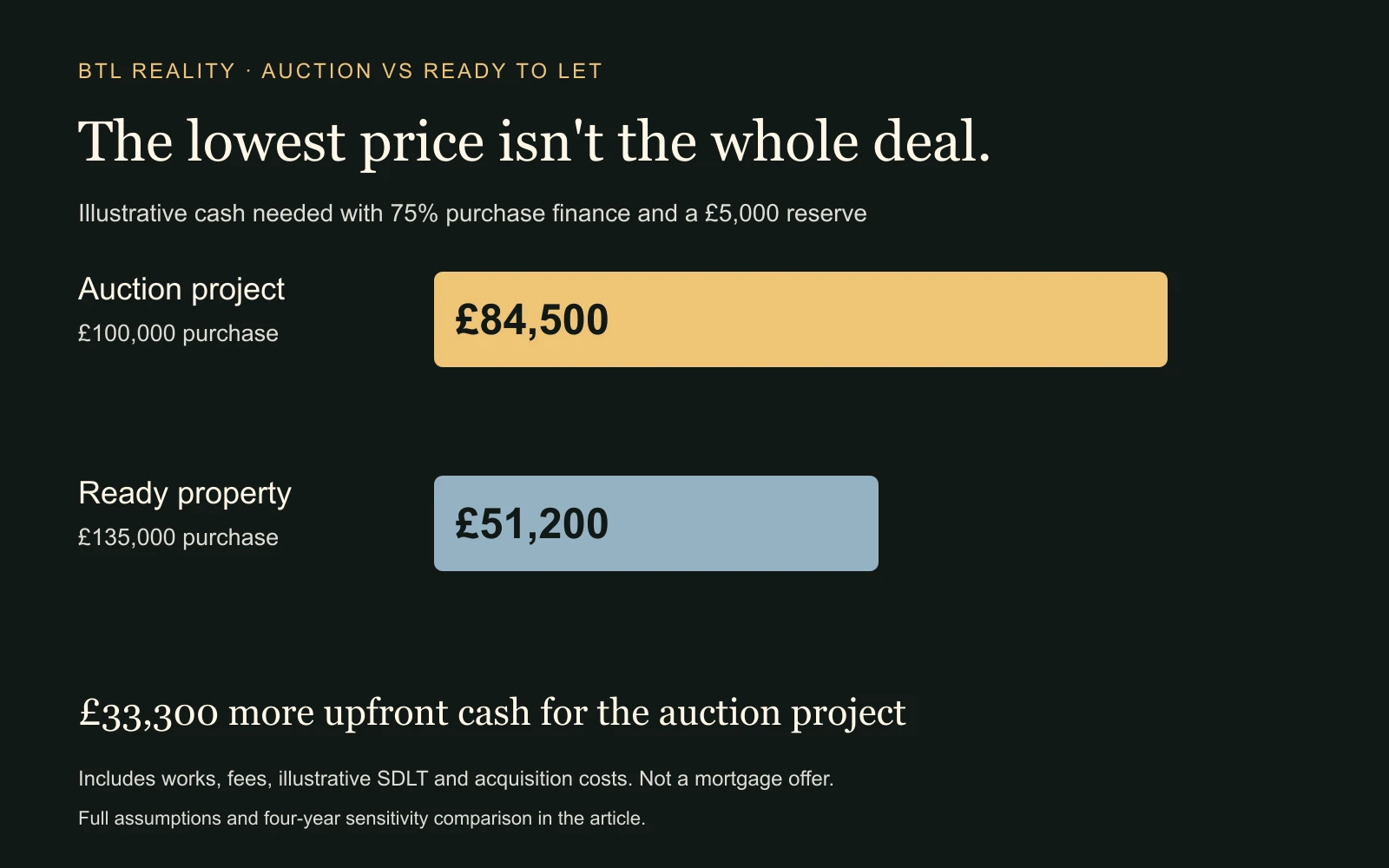
Assume initial interest-only debt of 75% of the purchase price. The auction project starts with £75,000 borrowing and £79,500 invested cash. The ready property starts with £101,250 borrowing and £46,200 invested cash. Add a separate £5,000 reserve to each and the funding requirements become £84,500 versus £51,200.
That £33,300 difference matters. It can be the difference between completing comfortably and running out of money halfway through a refurbishment. Retained reserves are still your cash, but they should not be used twice in your plan.
The auction finance assumption is particularly important. A property needing substantial work may not qualify for an ordinary buy-to-let mortgage. Bridging, cash funding or specialist finance can cost more and have different repayment deadlines. The illustration is deliberately transparent, not a statement that either buyer would receive a loan offer.
Could four years of rent and refinancing recover the cash?
We model £1,000 starting monthly rent for each property, 3.75% annual rent growth, a 25% allowance from gross rent for running costs and ordinary voids, and 5.5% interest on the original debt. These are assumptions, not verified rents or forecasts. The auction has six months without rent for works; the alternative has no initial works delay. Its ordinary void allowance remains included.
At the end of year four, we assume 5% annual property growth, a 75% loan-to-value refinance and £2,000 refinance costs. For the auction, growth on the completed £165,000 value runs for only 3.5 years after refurbishment. Neither property is refinanced earlier in this example.
The ready property reaches approximately £182,326. Refinancing releases about £33,494 after repaying the original £101,250 loan and paying the refinance fee. Add approximately £15,801 of accumulated rental cashflow and the total is £49,296, compared with £46,200 originally invested.
Under those assumptions, it clears the original invested cash by around £3,096 before tax. The auction also clears its original invested cash in this model: approximately £69,794 released plus £17,076 rental cashflow equals £86,870, against £79,500 invested. Its lower original debt helps subsequent rental cashflow despite the initial delay.
That result deserves to be shown. Auctions are not automatically bad investments. Here, the auction potentially returns more cash, but requires substantially more upfront funding and successful delivery of the refurbishment and valuation. An earlier refinance could change its result again, with additional costs and lending constraints.
Why “all your money out” is not guaranteed
With zero property growth, the ready-property example recovers only around £25,051 through rent and refinancing before tax. Approximately £21,149 of original invested cash remains unrecovered. Allowing £1,000 a year for tax cash payments would also turn the optimistic ready-property result into a small recovery shortfall. That allowance is a sensitivity test, not a calculation of anyone’s tax bill.
Refinancing also leaves more debt behind. In the growth case the ready property has roughly £136,744 debt afterwards, rather than £101,250. Higher debt means higher interest at the same rate. A lender can restrict borrowing because of rental coverage, valuation, personal circumstances or product criteria, even where a 75% LTV calculation looks comfortable.
Borrowed money is not profit. Accumulated rent counts only if you have retained it, rather than spent it. The separate £5,000 reserve remains ringfenced and is excluded from the capital-recovery comparison. Selling costs and capital gains tax are not modelled because neither property is sold. Use our refinance calculator to examine your own borrowing assumptions.
Checks before you bid
- Ask your solicitor to review the legal pack, special conditions and any late addenda before committing. Establish precisely when the contract becomes binding and when completion is due.
- Get a suitable survey and contractor inspection. A viewing is not proof that the roof, structure, electrics or heating are sound.
- Obtain an itemised works budget, programme and contingency. Know who carries the cost of delays and exclusions.
- Confirm funding suitability and deadlines in writing. An agreement in principle is not guaranteed finance for this property.
- Check rent using comparable lettings and local evidence, and value using completed comparable sales. Do not build your exit around the highest asking price nearby.
- Read every buyer charge and check whether VAT applies. Include legal costs, tax, insurance and the full empty period.
- Set a maximum bid from the complete appraisal and stick to it. Competition in the room does not improve your numbers.
Auction formats differ. Traditional auctions and conditional or modern-method sales can have different commitments, fees and timetables. The RICS property auctions guide is a useful starting point; the actual contract still governs your purchase.
My view: buy the outcome you want
If you want a hands-on project and have the skill, capital and margin to manage it, an auction could be appropriate. If you want a rental investment alongside a demanding job, a straightforward property bought against a clear brief may fit better, even with a higher purchase price.
The real comparison is cash required, probable cashflow, execution risk and the return on your time. Start with our buy-to-let deal calculator, then stress the costs and valuation. If you want help assessing your route, book a free call. If you want us to search against an agreed property brief, explore Done For You property sourcing.
Frequently asked questions
Are auction properties always cheaper?
No. A low guide price is not your final acquisition cost or proof of a discount. Compare the price you expect to pay, all charges and required works with evidenced value and achievable rent.
Is a sourcing fee better value than an auction fee?
It depends on the service and deal. Here £3,500 is less than £6,000, but the fee alone cannot decide the investment. Check the sourcer, conflicts, written scope, refund terms and property independently.
Can I get all my money back after four years?
It is possible under favourable assumptions, as the examples show. It is not assured. Growth, lending terms, tax, retained rent, refurbishment delivery and fees can all change the answer. Keep a lower-growth case alongside the attractive one.