How to Calculate Your Portfolio Loan-to-Value
October 19, 2026

By Mark Parham
BTL Reality · Practical property education
Calculate portfolio loan-to-value by adding the relevant mortgage balances, dividing by the combined property value and multiplying by 100. Do not simply average the individual LTV percentages unless all the properties have equal values. A larger property should carry more weight in the calculation.
The result is a useful balance-sheet measure, but it is not a mortgage approval or a complete risk score. Rental income, individual property LTVs, loan terms, reserves and lender criteria still matter.
Why averaging percentages gives the wrong answer
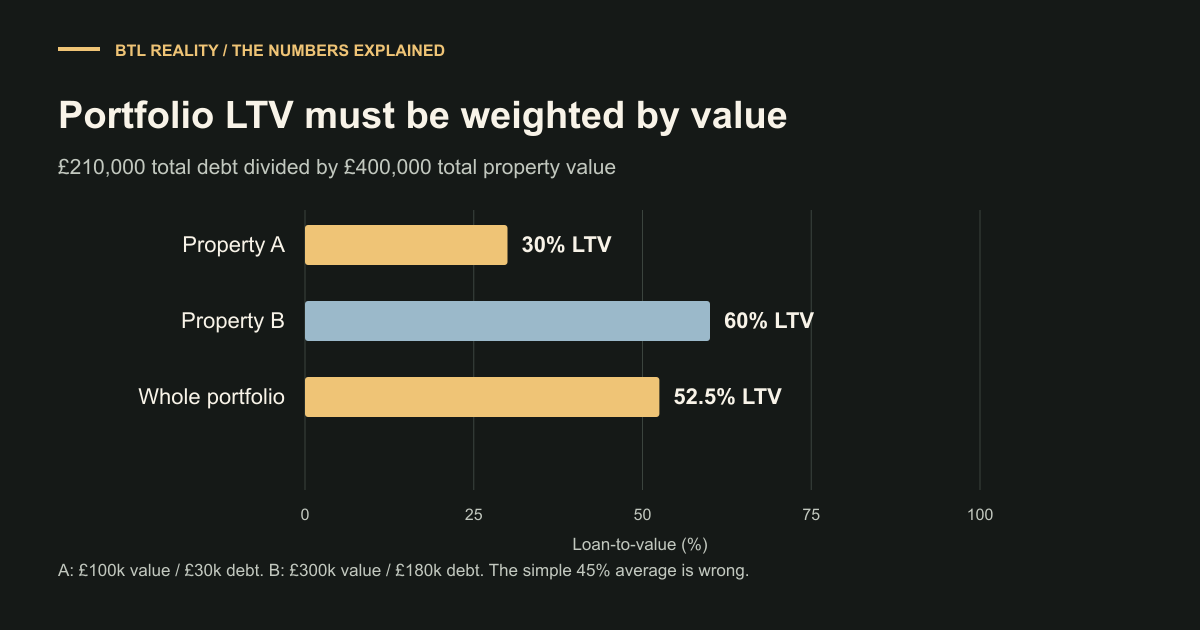
Imagine Property A is worth £100,000 and has £30,000 of debt. Its LTV is 30%. Property B is worth £300,000 and has £180,000 of debt. Its LTV is 60%.
The simple average of 30% and 60% is 45%, but that ignores the fact that Property B is worth three times as much. Add the actual numbers instead: £210,000 total debt divided by £400,000 total value equals 52.5%.
Portfolio LTV = total included mortgage debt ÷ total included property value × 100.
For this example: £210,000 ÷ £400,000 × 100 = 52.5%.
You can reach the same answer with a weighted average: A represents 25% of the property value and B represents 75%. Their LTVs therefore receive those weights. Adding the balances and values is usually simpler and less prone to error.
| Property | Value | Mortgage | LTV |
|---|---|---|---|
| A | £100,000 | £30,000 | 30% |
| B | £300,000 | £180,000 | 60% |
| Combined | £400,000 | £210,000 | 52.5% |
TRY YOUR OWN ASSUMPTIONS
Calculate a weighted portfolio LTV
Two properties, different values and loan balances. Change the valuation stress to see the effect with debt held unchanged.
Move a slider to explore the model.
Portfolio LTV = combined debt ÷ combined value × 100. Stress reduces both values by the selected percentage, with debt unchanged. No transaction costs, tax, rental-cover checks or lender-specific portfolio rules. Individual properties can have very different LTVs. Inputs stay on this page. Figures stay on this page and are not submitted or saved.
Enable JavaScript to use the sliders. The default worked example remains readable below.
Define which properties and debts are included
For your own management view, choose a clear scope and keep it consistent. You might calculate the rental portfolio separately from your home, or separate personally held properties from company-owned properties. Label the scope rather than presenting several different totals as the same measure.
Use current balances and sensible values from approximately the same date. If one value is a recent professional assessment and another is a hopeful asking price, the combined result may look more reliable than it is. Keep an evidence column alongside the figures.
Include relevant secured balances and understand how any second charge or cross-security arrangement is treated. A lender may define its assessment differently from your simple management spreadsheet, so ask the broker what belongs in the lender’s version.
What happens when values fall?
With £210,000 debt unchanged, a 10% fall in the example’s combined value reduces £400,000 to £360,000. Portfolio LTV rises to approximately 58.3%. A 20% fall reduces value to £320,000 and raises LTV to about 65.6%.
The mortgage balance did not increase. The denominator became smaller. That can matter when refinancing, because the valuation at that time may support a different set of borrowing options.
The same £210,000 debt against lower values
Property equity also changes more sharply in percentage terms. Starting equity is £190,000. After the 20% value fall it is £110,000 before costs, a reduction of about 42%. The net-worth guide explains why asset value and equity should remain separate in your planning.
A comfortable average can hide an uncomfortable property
Suppose one property has no debt and another is highly leveraged. The combined LTV may look moderate, yet the second property’s refinance could still be difficult. Unless borrowing is explicitly secured and assessed across assets in a suitable structure, spare equity elsewhere does not automatically solve that individual loan’s problem.
Keep a property-by-property schedule showing value, mortgage, rent, payment, deal end date and available cashflow. The portfolio total gives context; the individual rows show where action may be needed.
The same applies to income. A low-LTV property with weak rent or major works can still demand cash. A higher-LTV property may currently produce more rent, but that does not remove the extra sensitivity to rates and values.
What my portfolio account illustrates
My published refinancing story describes approximate portfolio value above £3.5 million and borrowing around £2 million. Using those rounded numbers gives a broad LTV around 57%, but it should not be mistaken for a current, precisely valued lender assessment.
The lesson is to show debt beside value. A large portfolio headline tells you little about the amount owed or the resilience of the individual properties. It also does not show whether the loans mature together or whether the rent supports a new rate.
That is why a portfolio review should join the balance sheet to the operating cashflow and financing calendar. Each view answers a different question about the same investments.
Reducing LTV is a decision, not just a target
LTV can fall because debt is repaid or because property values rise. You control repayments more directly than market values, but using cash to reduce debt also reduces the cash available for reserves or another investment.
Before making a large repayment, check charges, lender treatment and the wider cash position. The overpayments-versus-investing guide helps frame that trade-off without assuming one answer suits everyone.
Selling a property can also change the portfolio LTV, but the direction depends on the value and debt removed, as well as how the proceeds are used. Selling a low-debt asset may increase the LTV of the remaining portfolio if its proceeds are not used to repay other debt. Do the calculation rather than assuming every sale deleverages the remaining assets.
Build a useful quarterly review
- Update balances. Use lender statements rather than the original loan amounts.
- Review values sensibly. Record the evidence and avoid reacting to every online estimate.
- Calculate individual and combined LTV. Keep both visible.
- Apply a common value stress. Then consider whether some markets or properties could behave differently.
- Check the next refinancing dates. Identify which balances need attention first.
- Connect rent and reserves. Confirm the debt is serviceable, not merely supported by value.
Use the portfolio calculator for the wider operating picture and the mortgage stress calculator for rate changes. The purpose is to identify practical decisions early, while you still have time and options.
Review the portfolio as a whole
Private Mentorship is intended for more involved strategy and planning. Explore the fit if you want to connect debt, cashflow and future acquisitions in one coherent plan.
What is a safe portfolio LTV?
There is no universal figure that makes every portfolio safe. Rental strength, loan terms, property condition, concentration, reserves and your circumstances all affect resilience.
Does 60% portfolio LTV mean I can borrow more?
Not automatically. A lender must assess the actual case, including individual properties, rent, applicant circumstances and its own criteria.
Prepared using information checked on 30 September 2026. Check the linked product pages for current availability and terms. This is general property education, not personal financial, mortgage, tax or legal advice. Models and examples are illustrative. Property values and income can fall, and outcomes are not guaranteed.