How to Calculate Net Worth With Property and Mortgages
October 19, 2026

By Mark Parham
BTL Reality · Practical property education
Net worth is the value of what you own minus what you owe. With property, count the asset and its mortgage once, or use the property’s equity once. Do not add the full property value and the equity together, and do not confuse either figure with cash available for your next investment.
This calculation is useful because it gives your financial plan a starting point. A large property portfolio can coexist with substantial debt and little accessible cash. A smaller balance sheet may be easier to manage if it has stronger reserves and fewer commitments.
Start with assets minus liabilities
List assets at a reasonable current value and debts at their current balance, using the same date. For a simple personal picture, assets might include cash, investments, property, pensions and a business interest. Liabilities might include mortgages, loans, credit cards and other amounts owed.
Some values are easier to establish than others. A bank balance is directly observable. A property or private business valuation is an estimate until a transaction or formal assessment establishes otherwise. Mark the evidence and date so uncertainty does not disappear inside a precise-looking total.
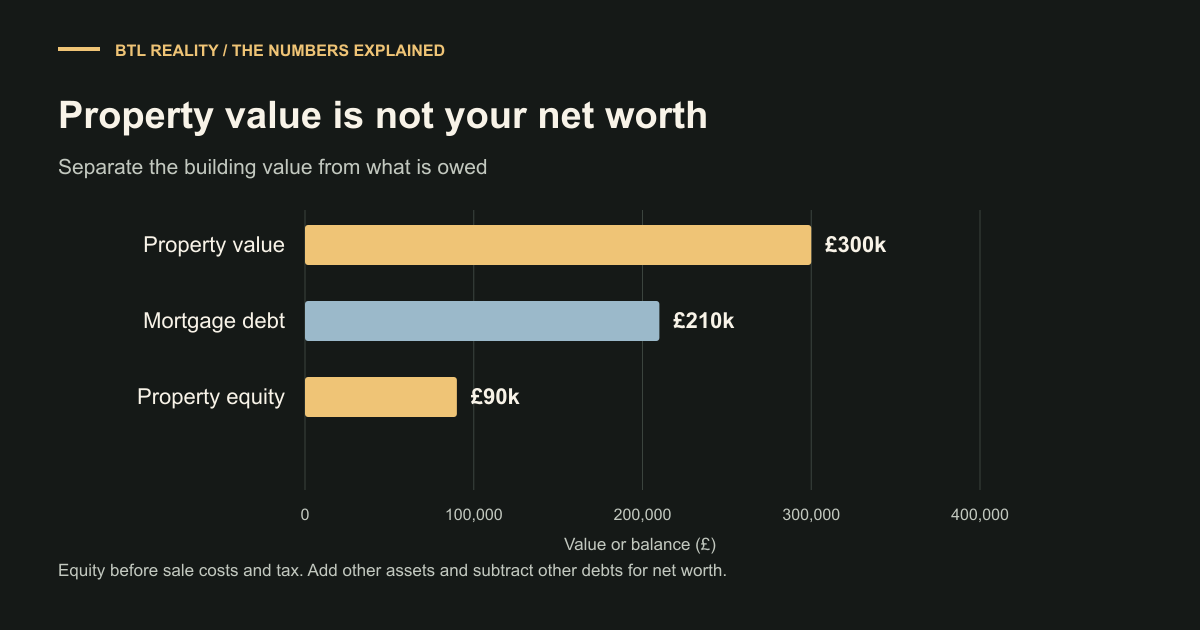
Property equity = property value minus mortgage debt.
A property worth an illustrative £300,000 with £210,000 of mortgage debt has £90,000 of equity before sale costs and tax.
For total net worth, add other assets and subtract other liabilities. With £20,000 cash, £30,000 other investments and £5,000 other debt, the simplified total becomes £135,000: £300,000 + £20,000 + £30,000 − £210,000 − £5,000.
Use one of two methods, consistently
Full balance sheet
Put the £300,000 property in assets and the £210,000 mortgage in liabilities. The net effect is £90,000.
Equity shortcut
Put £90,000 property equity into the net-asset total. Do not subtract the same mortgage again.
The full balance sheet is usually more informative because it keeps the debt visible. The shortcut can be convenient, but it hides how the equity is financed. Two people with £90,000 equity can have very different exposure if one owns a modest debt-free property and the other has a much larger mortgage.
TRY YOUR OWN ASSUMPTIONS
Separate assets, debt and accessible money
Use only the share of each asset attributable to you. This simplified model does not assess joint legal liability, pensions, businesses or tax.
Move a slider to explore the model.
Net worth = property + cash + other investments minus mortgage and other debt. The 2% sale-cost allowance is illustrative, excludes tax and may be inadequate. Other investments may fluctuate or be inaccessible. No pension or business values included. Inputs stay on this page. Figures stay on this page and are not submitted or saved.
Enable JavaScript to use the sliders. The default worked example remains readable below.
Value, debt and equity in one property
What my portfolio numbers actually mean
In my published account of building the portfolio, I describe approximate property value above £3.5 million, debt around £2 million and property equity around £1.5 million. Those are approximate figures from that account, not a live valuation statement.
The important distinction is that £3.5 million of property was not £3.5 million of personal net worth or spendable cash. The borrowing had to be considered. Even the property equity was not the same as cash sitting in a bank account, and it did not by itself describe every other personal asset or liability.
That is why I want the asset, debt, equity and cash figures visible separately. It makes conversations about the next purchase, reserves and risk much more grounded than simply quoting the gross portfolio size.
Separate net worth from investable cash
Your home may represent a large part of your net worth but still be where your family lives. A pension may be valuable but not available for immediate use. A business interest may have an estimated value without a ready buyer. None should be treated as freely available purchase cash.
Create a second figure for money genuinely available to invest after reserves and near-term obligations. Label cash, investments that could be sold, restricted assets and possible borrowing separately. If selling investments creates tax or dealing costs, account for those before using the proceeds in a plan.
The mini-tool’s cash-plus-investments total is deliberately not called available investment cash. The user still needs to assess access, volatility, tax and what the money is already intended to fund.
Property equity is not the same as sale proceeds
A sale can involve agent fees, legal costs, loan redemption costs and tax. If a £300,000 property has £210,000 debt and an illustrative £6,000 of selling costs, the remaining amount is £84,000 before any tax and other charges.
The 2% selling-cost allowance in the tool is only an example. Use quotations and an accountant’s assessment for the actual property. A book-equity figure helps measure the balance sheet; an after-cost sale estimate answers a different question.
Equally, a refinance does not usually release all the equity. The new loan is constrained by value, rent, criteria and fees, and the existing mortgage must be repaid. Use the refinance calculator for a separate borrowing scenario.
Handle joint ownership and company interests carefully
For a personal snapshot, identify the share of an asset that belongs to you and avoid counting a partner’s share as your own. Debt responsibility can be more complicated than simply multiplying a joint mortgage by an ownership percentage, so establish the legal position where it matters.
For a household snapshot, include the whole jointly owned asset and the whole relevant debt once. Do not combine two personal sheets without checking for duplicates. The same shared property can easily appear twice if each person entered the full value.
If a company owns the properties, do not automatically add both the company’s net value and all its underlying property equity to your personal total. Company liabilities, ownership shares and extraction costs may matter. Ask an accountant to help choose a consistent basis.
Use valuation ranges when precision is not justified
Try a lower, central and higher supported property valuation while keeping debt unchanged. On the example’s £210,000 mortgage, a value of £270,000 gives £60,000 equity, while £330,000 gives £120,000. A 10% asset-value movement creates a much larger percentage movement in the original £90,000 equity.
That sensitivity is one reason leveraged property wealth can feel substantial yet change quickly. It does not mean the lower or higher outcome will happen. It means you should avoid treating an estimated value as a fixed amount available on demand.
Build a snapshot you can maintain
- Choose one date. Use statements and balances as close to it as practical.
- Record the evidence. Note statement dates, valuation methods and ownership shares.
- List debts explicitly. Include balances beyond the mortgages.
- Separate accessible money. Identify reserves and money already committed.
- Check for double counting. Property equity, company value and joint assets are common traps.
- Review periodically. Update after significant borrowing, purchases or changes in circumstances.
Track progress without turning every market fluctuation into a decision. A useful snapshot supports a plan; it does not need to become a daily scoreboard. Pair net worth with cashflow and the level of debt you are comfortable carrying.
Connect the balance sheet to your next decision
Use the full net worth tool to organise your position. If the portfolio and strategy have become complex, explore whether Private Mentorship is an appropriate fit.
Does my own home count in net worth?
Normally its value and associated debt belong in the balance sheet. That does not make the equity accessible investment cash or mean selling or borrowing against the home is appropriate.
Is a higher net worth always a stronger position?
Not by itself. Consider debt, cashflow, liquidity, concentration and how reliable the valuations are. The quality and accessibility of the assets matter as well as the total.
Prepared using information checked on 30 September 2026. Check the linked product pages for current availability and terms. This is general property education, not personal financial, mortgage, tax or legal advice. Models and examples are illustrative. Property values and income can fall, and outcomes are not guaranteed.