How Long Does It Take to Save a Buy-to-Let Deposit?
October 6, 2026

By Mark Parham
BTL Reality · Practical property education
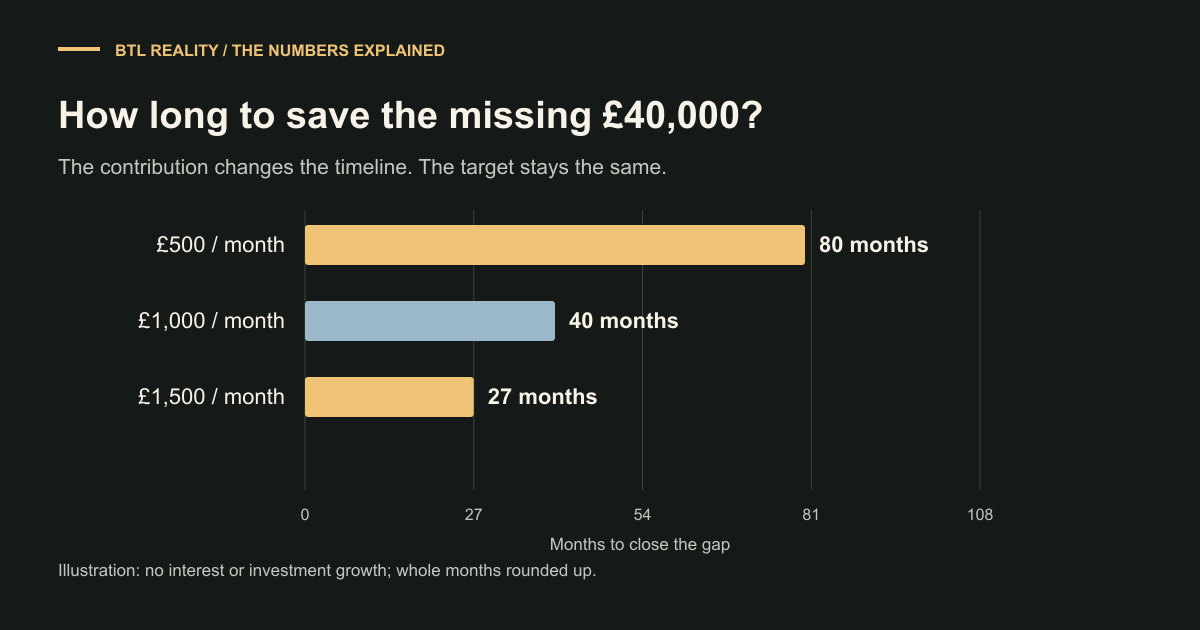
The time needed to save for a buy-to-let depends on the complete cash target, what you already have and how much you can consistently add. A £40,000 funding gap takes 40 months at £1,000 a month before interest or changing costs. The first job is to make sure that £40,000 is the right gap.
A deposit alone rarely represents all the money needed to buy and hold a rental property. Purchase taxes, fees, refurbishment and reserves can add materially to the target. Saving for the deposit while ignoring those items creates a frustrating finish line that moves just as you think you have reached it.
Turn a house price into a complete cash target
Start with a plausible purchase range and ask a mortgage broker what financing may be available in your circumstances. Do not assume a particular deposit percentage guarantees eligibility. Rental cover, property condition, ownership structure and your wider position can affect the loan.
Then build the cash budget from the bottom up. An illustrative £150,000 purchase with a 25% deposit requires £37,500 for the deposit itself. That is only the first line. Add the applicable acquisition tax, legal and finance costs, any sourcing fee, works and a reserve.
| Item | Illustrative cash |
|---|---|
| 25% deposit on £150,000 | £37,500 |
| Acquisition-tax allowance | £8,000 |
| Legal, survey and finance allowance | £3,500 |
| Initial works | £3,000 |
| Property reserve | £3,000 |
| Total target | £55,000 |
The £8,000 tax line reflects one illustrative additional-property purchase in England or Northern Ireland under the assumptions explained in our buy-to-let costs guide. Your circumstances may produce a different bill, and Scotland and Wales use different systems. Confirm the actual amount rather than adopting this example as your personal budget.
Keep a household emergency fund outside this target. The same £5,000 cannot simultaneously fund a rental repair, a family emergency and the deposit. Label money by purpose so the total genuinely represents cash you can commit.
The simple formula
Months needed = (complete cash target minus allocated savings) ÷ monthly saving.
Round up to the next whole month. With a £55,000 target and £15,000 already allocated, the gap is £40,000. At £1,000 a month, that is 40 months before interest and cost changes.
If you prefer a deadline, reverse the formula. A £40,000 gap over 24 months needs roughly £1,667 each month. That is a planning requirement, not a reason to promise a contribution your household cannot maintain.
TRY YOUR OWN ASSUMPTIONS
Find your deposit-fund timeline
Set the complete cash target, the money already allocated and a sustainable monthly saving. This is a cash-saving model with no assumed investment growth.
Move a slider to explore the model.
No interest, investment returns, inflation, tax, withdrawals or changing property costs. The target must include purchase costs and the intended property reserve; retain a separate household emergency fund. Month count rounds up. Inputs stay on this page. Figures stay on this page and are not submitted or saved.
Enable JavaScript to use the sliders. The default worked example remains readable below.
Find a monthly amount you can repeat
Review several months of actual spending, including irregular expenses. Annual insurance, holidays, maintenance and professional fees do not disappear because they were absent last month. Convert those costs into monthly provisions before deciding how much is available for the property fund.
Choose a sustainable base contribution and treat bonuses or irregular earnings separately. You can create an upside scenario that includes a bonus, but a plan dependent on money not yet earned is more fragile than one supported by the regular surplus.
Set a transfer after income arrives and review it when circumstances change. The practical benefit is consistency: you can see whether the plan is being followed without relying on whatever happens to be left at the end of a busy month.
Time to close the same £40,000 gap
Improve the plan without pretending the gap is smaller
There are three broad ways to shorten the timeline: save more, allocate more existing cash or reduce the genuine project cost. Each has trade-offs. A cheaper property may need more work; a smaller deposit may create higher borrowing costs; using every spare pound may remove the reserve you need.
Focus on changes that improve the whole position. A lower purchase price supported by evidence is useful. Omitting maintenance from the spreadsheet is not. Extra income can help if it is sustainable, but do not build a property plan that requires permanently working at a pace you cannot maintain.
My portfolio account describes how later purchases involved capital released from earlier properties. That is different from saving a first deposit. Existing equity does not mean a beginner can skip the initial funding problem, and refinance proceeds remain borrowing subject to lender checks.
Should the deposit be invested while you save?
The answer depends on when the money is needed and how much uncertainty you can accept. A market investment can fall just before a planned purchase. A smooth growth assumption in a calculator does not mean a short-term deposit fund will follow that path.
The FCA’s explanation of risk and returns is useful here: investments can lose value, and accepting more risk does not guarantee a higher return. Think about the purpose of the money before choosing where to hold it.
This article deliberately uses no growth in its main timeline. You can explore longer-term scenarios in the compound interest calculator, but keep those illustrations separate from cash you need to complete a purchase on a particular date. Obtain personal advice where appropriate.
Review the target as well as the saving rate
A £55,000 target set today might be wrong a year later. Property prices, borrowing terms, acquisition taxes and the intended specification can change. Review your assumptions periodically and whenever you narrow the search to a real property.
Use three columns: original estimate, latest evidence and difference. That turns a moving target into a visible update rather than a surprise. If works are now quoted at £7,000 instead of £3,000, the plan needs another £4,000 or a different project. The saving effort is still valuable; the decision has simply become better informed.
Also check that the chosen market still fits. Do not continue saving towards a specific property type merely because it was the first idea. Compare the rent, financing and management demands before deciding the goal remains sensible.
Use the saving period to become ready to buy
- Learn one market. Build a record of comparable sales and rental listings, and revisit what actually happens to them.
- Understand the numbers. Practise using the deal calculator with realistic costs.
- Speak to the right professionals. Clarify mortgage possibilities, ownership and tax before a deadline appears.
- Define a manageable brief. Specify location, property type, works tolerance and the reserve to retain.
- Track your progress monthly. Record actual contributions, not just the amount you intended to save.
Reaching the cash target should be one part of being ready, alongside credible rent evidence, finance and a property you understand. You do not have to rush into the first available deal because the account finally reaches a round number.
Turn the saving target into a property plan
Starter Club is designed to help connect your starting position with practical next steps. Explore the support and decide whether it fits the stage you are at.
Can I buy with less than the example deposit?
Possibly, depending on the property, lender and your circumstances. A broker should assess the available options. A smaller deposit does not remove fees, works or the need for a reserve.
What if my monthly saving is zero?
The timeline cannot progress through regular saving at that setting. Review the budget, income, target or timing rather than inserting an assumed investment return to make the answer look better.
Prepared using information checked on 30 September 2026. Check the linked product pages for current availability and terms. This is general property education, not personal financial, mortgage, tax or legal advice. Models and examples are illustrative. Property values and income can fall, and outcomes are not guaranteed.