How to Compare Two Buy-to-Let Deals
October 1, 2026

By Mark Parham
BTL Reality · Practical property education
To compare two buy-to-let deals fairly, put them on the same basis: supported rent, complete purchase cash, realistic running costs, the same financing assumptions and a clear downside. The property with the biggest advertised yield is not automatically the better use of your money.
This sounds obvious until two attractive listings arrive with different spreadsheets. One includes renovation and management. The other shows rent less mortgage interest and calls the result profit. You are comparing different calculations, so the apparent winner may simply have omitted more costs.
Start with the job you need the property to do
Write down your available investment cash, the reserve you must retain and the time you can commit. Then decide whether your priority is spendable income, a manageable first investment or a project with potential to add value. A property can be financially interesting and still fail your brief.
Someone working long hours may reasonably prefer a straightforward house with modest works over a complicated conversion. That does not mean conversions are bad. It means the comparison should include delivery risk and management demands, rather than pretending every investor has the same skills and spare time.
Our three-step property investment plan helps frame that brief. Set it before viewing, when it is easier to be honest about what you can afford and manage. Otherwise the property starts dictating the strategy.
Build one comparison sheet, not two sales presentations
Use a column for each property and identical rows. Record the purchase price, supported market value, rent range, deposit, purchase taxes, legal and finance costs, refurbishment, sourcing fees if applicable and opening reserve. Separate a written quotation from a guess, and put a date against the evidence.
Next list the operating costs: management including applicable VAT, maintenance, insurance, void allowance, compliance, service charges and any landlord-paid bills. Enter the actual mortgage payment basis. An interest-only example cannot be compared directly with a repayment example without identifying the capital being repaid.
Keep your personal tax calculation separate from the operating comparison, then ask an accountant to assess the ownership structure. The pre-tax winner may not be your after-tax winner. Acquisition taxes also depend on the location and buyer’s circumstances, so copy neither another investor’s tax bill nor an old transaction’s assumptions.
A worked comparison: more rent, less useful cashflow
Consider two invented properties. Deal A costs £150,000 and rents for £1,000 monthly. Deal B costs £160,000 and rents for £1,100. Their advertised gross yields are 8.0% and 8.25%, respectively. On that measure, B looks slightly stronger.
| Measure | Deal A | Deal B |
|---|---|---|
| Initial cash, including costs and reserve | £54,000 | £60,000 |
| Interest-only debt | £112,500 | £120,000 |
| Rate used in model | 5.5% | 5.5% |
| Monthly operating costs/reserves | £300 | £370 |
| Monthly interest | £515.63 | £550 |
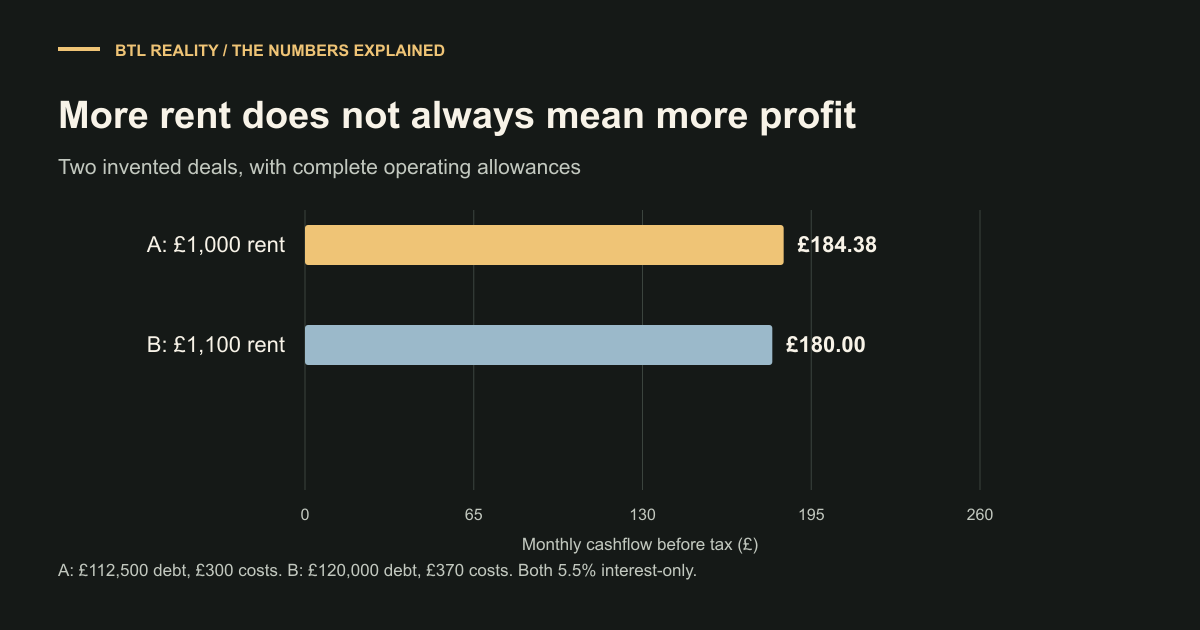
| Monthly surplus before tax | £184.38 | £180 |
A produces approximately £2,212.50 a year on £54,000 of cash, or 4.1%. B produces £2,160 on £60,000, or 3.6%. Those cash returns exclude capital growth, sale costs and tax. B might have other advantages, but a slightly higher gross yield has not translated into a stronger cash return in this model.
TRY YOUR OWN ASSUMPTIONS
Compare the cash left each month
Two invented interest-only deals. Change the rent evidence and borrowing rate; keep the complete cash commitments visible.
Move a slider to explore the model.
A: £150,000 price, £112,500 debt, £54,000 initial cash and £300 monthly operating costs/reserves. B: £160,000 price, £120,000 debt, £60,000 cash and £370 monthly costs/reserves. Interest-only. Before tax, capital growth, selling costs and major unexpected works. No lender eligibility test. Inputs stay on this page. Figures stay on this page and are not submitted or saved.
Enable JavaScript to use the sliders. The default worked example remains readable below.
Check why one property needs more money
A lower cash requirement can mean a genuinely cheaper project. It can also mean someone has forgotten the roof, assumed a minimal reserve or excluded a fee. Ask what each difference buys. A recently replaced boiler is different from a boiler that simply has not been budgeted for.
For a refurbishment, compare the same specification and the same readiness to let. Painting one house and replacing a kitchen in another are not equivalent programmes. Get evidence on safety, structure and services before describing an apparently cheap property as an easy cosmetic project.
My Rugby and Kettering walkthroughs illustrate that distinction. In the historical Rugby assessment, the renovation allowance changed as electrical uncertainty entered the discussion. The lesson is to investigate the scope, rather than treating the first round number as a fixed quotation.
The same deals after one percentage point more mortgage interest
Stress the assumptions most likely to change
Apply the same challenge to both properties. Reduce rent by a realistic amount, increase interest at refinancing and add a plausible repair. Then consider whether the risks are independent. A property dependent on one large employer has a different exposure from a similar house serving several employment centres.
In the example, one percentage point more interest reduces A’s surplus to about £90.63 and B’s to £80. If B also has a large building charge, its stronger headline rent may offer little comfort. Do not pile every possible disaster into one prediction, but understand which change first makes the deal uncomfortable.
Use the mortgage stress calculator for rate scenarios and the full deal calculator for the complete budget. If the outcome relies on rapid rent growth or an optimistic refinance, show the flat-rent, no-refinance version as well.
Score evidence and effort alongside returns
I would use a short decision sheet rather than a single magic score. Give each factor a plain assessment: supported, uncertain or unacceptable. The factors should include rental evidence, condition, finance, tenure, management, exit options and the cash reserve after completion.
An unresolved legal issue should not be averaged away by a beautiful yield. Neither should an unsupported valuation become credible because the kitchen looks good. Some issues are conditions to satisfy before buying, not weaknesses that a weighted score can politely hide.
- Rent: what closely comparable homes actually support the figure?
- Works: which costs are quoted and which remain provisional?
- Finance: has a broker assessed this property and borrower?
- Operation: who handles problems, and at what inclusive cost?
- Exit: who might buy it, and what could restrict a sale?
- Reserves: how much usable cash remains after the full project?
Write the reason you would reject each deal
This is a useful final exercise. For A, the rejection reason might be weak evidence for the rent. For B, it might be high recurring charges. Write what evidence would change your view, who will obtain it and when you need the answer.
You may then choose A, choose B, negotiate or reject both. Rejecting both is a valid result if neither meets the brief. A comparison process should protect your money, not force a purchase because you have spent time researching.
Keep the original comparison after completion and replace assumptions with actual figures. That gives the next decision a better starting point and reveals where your estimates were consistently too generous or too cautious. Over several decisions, that feedback is more useful than collecting impressive headline yields.
Compare the complete deal
Run the numbers for each property, save your assumptions and discuss the unresolved parts before committing.
Should I always choose the higher cash return?
No. Compare the return with the risk, work, liquidity and quality of the evidence. A fragile forecast is not improved by displaying an extra decimal place.
Should I include house-price growth?
Show it as a separate scenario. Keep the operating comparison visible without growth, and do not treat an assumed valuation increase as spendable rent.
Prepared using information checked on 30 September 2026. Check the linked product pages for current availability and terms. This is general property education, not personal financial, mortgage, tax or legal advice. Models and examples are illustrative. Property values and income can fall, and outcomes are not guaranteed.