Is It Worth Paying an Early Repayment Charge to Refinance?
October 9, 2026
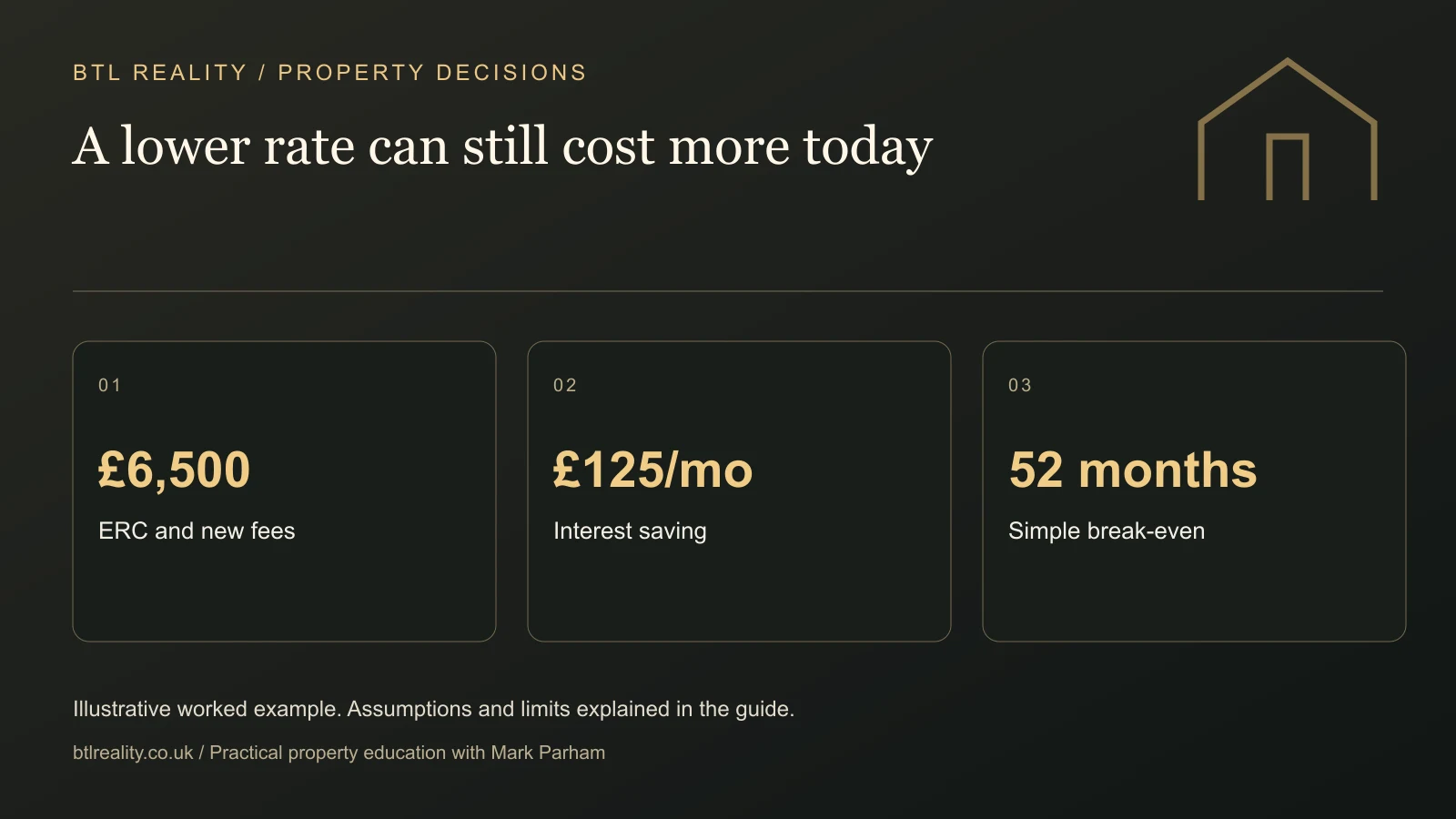
Paying an early repayment charge to refinance can be worthwhile, but only when the benefit exceeds the complete cost of moving now rather than waiting. A lower mortgage rate, a larger loan or a promising new purchase is not enough on its own. Compare both routes over the same period and distinguish a reliable interest saving from an uncertain investment return.
The important number is not simply the charge. It is the change in your net position after the charge, new fees, interest, usable cash release and any further commitments. Sometimes paying an ERC is rational. Sometimes a deal feels urgent because the spreadsheet has left out the cost of breaking the existing mortgage.
Find the actual charge and expiry date
Read your mortgage offer and request the lender's current redemption information. Charges may change on particular dates and may apply differently to partial and full repayment. Do not assume the percentage falls on the anniversary you remember or that an overpayment allowance removes the charge on a complete refinance.
Ask whether there are separate exit or administration fees and whether a proposed product transfer, further advance or other route changes the analysis. Availability and suitability depend on the lender and borrower. An option is worth comparing only when you know its terms, not because someone online used it successfully.
MoneyHelper's remortgaging guidance highlights the need to compare switching costs and any existing ERC with potential savings. For an investment property, also consider the rental cashflow and any additional borrowing purpose.
A lower-rate example that does not break even quickly
Suppose an interest-only loan is £150,000 at 5.8%, and a potential replacement on the same balance is 4.8%. Annual interest falls from £8,700 to £7,200, saving £1,500, or £125 monthly. Assume a 3% ERC of £4,500 plus £2,000 replacement-product and legal costs. Total switching cost is £6,500.
At £125 monthly, recovering £6,500 takes 52 months. If only twelve months remain before the charge ends, the £1,500 saving during that year does not cover the immediate switching cost. This does not prove waiting will be best, because future mortgage terms are unknown, but it shows why comparing the interest rates alone is inadequate.
The example ignores tax, changing balances and returns on cash. A repayment mortgage needs a more detailed comparison because the monthly payment includes capital reduction. Use a consistent loan balance, repayment basis and time horizon so the apparent saving is not caused by extending the debt.
Make the example your own
Will the interest saving repay the switching cost?
Same interest-only balance before and after. Capital raising and repayment mortgages require a different comparison.
No tax, future rate changes or opportunity return included. No positive saving means no saving-based break-even. Illustrative only. Inputs stay in this page and are not saved or sent.
Releasing equity is a different calculation
Imagine the property is valued at £240,000 and the existing debt is £150,000. A proposed 75% loan would be £180,000. After repaying the old loan, paying the £4,500 ERC and £2,000 fees, only £23,500 is released, not the headline £30,000 increase in borrowing.
Now suppose the new rate is 5.2% while the existing rate is 4%. Annual interest rises from £6,000 to £9,360, an increase of £3,360 or £280 monthly. The cash release comes with both an immediate transaction cost and a larger continuing obligation. Those amounts need to be included in any planned next investment.
Use the property refinance calculator to separate the gross new loan from usable proceeds. Then rebuild the rental cashflow using the larger debt. An equity release that empties the monthly surplus can make your wider position less resilient, even if it funds another deposit.
What must the next investment earn?
If the £23,500 release is going towards another property, calculate that property's complete cash requirement. It may still need additional savings for deposit, taxes, works and reserves. Refinance proceeds are funding, not a discount on those costs.
Suppose buying now rather than in twelve months is expected to produce £3,000 additional net rental cash before tax. That expected benefit is smaller than the example's £4,500 ERC alone, before considering extra interest or execution risk. A hoped-for increase in property value should be shown separately, because it is uncertain and may not be available as cash.
Set a demanding comparison: what benefit exists only because you act now? If you could buy a similar property later without the charge, do not count the entire future investment return as a reward for paying it today. Count the difference between the two credible timelines.
Waiting has risks and benefits too
Waiting may avoid or reduce the charge, preserve cheaper borrowing and allow more savings to accumulate. It may also mean losing a particular purchase or facing less favourable future rates and lending criteria. Those are genuine uncertainties, not reasons to assume either route wins.
Build a simple table for “refinance now” and “wait until the charge changes”. Record immediate fees, debt, monthly interest, cash available, reserve remaining and the next decision date. Use a range for future rates and valuations rather than assigning certainty to one forecast.
If the intended purchase cannot survive a short delay, find out why. A genuine seller deadline is different from marketing pressure. You still need enough time for legal, valuation and finance checks; an urgent label does not improve the underlying economics.
Stress-test the valuation and advance
The £240,000 valuation in the equity-release example may not be accepted. At £220,000, a 75% loan is £165,000. After £150,000 debt and the same £6,500 costs, usable cash falls to £8,500. Rental affordability could reduce the advance further.
That £15,000 difference can make the planned next purchase impossible. Avoid spending fees on the assumption that the largest advertised loan-to-value will be available. Ask a broker to assess both the property value and rental-cover constraints, as well as eligibility and the proposed use of funds.
Keep enough liquidity for costs incurred before the mortgage completes. Some fees may be payable even if the refinance or onward purchase fails. The decision should survive a smaller release rather than depend on the most optimistic number in the range.
Keep the objective visible
A landlord seeking reliable lifestyle income may prefer lower debt and stable surplus. Someone building a portfolio may accept more borrowing for a well-evidenced opportunity. Neither should hide the additional risk behind a single return percentage.
Write the purpose in one sentence, such as “release enough cash to buy a second rental while preserving £10,000 reserve and positive stressed cashflow on both properties”. That gives you conditions to test. “Make my money work harder” is too vague to expose a weak decision.
If you want help understanding property decisions and building a practical plan, Starter Club offers a route into the wider BTL Reality learning community. Specific mortgage recommendations should come from an appropriately qualified adviser with your full circumstances and current product information.
A useful decision before calling the broker
Prepare the existing offer, redemption figure, current rent, property value evidence and a schedule of your other borrowing. Write down the maximum upfront cost you can absorb and the reserve you will keep. This turns a general rate conversation into a comparison of feasible choices.
Then set a review date. If waiting is the stronger option, put the charge-change date and mortgage expiry into your calendar with enough lead time to prepare. Choosing not to refinance today is still an active investment decision when it is based on complete numbers.
Frequently asked questions
Is an early repayment charge always a percentage of the mortgage?
No universal calculation applies to every product. Many use a percentage of the amount repaid, but the schedule, allowances and additional fees depend on the contract. Get the lender's current redemption information for the intended date rather than estimating from a percentage remembered when the mortgage began.
Can a lower mortgage rate justify paying a large ERC?
Yes, if the saving over a suitable comparison period outweighs the total switching cost and the new terms suit your needs. Include product, legal, valuation and broker fees where applicable. A simple break-even calculation is a starting point; it does not capture all differences between mortgage structures or future options.
Can I add the early repayment charge to the new mortgage?
That depends on available borrowing and lender terms. Even if costs can effectively be financed, they still reduce your equity or usable release and can attract interest. Treat borrowed fees as a real cost. Having no immediate cash payment does not make the refinance free or improve the underlying investment return.
Should I refinance early to buy a below-market-value property?
Compare the evidenced buying advantage with the ERC, new fees, extra interest and full acquisition costs. Check the discount independently and model a delayed purchase as an alternative. A claimed discount is not cash profit, and it may be outweighed by the cost of accessing funds before your current deal ends.
Does my annual overpayment allowance remove the ERC on remortgaging?
Do not assume so. Allowances and full-redemption treatment vary by mortgage contract. Ask the lender how the allowance would apply to the exact repayment proposed and date involved. A partial overpayment within an allowance can be treated differently from repaying the entire loan through a new lender.
What if I wait and mortgage rates rise?
That is a risk to model, not a known outcome. Compare several future-rate scenarios with the certain cost of moving now. Also consider the remaining fixed period, available reserves and your need for the released cash. A broker can help assess current options without pretending future rates are predictable.
Put the next step into practice
Use the free tools to test your numbers, then choose the level of support that fits your next decision.