Should I Buy a Rental Portfolio or One Property at a Time?
October 8, 2026
Buying a rental portfolio can save time and secure several properties in one negotiation, but it also concentrates your purchase risk into one decision. Buying one property at a time usually gives you more room to learn, adjust the brief and keep cash available. Neither approach is automatically better. The quality of each property and your ability to operate the combined business decide the answer.
The biggest mistake is accepting the seller's total rent and portfolio price as sufficient evidence. A strong unit can hide a weak one. A bulk discount can disappear into repairs. Several mortgages can depend on one completion timetable. You need to understand each property before trusting the collection.
Start with the same capital budget
Imagine you have £200,000 available and are comparing three rentals bought together with three bought gradually. The portfolio costs £450,000 and the assumed mortgages total £337,500, leaving a £112,500 deposit. Add an illustrative £30,000 purchase-cost allowance, £25,000 immediate works and £20,000 operating reserve. Total allocated cash is £187,500, leaving £12,500 unallocated.
These are planning assumptions, not a tax quotation or an indication that the lending will be approved. Purchase tax can depend on location, ownership and the structure of linked transactions. Obtain the solicitor's actual calculation before assuming a portfolio is taxed like three unrelated purchases.
For a staged route, suppose each property needs £37,500 deposit, £10,000 costs, £8,000 works and £7,000 reserve. That is £62,500 per acquisition, or £187,500 for three. The same final capital allocation can have a very different timetable: after the first purchase, £137,500 remains available while you test the letting and operating assumptions.
Inspect the weakest unit first
Assume the portfolio's three properties are each priced at £150,000. Annual rent is £12,000, £10,800 and £9,600. Total rent is £32,400, giving a 7.2% gross yield against the £450,000 purchase price. That looks tidy until you inspect the costs and borrowing property by property.
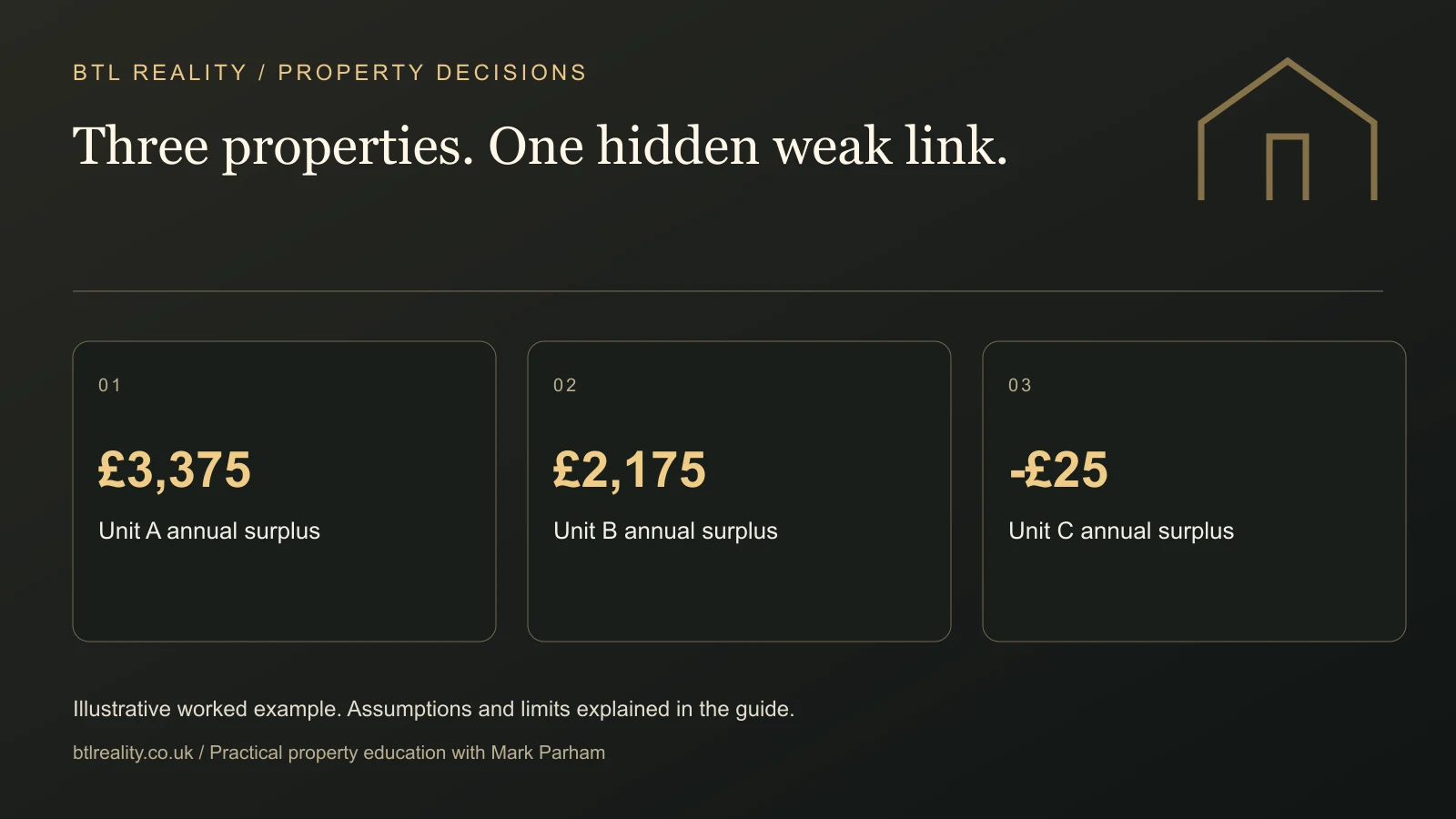
With illustrative annual operating costs of £3,000, £3,000 and £4,000, and £112,500 interest-only debt per property at 5%, the annual pre-tax cash surpluses are £3,375, £2,175 and minus £25. Combined surplus is £5,525. One property contributes almost nothing while tying up a deposit and exposing you to repairs.
The answer might be a lower price, a verified improvement plan, buying only two properties or rejecting the package. It is not to divide the total surplus by three and pretend all units are equally attractive.
Make the example your own
How much does the weakest property contribute?
Three £150,000 units with £112,500 debt each at 5%. Units A and B contribute £3,375 and £2,175 before tax.
A portfolio average can hide a property that absorbs capital without contributing income. Illustrative only. Inputs stay in this page and are not saved or sent.
Match advertised rent to actual receipts
Ask for tenancy documents, rent schedules, payment histories, deposit records and details of arrears or disputes. A schedule showing rent due is not the same as a statement proving money received. Also check whether quoted rent includes bills, service charges or income that will stop when ownership changes.
Look at the dates. A fully occupied snapshot today may hide a long void earlier in the year. Conversely, a genuinely below-market tenancy should not be valued as though an immediate increase is guaranteed. The tenancy, legal rules, condition and local demand all affect what can happen next.
Our buy-to-let due diligence guide explains the wider evidence checks. For a portfolio, repeat them for every address, then ask what risks the properties share. Three units dependent on the same employer or building are not three independent income streams.
Understand the finance as a package
A lender may assess both the proposed acquisition and your existing portfolio. Broker analysis should cover rental cover, values, personal or company circumstances, existing debt and the structure of the facilities. Do not assume three acceptable individual properties automatically produce an acceptable combined transaction.
Ask whether loans are separate or cross-secured, what happens if one valuation is lower, and whether a failed mortgage on one unit stops all completions. Establish the process for selling or refinancing one property later. A convenient purchase arrangement can create an inconvenient exit if releasing individual security is difficult.
Keep a borrowing schedule with loan amount, rate, fixed-period end, repayment basis and maturity for each unit. If all rates expire together, test the effect of a simultaneous increase. Staggering purchases may naturally spread those dates, although it does not guarantee better future rates.
Price the handover, not just the acquisition
Taking over three occupied homes means handling three sets of documents, maintenance histories and tenant communications at once. Agree who checks safety records, licensing, insurance, tenancy information and the arrangements for transferring deposits and notifying tenants. Requirements vary across England, Wales, Scotland and Northern Ireland.
Ask for keys, warranties, appliance records, service contracts and outstanding repair requests. An existing tenant may have reported a leak that has not yet appeared on the seller's accounts. Your management agent needs the history, not merely a spreadsheet with names and rents.
Budget for the first ninety days. There may be minor repairs, document gaps and service changes even in an otherwise sound portfolio. Cash reserves should reflect known conditions and operating needs rather than an arbitrary percentage applied without inspection.
What staged buying gives you
Buying one property lets you test your team and assumptions using a smaller commitment. You learn how quickly the agent lets it, whether maintenance estimates were sensible and whether you enjoy managing the decision-making. That information can improve the second purchase.
The cost is time. Suitable properties may become more expensive or harder to find, repeated transactions involve work, and uninvested cash may earn less than a successful rental. But delayed deployment is not automatically a failure. Paying for a weak deal to avoid holding cash can be much worse than waiting.
Set milestones for the next purchase: a stable tenancy, complete records, a minimum reserve and a clear understanding of actual cashflow. Do not use an arbitrary calendar date as the only reason to buy again.
When a portfolio purchase can make sense
A portfolio deserves serious consideration when the units meet your brief individually, the combined price is attractive after costs, finance is workable and your team can absorb the handover. An experienced investor adding familiar properties in a known area may be better placed than a beginner buying an unfamiliar operation remotely.
Ask what advantage the package provides. Is there a demonstrable price benefit? Strong, evidenced tenants? Useful concentration in an area you already manage? Or simply the emotional appeal of becoming a three-property landlord overnight? Only the first set of reasons belongs in the investment case.
Use the property portfolio calculator to assess the combined position, but retain separate property records. Portfolio-level success should never make an individual loss invisible.
Turn the decision into a buying brief
Write your maximum total cash commitment, minimum reserve, acceptable works, target tenant demand and required cashflow. Include the circumstances in which you would accept a weak unit as part of a package, such as a priced and independently assessed repair plan. If there is no convincing reason, remove it from the offer.
BTL Reality Done For You is property sourcing against an agreed brief. Discuss the proposed scope before assuming a particular portfolio search or ongoing management service is included. The value of support is a better buying decision, not simply acquiring more addresses faster.
Frequently asked questions
Is it cheaper to buy a property portfolio in one transaction?
It can be, but a negotiated discount is only one part of the total. Compare purchase taxes, legal work, surveys, finance, repairs and reserves with separate purchases. Have the solicitor assess linked-transaction treatment where relevant. A lower aggregate price can still produce a worse investment if several units need expensive work.
Can I get one mortgage for several rental properties?
Some lenders offer portfolio or multi-property arrangements, while others use separate facilities. Eligibility and security terms vary. Ask how individual properties can be sold or refinanced, how valuations affect the advance, and whether a problem with one property has consequences for the other security in the arrangement.
Should I buy a portfolio with tenants already in place?
Existing occupancy can reduce initial letting work, but inspect the tenancy and payment evidence. Check arrears, deposits, compliance records, repairs and the legal position on future changes. Treat verified receipts as stronger evidence than advertised rent. A tenanted purchase is not automatically a trouble-free handover.
How much cash should I keep after buying several rentals?
Build the reserve from known repairs, mortgage commitments, likely voids and operating costs across the properties. Then test simultaneous problems, not just one isolated repair. The £20,000 example in this article is illustrative, not a recommended minimum. Your portfolio's condition and debt can justify a very different amount.
Is buying three properties in one town diversified?
It spreads some tenant-specific risk, but may leave major local risks unchanged. A shared employer, flood area, building type or managing agent can affect several properties together. Record those common exposures. Diversification is about the causes of potential losses, not simply the number of addresses on a spreadsheet. For a practical example, see our Flood Performance Certificate pilot guide and rental interruption calculator. It shows how lost rent and extra costs can change a property’s cash flow.
Is it better to start with one buy-to-let property?
Often it is easier to learn and preserve flexibility with one, but the right answer depends on your experience, capital and support. Compare the actual alternatives. A well-evidenced portfolio with adequate reserves may beat three rushed individual purchases, while staged buying may be preferable when your operating assumptions are still untested.
Put the next step into practice
Use the free tools to test your numbers, then choose the level of support that fits your next decision.