Is Bridging Finance Worth It for a Buy-to-Let Refurbishment?
October 8, 2026
Bridging finance can be worth using for a buy-to-let refurbishment when it solves a real funding problem, the project retains a worthwhile margin after every cost, and you have a credible way to repay the loan. It becomes dangerous when an attractive purchase price disguises an optimistic timetable or an untested refinance.
The question is not simply whether you can borrow the money. It is whether the finished investment still makes sense after paying for the time between purchase and long-term finance. A monthly rate can look small beside a large potential uplift. Multiply it by a delay, add the fees and check how much cash reaches completion, and the picture can change quickly.
What does a bridge actually solve?
A short-term loan may allow a purchase before a property meets a conventional lender's condition requirements, or while a planned sale or refinance is being arranged. Those are different reasons for borrowing, with different risks. A property needing cosmetic work does not automatically need bridging finance. Ask a broker whether an ordinary mortgage is available before adding complexity.
For a refurbishment, identify the exact obstacle. Is the kitchen missing? Is there structural work? Is the intended use changing? Are permissions outstanding? The lender must accept both the property and the proposed works. Approval for a light refurbishment should not be treated as approval for a conversion with planning and construction risks.
United Trust Bank's bridging guidance emphasises a viable repayment route and explains that individual facilities have their own terms. That is a useful starting principle, not a recommendation for that lender or an indication that you qualify.
Model three, six and nine months
Consider an illustrative £100,000 advance at 0.8% monthly simple interest, with a £2,000 arrangement fee and £2,500 for the assumed valuation, legal and broker costs. This is a teaching example, not a current finance quotation. We assume fees are paid separately, the balance stays at £100,000, interest is not compounded and there is no exit fee or minimum-interest adjustment.
- Three months: £2,400 interest plus £4,500 fees, giving £6,900 finance cost.
- Six months: £4,800 interest plus £4,500 fees, giving £9,300 finance cost.
- Nine months: £7,200 interest plus £4,500 fees, giving £11,700 finance cost.
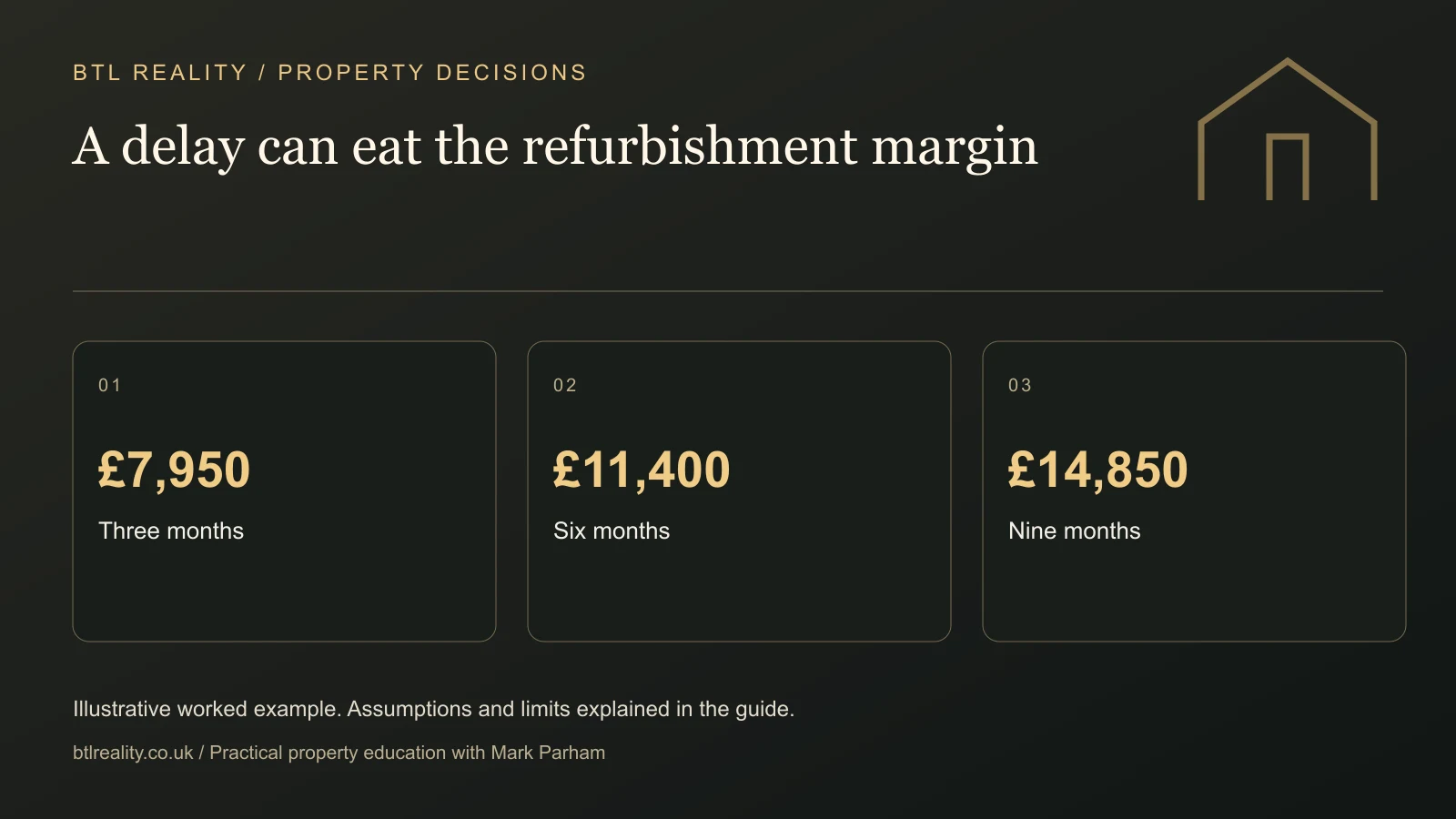
Add £350 monthly holding costs for insurance, utilities and other assumed empty-property expenses. Combined finance and holding costs become £7,950, £11,400 and £14,850. The six-month delay from month three to month nine consumes another £6,900 before any building overrun. Lost rent is a separate opportunity cost; do not also deduct it as though rent had already been received.
Finance and holding cost as the project takes longer
Make the example your own
Watch delay consume the margin
£100,000 constant loan, simple monthly interest, fees paid separately and no exit fee in this example.
No compounding, works overrun, retained-interest adjustment or rental opportunity cost included. Illustrative only. Inputs stay in this page and are not saved or sent.
Net advance matters more than the headline loan
Serviced interest is paid as you go. Rolled interest increases what must be repaid. Retained interest reduces the cash available at the outset under the facility's calculation. Lenders use different structures, so get a cash statement showing the gross facility, every deduction, the amount sent to your solicitor and the expected redemption amount.
If a £100,000 gross facility has £9,600 retained for interest and £2,000 deducted for a fee, only £88,400 remains before other deductions in that simplified example. It cannot fund a £100,000 completion payment. Nor should you deduct retained interest twice when calculating the project's total financing cost.
Ask what happens on early repayment, whether unused retained interest is credited, and which charges continue during an extension. A product with a lower advertised monthly rate can cost more overall if it gives you less usable cash or carries different exit terms.
Check the exit before committing to the purchase
Suppose the intended finished value is £180,000 and the hoped-for long-term mortgage is 75% of that value. The headline loan is £135,000. If the bridge redemption is £112,000 and refinance costs are £3,000, the remaining £20,000 is cash released, subject to the lender actually offering that advance.
Now reduce the valuation to £165,000. At the same percentage, the maximum suggested loan becomes £123,750 and cash after those assumed deductions falls to £8,750. That is £11,250 less released. A rental affordability limit could reduce the advance further, even when the valuation is accepted.
You need evidence for the anticipated rent, acceptable property condition, borrower eligibility and the lender's ownership-period policy. A broker's initial assessment is useful, but it is not an unconditional future mortgage offer. Keep enough capacity to cope if the finished project needs a smaller loan than planned.
Separate profit, equity and cash returned
A £40,000 uplift from purchase price to finished value is not £40,000 profit. Works, purchase taxes, professional fees, borrowing and holding costs all sit between those numbers. If you keep the property, the valuation is also unrealised. Selling costs would affect a sale outcome; mortgage availability affects a refinance outcome.
Build three totals: total project expenditure, equity after the new debt, and cash left tied up after refinancing. Then calculate the rental cashflow with the actual proposed long-term debt. An impressive refinance can leave a thin monthly surplus if the new interest bill absorbs too much rent.
Use the buy-to-let deal calculator for the full acquisition and the refinance calculator for the exit. Reconcile the two rather than choosing whichever result looks better.
Give delays a cash budget
Write the programme around dependencies: surveys, consents, contractor availability, materials, inspections, completion certificates, letting and the new lender's process. Finishing the decorating does not necessarily mean mortgage funds arrive that week. Allow time for valuation, underwriting and legal work after the physical project.
For each month of delay, show interest, holding costs and any contractor commitments separately. Keep a reserve outside the refurbishment allowance. A £5,000 contingency cannot fund both an unexpected roof repair and an extension of the borrowing unless the figures genuinely cover both.
An alternative sale exit should have its own realistic price, marketing period and selling costs. “I can always sell it” is not an adequate backup if a quick sale would leave a shortfall against the loan.
When would I choose a simpler deal?
Compare the refurbishment with a lettable property bought using ordinary finance. Include the sourcing or buying costs on both sides and compare the cash tied up, net rent and workload. The more complicated project needs enough additional benefit to justify the extra uncertainty, not merely a larger gross discount.
Our auction comparison explores why the lowest purchase price is not always the best complete investment. If your main objective is dependable rental income and you have limited spare time or cash, a project that needs three favourable events before it works may be the wrong fit.
For a structured approach to analysing purchases and building a strategy, see The Blueprint. The learning objective is to identify which deals deserve your money, including the ones you should leave alone. Mortgage selection belongs with an appropriately qualified adviser.
Frequently asked questions
Can I use a bridging loan to buy an uninhabitable property?
Some specialist lenders consider properties that ordinary mortgage lenders will not accept, but condition, works, security and the exit all matter. Obtain a property-specific assessment before committing. A bridge does not cure structural, title or planning problems; it provides temporary funding while agreed issues are addressed.
Is bridging interest charged monthly or annually?
Rates are often quoted monthly, although the actual interest calculation and payment arrangements depend on the contract. A quoted 0.8% monthly rate is not a 0.8% annual cost. Ask for the total pounds payable at your intended repayment date and at later dates, including all fees.
What happens if my refurbishment takes longer than the loan term?
You may need an agreed extension, another refinance or a sale, with further costs and no assurance that any option will be available. Speak to the lender before a problem becomes urgent. Model the delay before borrowing and keep a practical contingency rather than relying on a future extension.
Can a buy-to-let mortgage repay the bridge straight after the work?
Possibly, subject to the new lender's property, rent, borrower, valuation and ownership-period criteria. Completion of the work alone does not guarantee approval. Your broker should assess likely exit routes before purchase and update the assessment if the project, rent, valuation or your circumstances change during the works.
Does a higher valuation mean I get all my deposit back?
No. The new loan must first clear existing debt and costs, and the permitted advance may be constrained by rental affordability. Compare the remaining release with every pound you contributed, including works and fees. You can create equity while still leaving substantial cash in the investment.
Is bridging finance suitable for a first property investment?
Experience is only one consideration, but a first project with limited reserves leaves little room for learning through mistakes. Compare simpler funding and lettable properties first. If specialist finance remains necessary, use experienced professional support, a detailed cost plan and a credible exit that survives an adverse scenario.
Put the next step into practice
Use the free tools to test your numbers, then choose the level of support that fits your next decision.