What Should a Property Sourcing Agreement Include?
October 6, 2026
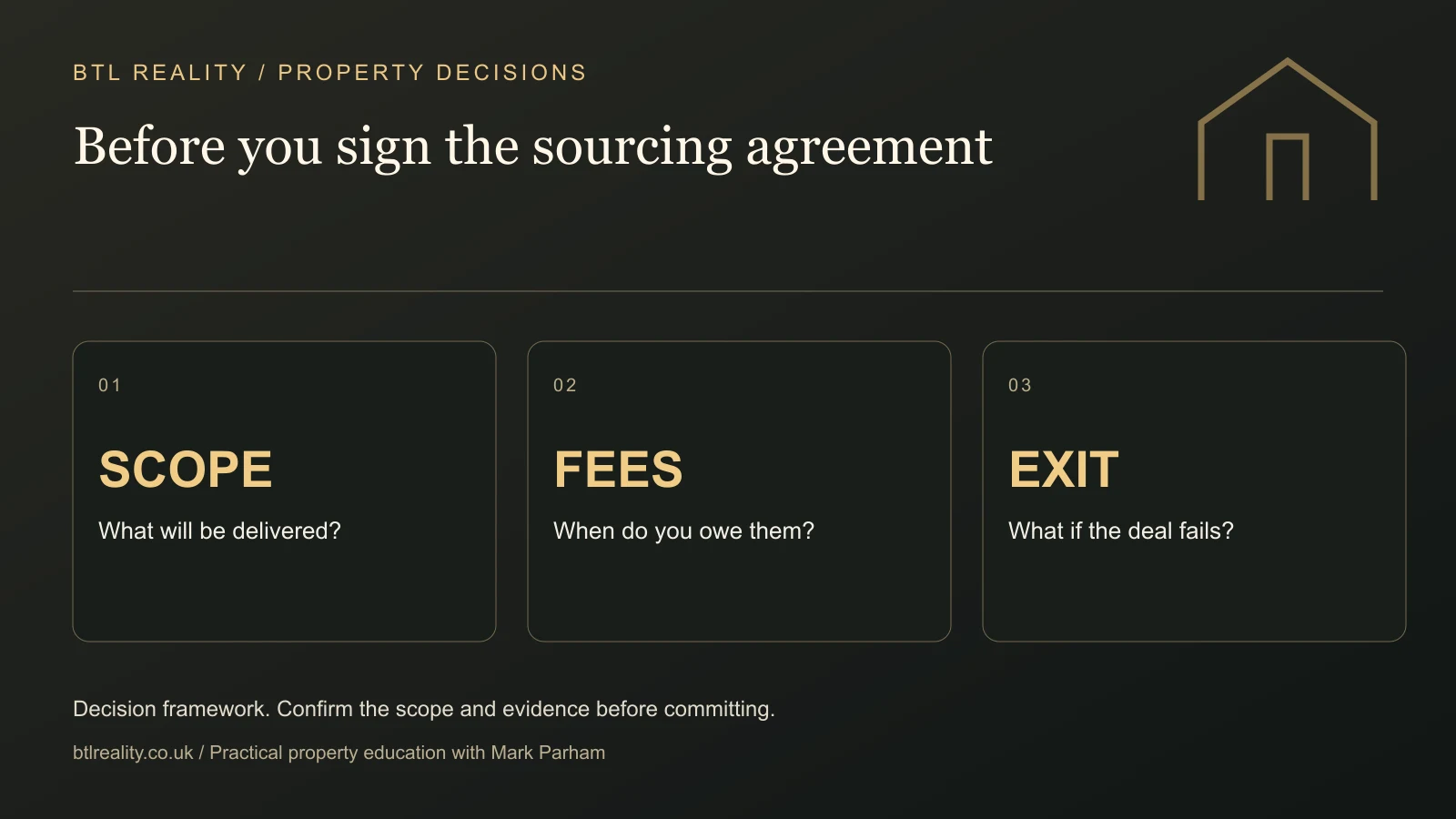
A property sourcing agreement should explain who is doing what, what you are paying for, when payment becomes due and what happens if the purchase does not proceed. It should be specific enough that you can understand the service before sending money. A persuasive conversation is not a substitute for clear written terms.
This is a practical reading checklist, not a legal contract template. The appropriate wording depends on the transaction, service and applicable law. If a clause affects a substantial commitment or you do not understand it, get independent advice before signing.
Identify the actual parties
Start with the legal entity providing the service and the person or company buying it. A trading name, social-media profile and limited company can be different things. The agreement should make clear who owes the obligations and receives the fee.
Check the business details, contact route and relevant professional registrations independently. Companies House's search service can help check a UK company's identity, but a registration alone is not approval of its services or financial health.
If another firm will perform part of the work, ask how that relationship operates. Who is responsible if information is wrong or an agreed task is not completed? A chain of introductions should not leave you unsure whom you are instructing.
Attach a usable investment brief
The agreement should connect the service to the brief you actually agreed. Include your total cash budget, reserve, acceptable locations, property type, amount of work, funding assumptions and intended letting strategy.
Avoid an objective such as “high returns” without defining the calculation. A gross yield target is different from monthly cashflow after management, repairs, mortgage interest and tax. A return based on a future refinance is different again.
Record how changes are approved. If the search moves from a straightforward single let to a refurbishment or a leasehold flat, that should be an explicit decision. A property being available does not mean it fits the original instruction.
Make the example your own
Review the sourcing agreement
Use this to organise the evidence and questions before your next decision.
0 of 6 checks reviewed
This is an organiser, not approval to invest. Selections stay in this page and are not saved or sent.
Define the deliverables
Ask what you will receive before committing to a property. That could include an opportunity summary, purchase-price rationale, rental evidence, estimated costs, known issues and a description of what remains unverified.
Then establish what the sourcer does during the transaction. Do they negotiate, coordinate enquiries, attend viewings or introduce professionals? Does their involvement end at reservation, exchange or completion? Are any refurbishment or management services separate contracts?
The Property Redress sourcing guide highlights the importance of clear relationships, responsibilities and fees. Use that principle to read the specific document in front of you. A broad label such as “fully managed investment” needs a much more precise explanation.
Make the fee and payment triggers visible
Write down the complete fee, including VAT where applicable, and any additional charges. A low headline price can be misleading if administration, reservation or connected service fees appear later.
Separate the amount due from the trigger that makes it due. “On introduction” is not the same as “on completion”. If a deposit is paid first, establish whether it forms part of the total fee, what it secures and how it is held.
For example, an illustrative £3,500 total fee might be split between an initial payment and a completion payment. The agreement needs to explain both amounts and their conditions. This example is not a statement of BTL's current terms or a recommended payment structure.
Test the refund wording against real situations
Do not stop at finding the word “refundable”. Ask which events trigger a refund, whether deductions apply, how to request it and when payment is due. A refund right that depends on an undefined condition can still create disagreement.
Consider a seller withdrawing, a lender declining the property, a major survey defect, inaccurate rental information or a purchase that no longer fits the agreed brief. Also consider you changing your mind after the service has been delivered. These situations need not have identical outcomes.
Check whether statutory rights may apply to your circumstances, particularly where services are agreed remotely. Do not assume one cancellation rule applies to every investor or business transaction. GOV.UK's distance-selling guidance is a useful starting point, with the specific position confirmed professionally.
Understand what remains your responsibility
A sourcing report should not be mistaken for a structural survey, legal report or mortgage offer. The agreement should explain the boundaries of the appraisal and your responsibility for appointing appropriate advisers.
That does not mean every responsibility can fairly be pushed onto the buyer while the marketing promises certainty. If the sales conversation says rent and condition have been verified, ask how that matches the written scope and limitations.
Read my property sourcer due-diligence guide alongside the contract. The service can help you organise the search, but you still need to understand the evidence and retain the ability to reject an unsuitable purchase.
Ask about conflicts and connected payments
Find out whether the sourcer receives payment from the seller, developer, broker, letting agent or another connected party. Ask whether recommended providers are independent and whether using them is optional.
A disclosed commercial relationship is something you can assess. An undisclosed incentive is harder to account for. If the service claims to search the whole market but only presents stock from one developer, the written scope should reflect that reality.
Also ask what happens when two clients want the same property. Does the agreement provide exclusivity, and if so, what does it actually cover? Do not assume sending a fee creates rights over a property that the seller has never agreed to provide.
Check the evidence and communication process
Agree how recommendations, changes and approvals are recorded. A short written summary after a call can prevent misunderstandings about price, work or deadlines. Keep documents in a place you can access without relying on disappearing messages.
Clarify who can authorise costs and whether approval is needed before a third party is instructed. A sourcing fee and a surveyor's fee are different commitments. You should know when each becomes payable and to whom.
If a figure changes, ask for a revised appraisal rather than mentally combining the best parts of several versions. A lower purchase price from one draft and a higher rent from another do not form a reliable final budget unless both remain supported.
Know the complaints and exit route
The agreement should explain how to raise a complaint and the relevant escalation route. Confirm membership of any stated redress scheme through the scheme itself and understand what kinds of issue it handles.
Read the termination provisions. Can either party end the search? What work or money remains outstanding? Are there restrictions on purchasing an introduced property later, and how long do they last? Those details affect your choices if the relationship stops working.
Keep a copy of the terms as accepted, the brief, invoices and important correspondence. Good records help both parties resolve a disagreement without reconstructing the arrangement from memory.
The final check before paying
Read the agreement against the sales claims, not in isolation. List any promise you relied on and identify where it appears in the contract. Ask for clarification where the two do not match. A reasonable question before payment is easier to resolve than an argument afterwards.
BTL Reality's Done For You page explains our property-sourcing proposition. Any engagement should then be assessed against its actual brief and current terms. Use the free deal calculator to include the complete service cost in the investment. Clear paperwork should support a clear buying decision, not distract from whether the property itself makes sense.
Frequently asked questions
Should I pay a property sourcing fee before seeing the property?
Understand exactly what payment secures, what information you receive and the refund conditions before deciding. Different services use different stages, so timing alone does not establish quality. Avoid committing under pressure with an unclear brief or contract. Independent legal advice may be appropriate where substantial money is payable before full investigation.
Is a property sourcing reservation fee refundable?
The answer depends on the agreement, what happened and any applicable legal rights. The word “reservation” does not decide it. Read the trigger, deductions, deadlines and process, and test the clause against likely scenarios. Ask for clarification in writing rather than relying on a general reassurance that someone will look after you.
What happens if the mortgage is declined after I pay a sourcer?
Check the agreement's treatment of finance failure and why the application was declined. The position may differ where the property is unsuitable, information was inaccurate or your circumstances changed. Keep the appraisal, disclosures and correspondence. Do not assume a refund is either automatic or impossible without reviewing the actual facts and terms.
Can a sourcer stop me buying an introduced property myself?
An agreement may contain introduction, exclusivity or later-purchase provisions. Their wording, duration and enforceability require attention. Read them before accepting an introduction and obtain advice if unclear. Trying to bypass an agreed fee can create a dispute, while an overly broad restriction also deserves scrutiny before you sign.
Should a sourcing agreement promise a particular return?
It should clearly distinguish contracted services from investment projections and any genuine guarantees. Forecasts depend on assumptions that can change. Ask how rent, costs and value were verified, and do not treat a headline percentage as assured profit. A clear scope and evidence are more useful than an unexplained return promise.
Who handles complaints about a property sourcer?
Start with the business's written complaints process and verify any stated redress membership directly with the scheme. The available route depends on the service, jurisdiction and issue. Keep the contract and evidence. A company's registration or a logo on its website should not be treated as confirmation of independent complaint protection.
Put the next step into practice
Use the free tools to test your numbers, then choose the level of support that fits your next decision.