Does Buying Below Market Value Reduce the Deposit I Need?
October 4, 2026
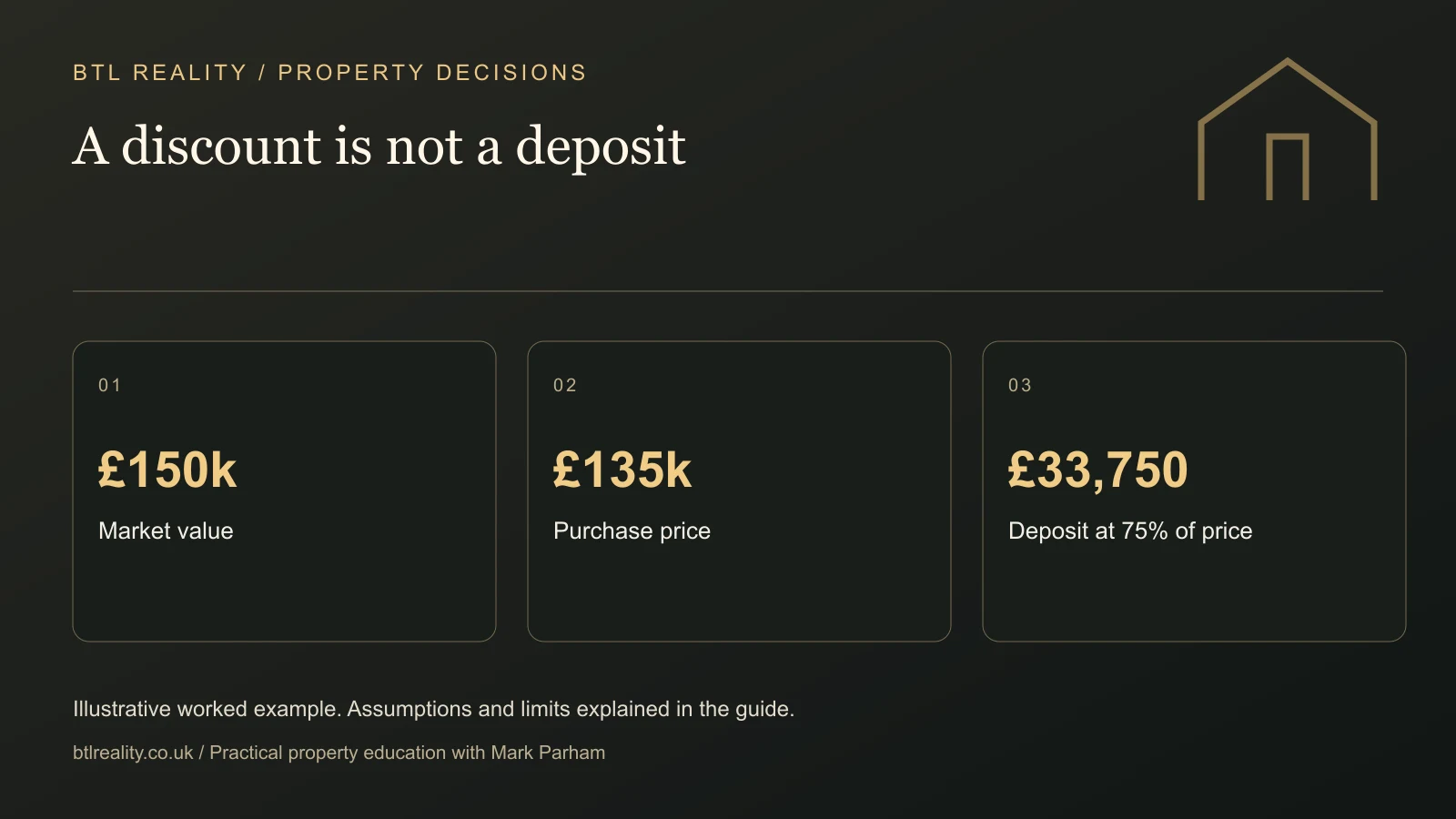
Buying below market value can reduce the cash you need, but the discount does not automatically replace your mortgage deposit. The answer depends on the lender's accepted valuation, how it calculates the maximum loan, the rent and your eligibility. A £150,000 property bought for £135,000 is not automatically a purchase you can complete with £22,500.
That distinction matters because a promising investment can still be unaffordable. I like buying at a sensible price, but I want the purchase budget to work before considering any future refinance. Here is how I would separate the discount, deposit and total cash commitment.
Start with three different numbers
The asking price is what the seller hopes to receive. The agreed purchase price is what you have contracted to pay. Market value is an assessment supported by evidence, and your lender may reach a different figure from you or the selling agent.
A seller reducing an asking price from £165,000 to £150,000 does not establish a £15,000 discount to value. If comparable properties sell for £150,000, you may simply be paying the market price. Equally, buying for £135,000 might be attractive if properly comparable sales support £150,000 and no expensive defect explains the difference.
My guide to buying property below market value deals with that evidence. Here, the question is narrower: what will the bank advance, and what must you provide yourself?
The £150,000 property bought for £135,000
Consider a hypothetical purchase with an agreed price of £135,000, an independently supported value of £150,000 and a proposed 75% loan-to-value mortgage. Ignore fees initially so we can see the lending calculation clearly.
If the lender calculates 75% against the purchase price, the mortgage is £101,250. You provide the remaining £33,750. Your apparent £15,000 equity advantage has not been accepted as a substitute for that cash deposit.
If a particular lender and transaction genuinely qualify for lending of 75% against the £150,000 valuation, the advance could instead be £112,500. The purchase-price balance would be £22,500. This is an alternative illustration, not an assurance that such terms are available for an ordinary negotiated discount.
The difference is £11,250 of cash required. That is large enough to change whether you can afford the transaction, retain a reserve or carry out necessary work. It is therefore something to resolve in the finance assessment, not something to assume from a spreadsheet.
Make the example your own
What does the discount do to your cash?
Compare the two loan bases at the same LTV. Value-based funding is conditional, not an assumed lender offer.
Price-based model uses the lower of price and value. A negative value-based contribution is not a promise of cashback. Illustrative only. Inputs stay in this page and are not saved or sent.
Lender policy beats a clever deposit calculation
Mortgage criteria differ. A normal open-market discount, a sale between relatives, a gifted deposit, a builder incentive and a concessionary purchase are not interchangeable. A rule available for one transaction type may not apply to another.
For example, Bank of Ireland's lending criteria describe its purchase-price and valuation treatment with specific conditions. Other lenders apply their own definitions and limits. The useful lesson is to have a broker check the precise facts against current policy, rather than trying to turn an exception into a universal rule.
Give the broker the actual agreed price, seller relationship, proposed ownership structure, deposit source, property condition and any incentives. Ask which figure sets the maximum advance, whether the proposed borrowing depends on special treatment, and what evidence is still outstanding. Keep the answer with the appraisal.
The rent can restrict borrowing too
Even where the value supports a larger loan, the rental assessment may not. Buy-to-let lenders generally assess whether the rent provides sufficient coverage under their own calculations. A valuation that looks strong on the capital side does not necessarily produce the loan you requested.
Suppose you planned around a £101,250 mortgage but the lender ultimately offers £95,000. Your purchase-price contribution rises to £40,000. The property has not become more expensive, but your financing has changed, and the cash required changes with it.
This is why I would assess the borrowing and rental position together. Confirm whether the rental estimate comes from achieved comparable lettings, an agent's proposal or the lender's valuer. A marketing rent is a starting assumption, not an approved mortgage calculation.
The deposit is only one part of your cash budget
Now add an illustrative £9,000 for acquisition costs and initial work, plus £6,000 you want to retain as a property reserve. These are example allowances, not quotations or a stamp-duty calculation.
With the £101,250 advance, the total cash allocation becomes £48,750: £33,750 towards the price, £9,000 of other spending and £6,000 kept aside. Under the alternative £112,500 advance, the allocation is £37,500. Both are materially above the purchase-price balance alone.
Replace those allowances with actual figures for legal work, searches, valuation, lender and broker fees, sourcing fees where applicable, essential repairs, insurance and empty-property holding costs. Some fees may be added to borrowing rather than paid upfront, which still affects debt and future interest.
Calculate the relevant purchase tax separately. England and Northern Ireland, Scotland and Wales have different systems, and ownership or residency can affect the calculation. Our stamp duty calculator is a useful starting point, with the final treatment confirmed by your solicitor.
What if the valuation is lower than expected?
Try a £130,000 accepted value against the £135,000 purchase. If the lender applies 75% to £130,000, the mortgage is £97,500 and your contribution to the price is £37,500. The previously expected discount has disappeared from the lender's assessment.
At that point, the decision is not simply whether you can find the extra money. Ask whether the price still makes sense. Is there stronger comparable evidence? Has a condition issue emerged? Would renegotiation be justified? Are you becoming attached to the purchase because you have already paid for searches or a survey?
Costs already incurred are frustrating, but they do not make the remaining commitment sensible. I would rather reassess the deal than use every remaining pound to preserve an investment thesis that no longer matches the evidence.
Do not confuse purchase funding with a later refinance
A future remortgage is another transaction, with another valuation, affordability assessment, fee structure and set of lender conditions. A property being worth more than you paid does not guarantee when that difference becomes accessible cash.
Any refinance projection should show the new loan less the mortgage being redeemed, early repayment charges where applicable and refinancing fees. It should then recalculate interest and cashflow using the new debt. Simply reducing the money left in while leaving mortgage costs unchanged exaggerates the return.
Use the property refinance calculator for that later decision. Keep it separate from the amount you need to complete today. A sound starting budget should not depend on immediately withdrawing money that no lender has agreed to release.
Questions I would settle before proceeding
- What comparable evidence supports the value, and does it reflect this property's condition and tenure?
- Is the proposed loan based on price, value or another specific policy, and has the broker confirmed that treatment?
- Does the realistic rent support the borrowing under the lender's assessment?
- Have incentives, relationships and the deposit source been fully disclosed?
- What cash is needed for the price balance, all costs and a retained reserve?
- Does the deal remain affordable if the valuation or mortgage advance is lower?
A below-market purchase can improve an investment. It does not remove the need to verify the funding. The result I want is a property bought at a defensible price, with a workable loan and enough liquidity to own it properly.
Run the complete purchase through our free buy-to-let deal calculator. If you want help turning the numbers into a practical first-property plan, Starter Club explains the support available. Mortgage approval remains a separate decision for your lender and adviser.
Frequently asked questions
Can I use a below-market-value discount as my deposit?
Not automatically. A discount is a difference between price and a supported value; a deposit is the buyer's required contribution to the purchase. A lender may have specific rules for concessionary purchases or gifted equity, but those rules cannot simply be applied to any negotiated bargain. Confirm the transaction's treatment before relying on it.
Is a buy-to-let mortgage based on purchase price or market value?
It depends on the lender and transaction. Many purchase calculations restrict lending using the lower relevant figure, while particular exceptions may exist. Ask the broker to show the actual maximum advance in pounds. A headline LTV percentage is incomplete unless you also know the figure against which it is applied.
Does buying 10% below market value mean I need 10% less cash?
No. The effect on cash depends on the loan calculation and the full costs. In our example, reducing the price also reduces a mortgage calculated against that price. You still need the balance plus fees, purchase tax, work and reserves. A discount can help without translating pound-for-pound into reduced cash required.
What if the mortgage valuation is below my agreed purchase price?
The lender may reduce the advance, require further evidence or decline the property. You can reassess the price, investigate the valuation and discuss available options with the broker. Do not assume covering the shortfall is the right answer. A lower valuation may also change your view of the investment itself.
Can I remortgage immediately after buying below market value?
Do not build the purchase around an immediate release. Ownership-period requirements, valuation evidence, rental coverage, fees and early repayment charges can affect a subsequent application. A broker should assess the proposed route before commitment. Even where an early refinance is possible, it may release less cash than expected and increase ongoing finance costs.
Is buying below market value always a good investment?
No. A discount can be outweighed by repairs, weak demand, unsuitable finance, lease restrictions or an exaggerated valuation. The property still needs to meet your budget and objectives. I would test the rent and complete costs first, then treat a defensible discount as one advantage within the wider decision.
Put the next step into practice
Use the free tools to test your numbers, then choose the level of support that fits your next decision.