Buy-to-Let Mortgage Rates: What Rising Costs Mean for Your Cash Flow
September 8, 2026
A quarter-point increase in a mortgage rate can sound fairly insignificant until you apply it to the amount you actually owe. On £2 million of interest-only borrowing, it represents another £5,000 a year in interest. That’s money that has to come from somewhere.
I’ve got roughly £2 million of mortgages across my property portfolio, so buy-to-let mortgage rates have a very real effect on my cash flow. When I recorded my video on 8 September 2026, lenders were repricing products upwards and that pressure was spreading into the landlord market.
My response wasn’t to panic or assume property had stopped being a worthwhile long-term investment. It was to pay closer attention to refinancing dates, available mortgage terms and the purchase prices needed to make new deals work. Here’s how I think about those decisions.
What was changing in the mortgage market?
In the video, I discussed a group of residential lenders increasing rates, alongside changes to buy-to-let products. The examples included higher prices on selected deals and some products being withdrawn.
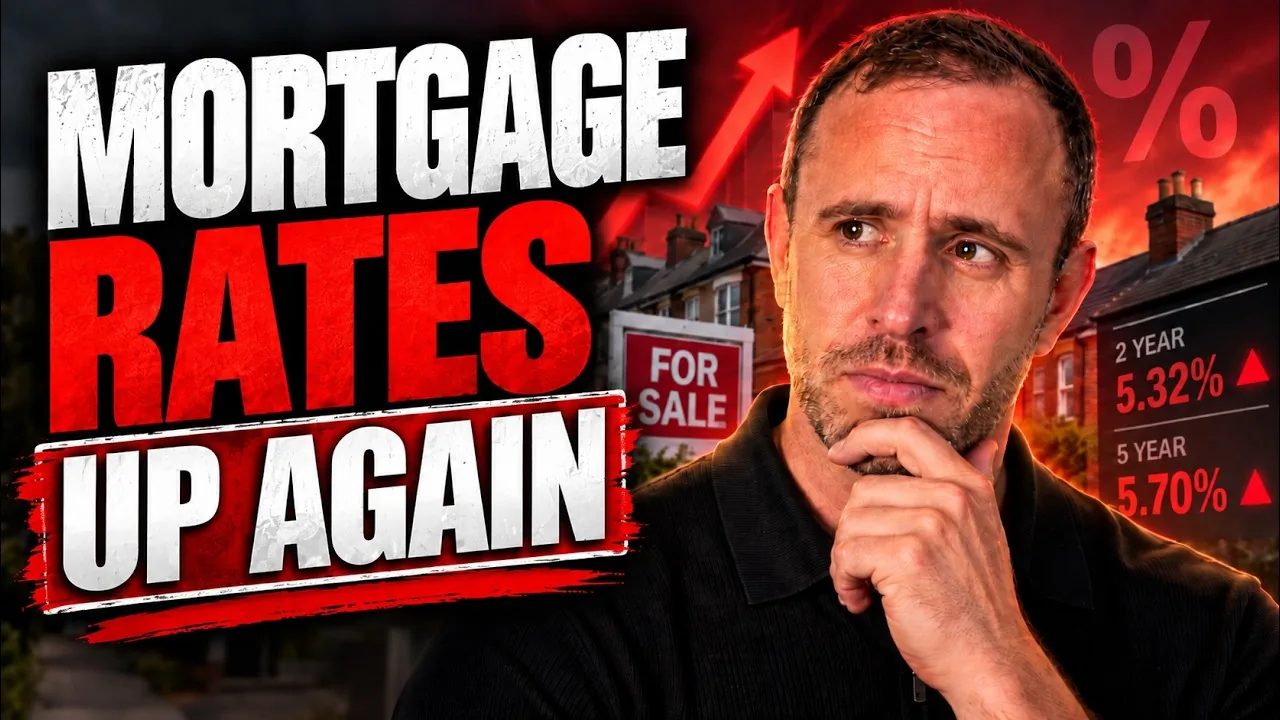
The average two-year buy-to-let fixed rate I discussed had moved from 5.29% at the start of September to 5.32%, while the five-year average had moved from 5.66% to 5.70%. Those were the market figures being discussed at the time, not rates that every borrower could obtain or a live product comparison.
That distinction matters. A market average includes products with different fees and lending criteria. The actual mortgage available to me depends on the property, the borrowing, the rental income, my circumstances and the lender’s requirements.
A single withdrawn product wouldn’t make me particularly worried. Mortgage ranges change routinely. What caught my attention was the combination of rising funding costs, several lenders increasing rates and fewer options in parts of the market. Together, those changes were worth incorporating into a refinancing plan.
Why fixed mortgage rates can rise without a Bank Rate increase
At the time of the video, Bank Rate was 3.75%. People understandably ask why mortgage offers can become more expensive when that headline rate hasn’t gone up.
The answer is that fixed mortgage rates don’t follow Bank Rate mechanically. Lenders need to consider the cost of providing money over the fixed period. Interest-rate swaps help them manage that exposure, and market expectations can change before the Bank of England makes its next decision.
In the video, I described two-year swap rates moving from approximately 4.06% at the beginning of August to 4.26% by 3 September, with five-year swaps moving from around 4.16% to 4.36%. Each example is a rise of 0.20 percentage points, or twenty basis points.
Those historical observations help explain the repricing I was discussing. They aren’t today’s available mortgage rates, and a lender doesn’t simply pass on every market movement in exactly the same amount.
The Bank of England’s explanation of reference rates and lending costs sets out the broader mechanism: reference rates matter, but so do other funding costs, credit risk and the costs of lending. Competition and the lender’s appetite for new business influence the final offer too.
What a small rate increase costs in pounds
For an interest-only loan with an unchanged balance, the basic calculation is straightforward: multiply the mortgage balance by the increase expressed as a decimal. A rise of 0.25 percentage points means multiplying by 0.0025.
On a £250,000 mortgage, that’s £625 a year, or about £52 a month. On £1 million, it’s £2,500 a year. On £2 million, it’s £5,000 a year, or roughly £417 a month.
Those aren’t enormous numbers compared with the value of a large portfolio, but they can be significant compared with the cash left after operating costs. That’s the comparison that matters to a landlord trying to keep the business healthy.
A full percentage-point increase on £2 million is £20,000 a year. Seeing the figures at different levels makes it easier to understand your exposure without having to guess what the next interest-rate decision will be.
These calculations show additional interest, not a complete repayment-mortgage calculation. If you’re repaying principal as well, the term and repayment schedule also affect the monthly payment. Product fees, refinancing costs and any early repayment charges need separate consideration.
How the change has affected my own portfolio
Back in 2022, my average mortgage rate was around 3%. As loans have come up for renewal, that average has moved to roughly 6%. On £2 million of borrowing, the difference is approximately £60,000 a year in interest.
I haven’t experienced that as one sudden change on every mortgage. My loans were fixed at different times, on different terms, and refinance on different dates. The higher costs have gradually worked through the portfolio.
That’s why looking only at today’s total mortgage payment can give a false sense of comfort. A portfolio may still contain some older fixed rates that don’t reflect what the borrower would pay if everything refinanced now.
I’d want to know both figures: what the portfolio costs today, and what it might cost as the next group of fixes expires. The gap between them tells me how much planning I need to do.
I’ve written separately about gilt yields and mortgage pricing if you’d like the wider market explanation. For managing my own properties, the refinancing timetable is where that market story becomes actionable.
Build the refinancing picture before the deadline arrives
If I had a fixed rate ending in the next few months, I’d speak to a broker early. I wouldn’t assume that waiting automatically produces a cheaper deal, and I wouldn’t leave the first conversation until the existing fix was about to end.
I’d start with a simple list for each mortgage: the balance, current rate, fixed-rate end date, payment and any charges for leaving early. Then I’d put the available replacement options next to it.
I would ask about the total cost over the period I’m comparing, including fees. A slightly lower headline rate can be less attractive once a substantial product fee is included, particularly on a smaller mortgage.
I’d also ask how long an offer is valid, whether a better deal can be selected before completion and what conditions apply. Those details vary, so I wouldn’t treat flexibility as something every offer automatically includes.
The purpose is to understand my choices while I still have time to act. If the market improves, I can review them. If it doesn’t, I’ve avoided building my entire plan around a rate cut that nobody promised me.
Check the cash flow after refinancing
The rent isn’t the amount available for my own spending. Before I decide a property works, I need to allow for finance, management, repairs, maintenance, insurance, empty periods and other relevant running costs.
Then I need to think about tax in the appropriate ownership structure. A figure left after operating costs isn’t automatically after-tax income. That distinction becomes especially important when interest makes up a large share of the costs.
I’d run the figures using the mortgage terms actually available, then test a less comfortable scenario. What happens if the next rate is higher, the property is empty for a period or a repair arrives at the wrong time?
The point isn’t to assume every bad event happens at once. It’s to know whether there is enough room to handle ordinary setbacks without being forced into a rushed decision.
I remain positive about property over the long term, including the potential for rents and values to grow and inflation to reduce the real burden of a fixed nominal debt. But none of that guarantees a particular property’s return or pays this month’s bills. Cash flow is what lets you stay invested long enough for your wider plan to develop.
A softer market can change the purchase price
Higher mortgage costs can also reduce competition from other buyers. Properties may take longer to sell, and sellers who need to move can become more willing to negotiate.
In the video, I used a simple example of a property worth around £200,000. In a stronger market, I might have needed to pay £195,000. In a softer market, perhaps I could agree £180,000. That’s a £15,000 difference in the purchase price.
For me, a meaningful reduction in price can matter more than a modest extra monthly financing cost. But I still have to consider how long I expect to hold the property, the full cost of borrowing and whether the rental cash flow works throughout that period.
A discount isn’t a licence to ignore affordability. Nor is an asking price proof of market value. I’d want evidence from comparable sales and a realistic assessment of rent before treating the lower price as an opportunity.
That is the other side of a difficult market: the reason borrowing feels less comfortable may also be the reason a seller is willing to discuss a price they wouldn’t previously have accepted.
I don’t need a perfect forecast to make a decision
People often say they’ll wait six months because mortgage rates will be lower. They might be right. They might not. The practical problem is making an investment depend on the prediction coming true.
I’d rather ask whether the deal available today makes sense. What am I paying? What rent can it support? What mortgage can I actually get? What happens when that mortgage needs refinancing?
If the figures work and the property suits my wider plans, I’m interested. If they don’t, a confident forecast about next year’s rates doesn’t change the weakness in today’s numbers.
There isn’t a perfect property market for everyone. Cheap borrowing can come with stronger competition and firmer prices. A softer market can offer more room to negotiate but also more uncertainty. I want to understand the trade-off instead of waiting for every condition to line up in my favour.
My approach for existing landlords and new buyers
If I already own good property, a quarter-point rate movement alone wouldn’t make me rush to sell. I’d review the cash flow and the timing of my borrowing. If a refinance is approaching, I’d get organised early. If I’m buying, I’d be more demanding on price.
That discipline supports the longer-term goals in my property retirement plan. The portfolio needs to carry its costs while I build towards the income I ultimately want.
If you’d like to discuss your next property decision, book a free strategy call with me. For help preparing for your first purchase, explore Starter Club. You can also explore Done For You and a 20-minute suitability call.
Watch the original video
Watch my video on rising buy-to-let mortgage rates, published on 8 September 2026.