What Is Passive Income? Five Routes and the Work Behind Them
July 29, 2026
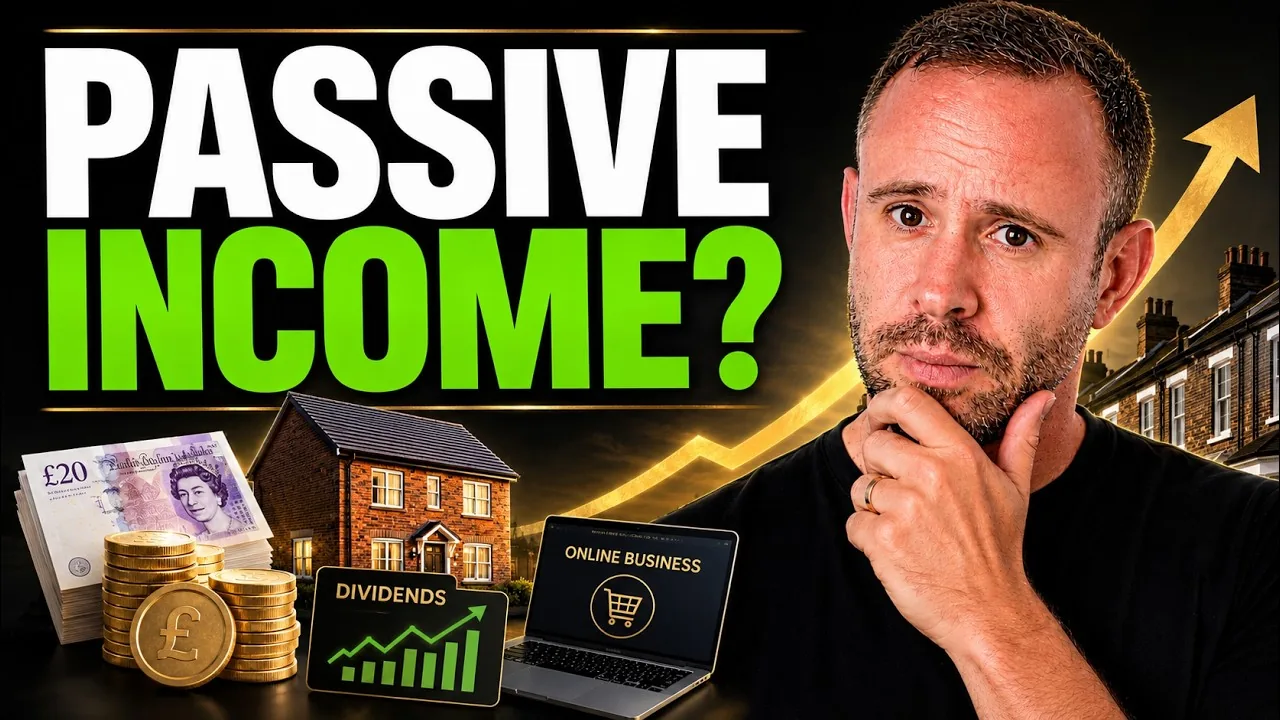
Passive income is one of the most overused phrases on the internet. It is often presented as money arriving while you do nothing, with very little said about the work or capital needed before that can happen. My experience is that the passive part usually comes later.
The idea itself is useful. I want to own assets that can continue producing value without every pound depending on another hour of my time. But I don’t want to confuse that goal with finding an activity that has no effort, responsibility or risk attached.
In my video published on 29 July 2026, I broke passive income into five broad routes: property, financial assets, businesses, intellectual property and audience-based income. They look different, but they share something important. Each involves owning or building something that can keep working after the initial effort.
You can also watch my passive income video on YouTube.
What I mean by passive income
I think of passive income as money generated by something I already own or have created, rather than payment directly tied to the next hour I work. A rental property, an investment or a book can potentially keep producing income after the original purchase or creation.
That is a practical description, not a claim that every income stream in those categories is effortless. Someone managing a busy short-stay property themselves may be doing a great deal of active work. Someone with a well-organised ordinary rental and an agent may spend much less time on day-to-day tasks.
There is also a difference between income and growth. Rent or a dividend can provide cash. An increase in the estimated value of a property or fund builds wealth on paper, but doesn’t automatically put money in the current account.
I want to know which of those things an investment is doing. If the goal is to pay monthly living costs, an attractive valuation increase is not the same as a reliable stream of spendable cash.
Property income: powerful, but never completely hands-off
Property is one of my favourite routes because I understand the asset and can influence parts of the result. I can investigate a location, negotiate the price, improve a property where appropriate and choose how it is managed.
The basic arrangement is easy to grasp. Someone occupies the property and pays rent. If the rent exceeds the mortgage interest and all the other costs, there is a surplus. Over a long holding period, there may also be capital growth, although neither income nor growth is guaranteed.
The beginning is usually very active. Finding the purchase, arranging finance, dealing with solicitors, completing work and getting the property ready to let all take attention. A good agent can help, but I still need to make decisions and understand what is being done.
The work doesn’t disappear completely once a tenant moves in. Mortgages renew, insurance needs reviewing, repairs arise and management needs oversight. I often describe this as having to manage the managers. Delegating tasks can reduce my involvement without removing my responsibility as owner.
For me, ordinary property bought well in an area where people want to live can become more manageable over time. It offers a combination of rent, potential growth and control that I like. I wouldn’t sell it to someone as a way to collect money without ever thinking about it again.
Don’t mistake the rent for the income you can spend
A rental payment is the starting figure. Mortgage interest, maintenance, management, insurance and empty periods need allowing for before deciding what the property produces. Tax can then reduce the amount available further.
The costs may not arrive evenly. A month with no repair bill doesn’t prove that maintenance costs nothing. I would keep money available for future work rather than spend the entire bank balance because the property had a quiet few weeks.
I also need to be clear about borrowing. Refinancing may release money, but it does so by increasing debt. That can be useful in a growth strategy, yet it isn’t another form of rental profit.
My property retirement plan explores the distinction between owning a portfolio and having enough income to support a lifestyle. The relevant number is what remains available after the obligations have been met.
Financial assets: less daily work, more dependence on capital
Shares, funds, bonds and savings can involve very little daily management once an appropriate arrangement is in place. The type of return differs: savings may pay interest, companies may pay dividends, and investments may rise or fall in value.
An index fund can spread money across many businesses without requiring me to choose each one individually. Some funds distribute income, while others reinvest it. If the income is being reinvested, it is helping the balance grow rather than being paid out for me to spend.
The appeal is the low level of ongoing work. I don’t need to organise a plumber or approve a tenancy to own a fund. The trade-off is that I need sufficient capital before even a reasonable percentage return becomes a large amount of money.
Take the simple 5% illustration from my video. On £10,000, 5% is £500 a year. On £1 million, it is £50,000 a year before tax. The same percentage has a very different effect because the starting amount is different.
That example doesn’t establish a safe withdrawal rate or guarantee that an investment will pay 5% annually. A total return can include changes in value, and taking money out reduces what remains invested. I would distinguish actual income from an assumed return before planning living costs around it.
Choose the financial asset around the purpose
Money needed soon has a different job from money invested for decades. Shares can fall, bond values can move and access to pension investments is subject to rules. “Financial asset” is a broad category, not a single level of risk or access.
For eligible UK investors, an ISA or pension can be relevant to the tax position, but the wrapper doesn’t remove the risk of the investment held inside it. I would understand both before deciding where to put the money.
My index-fund guide for beginners explains why simple, regular investing appeals to me. For an official starting point, the FCA’s guide to deciding whether to invest covers readiness, including the importance of emergency cash and expensive debt.
I like financial investments as part of a wider plan. They can provide a relatively low-maintenance way to accumulate assets, even if meaningful income is some distance away at the beginning.
Business income: the owner needs to be replaceable
Owning a business doesn’t automatically make its income passive. If I am the person serving customers, solving every problem and making every routine decision, the business still depends directly on my working time.
I’ve built several businesses, and the early stages can feel as though the business owns you more than you own it. Customers, staff, suppliers, complaints and cash flow all need attention. There isn’t much passive about being responsible for all of that yourself.
A business becomes less dependent on the owner when it has capable people, clear processes and management that can operate without constant intervention. There also needs to be enough profit left after paying those people. Otherwise, the apparent profit may largely be payment for the owner’s unpaid work.
The useful test is what happens when I step away. Does the business continue serving customers and earning a surplus, or does everything wait for me to return? Building independence takes deliberate work; it doesn’t arrive automatically with a company registration.
I see that as a progression rather than a switch. A business can become more manageable and less dependent on me without being completely effortless. The improvement is still valuable even if occasional owner decisions remain necessary.
Intellectual property: create something that can be used repeatedly
Books, music, courses, software, apps and photography can all produce value beyond the first sale. The attraction is that the original work may be sold, licensed or used repeatedly, rather than starting from nothing for every customer.
That can be powerful, but creating the product is only part of the job. People need to want it, find it and continue finding it useful. A finished book that nobody buys doesn’t produce passive income just because the writing is complete.
Some products also need ongoing updates, support or marketing. Software can require maintenance, a course can become outdated and customers may have questions. Those obligations need to be included when deciding how passive the income really is.
I would ask what useful thing I can create, who it serves and how it will continue reaching those people. That is a more practical starting point than choosing a product purely because someone online labelled it passive.
Audience income: trust has to come first
YouTube, blogs, newsletters and podcasts can generate income through several routes, including advertising, products, sponsorships and affiliate arrangements. But building an audience is work. I know that from making the videos behind these articles.
When I recorded this particular video on 8 July 2026, it was around midnight and I was still filming. The video was published later, on 29 July. Someone watching months afterwards may see content that is still useful, but the original work happened before that later viewing.
A video can continue attracting viewers after it has been edited and uploaded. An article can continue answering a question after it has been written. That repeat value is what makes the work interesting, even though creating and maintaining an audience isn’t effortless.
Trust matters particularly with recommendations. An affiliate link isn’t valuable simply because it exists. The audience needs a reason to listen, and recommending something unsuitable can damage the relationship that made the recommendation useful in the first place.
I would rather build something people find helpful than chase a quick payment at the expense of that trust. Ongoing attention still matters, because platforms, interests and the information people need can change.
Ownership is the common thread
Across the five routes, the pattern is similar. You own the property, investment or business, or you have created something that people can keep using. The future income comes from that asset or relationship rather than only from selling another hour.
That is why earning more isn’t the same as becoming wealthy. A large salary can disappear into a large lifestyle. The change begins when some active income is kept and converted into assets that may provide value later.
I don’t think this requires choosing five routes at once. Trying to build a business, buy property, launch a course and start a channel simultaneously can leave very little attention for doing any of them well. I would start with the route that fits my resources and what I am willing to learn.
Start with an asset you can build or buy properly
If I have limited capital, the first job may be increasing income and saving consistently. If I have money but little time, a simple investment may suit me better than running an operational business. If I want property, I need to understand the purchase and the ongoing responsibilities.
My first £100,000 guide explains how savings and investments can begin working together. If you’re considering property as part of your plan, book a free strategy call, explore Starter Club or Done For You and a 20-minute suitability call.
The sequence I keep coming back to is active income first, assets second and the possibility of more passive income later. I want the work I do now to buy me more choices in the future. That is a much more useful goal than searching for money that supposedly requires nothing from me at all.