UK Interest Rates: What Four Possible Rises Mean for Property Investors
September 11, 2026
UK interest rates matter to me because I have around £2 million of mortgage debt across my property portfolio. When expectations move from cuts towards increases, that changes the numbers I need to think about, even before my next mortgage comes up for renewal.
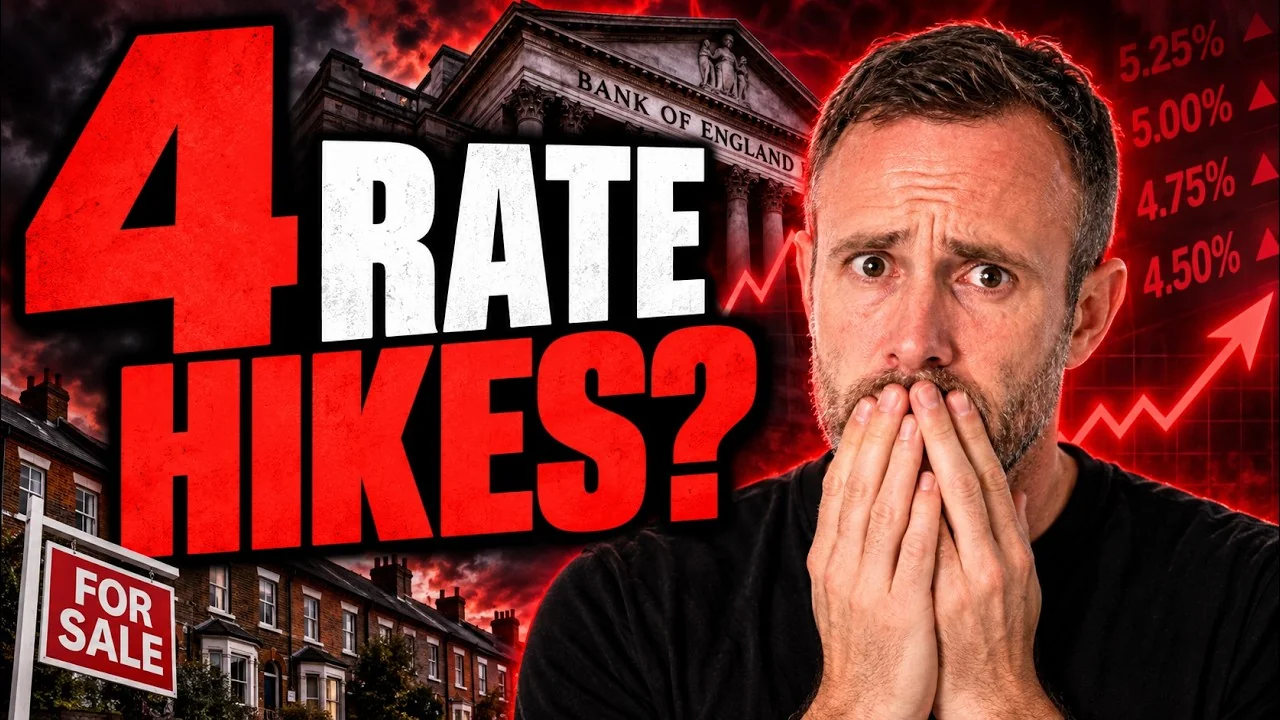
In my video published on 11 September 2026, I discussed markets pricing roughly four quarter-point Bank of England increases over the following year. That was a snapshot of market expectations, not an announcement that four rises had been agreed. The distinction is essential if you’re making decisions about a property purchase or refinancing.
My response is to keep assuming expensive borrowing and buy only where the deal works. I’m still interested in UK property. I just don’t want the success of an investment to depend on cheaper money arriving exactly when I need it.
Why the latest GDP figures changed the conversation
The ONS July 2026 GDP release, published on 11 September, estimated that the economy grew by 0.4% during July. That followed 0.3% growth in June and no growth in May. Output was estimated to be 1.6% higher than in July a year earlier.
Those are different comparisons. The 0.4% figure describes one month’s change, while 1.6% compares July with the same month the previous year. It would be misleading to treat either as a guaranteed annual growth rate from this point forward. Early GDP estimates can also be revised as more information arrives.
In the video, I explain that the monthly result was stronger than the roughly flat outcome economists had been expecting. Normally, stronger growth is welcome. Businesses doing more activity and an economy holding up better than anticipated are not things I want to complain about.
But the timing complicates the interest-rate outlook. If growth is weak, raising borrowing costs risks putting more pressure on already struggling households and businesses. A stronger economy can give the Bank more room to act against inflation. It does not force a rate rise, but it changes the balance of the discussion.
Why oil belongs in a property investor’s thinking
When I recorded the video, I was looking at Brent crude around $109 a barrel. That is a dated observation from the recording, rather than a live oil quote. Commodity prices can change sharply during a single day, so I wouldn’t build a long-term property plan around that exact number.
The important point is how energy costs travel through the economy. We notice petrol prices when we fill the car, but transport is only one part of it. Businesses use energy to manufacture goods, keep premises operating and get products to customers. More expensive fuel can therefore affect much more than our own journeys.
The Bank of England’s July 2026 Monetary Policy Report describes the inflation pressure from volatile energy prices and the uncertainty over how long the shock will last. It also explains that monetary policy cannot control global energy prices. The Bank is concerned with whether the effects spread and become embedded in wider price and wage decisions.
That is the difficult combination I’m watching: stronger activity alongside renewed pressure on costs. It makes the idea of an uncomplicated return to cheap borrowing much less comfortable. The eventual outcome depends on what happens next, rather than one GDP number or one morning’s oil price.
Four possible rises are not four promised rises
The starting Bank Rate at the time of the video was 3.75%. Four increases of 0.25 percentage points would add one percentage point, taking it to 4.75%. That is the arithmetic behind the headline.
It isn’t the same as the Bank publishing a schedule of four increases. Market pricing reflects expectations and uncertainty, and those expectations can move quickly when new information arrives. They are useful signals, but they are not instructions from the Monetary Policy Committee or guarantees about future mortgage offers.
At its July meeting, the committee voted six to three to maintain Bank Rate at 3.75%, with three members preferring an increase to 4%. The Bank’s official rate decision page records that decision and the next scheduled meeting on 17 September 2026.
I pay attention to that split because there was already support for higher rates before the latest GDP release. I’ll be watching the next decision and the explanation behind it. But I’m not going to turn either a market forecast or a minority vote into a certainty about what the whole committee will do.
Why mortgage rates can move before Bank Rate
For an investor, the rate on the mortgage offer is what feeds into the cash-flow calculation. It does not have to wait for an official Bank Rate increase before it changes.
Fixed mortgage pricing is influenced by lenders’ funding costs and expectations about future interest rates, including the swap markets discussed in my video. Those markets look ahead. If expectations change, a lender can change the price of a new fixed deal even while the official rate remains where it was.
That means two statements can both be true: Bank Rate has not changed, and the mortgage products available to you have become more expensive. Conversely, the pricing of new fixes can improve before an official cut. Your existing fixed payment normally follows the terms of your current contract until that fix ends.
I therefore want to understand both the mortgage I have and the options available when it expires. A tracker, a fixed deal and a lender’s variable rate do not behave identically. Looking only at the Bank Rate headline won’t tell me what my own payment will be, or when it will change.
What the numbers mean on my £2 million of debt
A few years ago, my average borrowing cost was around 3%. In the video, I put it much closer to 6%. Applied to £2 million of debt, that three-percentage-point difference represents around £60,000 a year in additional interest.
The same calculation shows why another one percentage point gets my attention: £2 million multiplied by 1% is £20,000 a year. Spread over twelve months, that is roughly £1,667. Small percentage movements become substantial money when the borrowing balance is large.
These are interest-cost illustrations using the stated balance and average rate. They aren’t a claim that every mortgage in my portfolio resets on the same day or moves in exact step with Bank Rate. Each loan has its own terms, balance, expiry date and available refinancing options.
Nor does a change in interest cost translate automatically into the same change in after-tax income. Tax treatment and ownership structure matter. I keep the financing calculation clear first, then work through the wider position rather than mix interest, mortgage repayments and taxable profit into one vague number.
Higher borrowing costs have been a major pressure on my property cash flow. The properties themselves have performed well in my experience: rents have increased and asset values have risen. Yet the amount going out to lenders has increased too. Both sides belong in an honest account of how the portfolio is doing.
I was thinking about cuts too
I’m not pretending I saw every part of this coming. In the video, I admit that six months earlier I was thinking about what a 1% reduction would mean for my finances and how much faster I might buy more assets.
It is easy to start mentally spending a saving before it exists. When you have a large mortgage balance, the potential benefit of cheaper borrowing is attractive. But wanting that outcome doesn’t make it more likely, and it certainly doesn’t make it a sensible requirement for the next deal.
This is why I try to separate what I hope will happen from what I need an investment to survive. I can welcome lower rates if they arrive while still assessing a purchase on the assumption that borrowing remains expensive.
If you’re building your own plan, the same principle applies at a smaller scale. Start with the loan you actually expect to need and calculate the cost at realistic available terms. Then look at a less comfortable outcome. A plan should help you see the pressure points before you commit the money.
How I’m assessing purchases now
I’m still buying where the numbers work, but I’m putting more emphasis on purchase price, rental income and the cost of debt. My assumption is that expensive borrowing may reduce the number of buyers competing for some properties. That is one reason I’m looking for bigger discounts.
A discount needs evidence. An asking price is not automatically market value, and buying below an optimistic listing price does not prove you’ve found a bargain. I want to understand what comparable homes are worth and what tenants will realistically pay for the specific property.
I then want enough margin after the mortgage and other running costs. That includes management, insurance, repairs, empty periods and applicable compliance expenses. It is no use celebrating a strong gross rent if most of it has already been allocated before I receive it.
I also pay attention to refinancing dates. A property can feel comfortable during an existing fix and look quite different at renewal. Writing down when each loan ends helps turn a general concern about rates into a practical plan for conversations with a mortgage adviser and decisions about cash reserves.
For an illustration, an additional 1% interest cost on a £150,000 loan is £1,500 a year, or £125 a month. That is much smaller than my portfolio-wide example, but it could still absorb a meaningful part of a single property’s surplus. The size of the buffer matters more than whether the headline rate sounds high or low.
Build a plan that works without a rescue from rates
I still believe good UK property, bought at the right price and held for the long term, can be an excellent investment. That is my investment view, not a promise that every property will rise or every purchase will succeed.
The lesson I take from this change in expectations is to keep planning around the conditions in front of me. If rates fall, I get the benefit. If they stay high or rise, I want the investment to have enough room to cope. Hoping the Bank will rescue an overstretched purchase isn’t a strategy I want to rely on.
If you want to connect these calculations with a longer-term income target, read how I’m planning to retire from property investing. The goal is the income left after costs, rather than simply owning the largest possible collection of properties.
You can book a free strategy call with me to discuss your starting point. Starter Club provides regular coaching and accountability, or you can explore Done For You and book a 20-minute suitability call to see whether it suits your plans.
Watch the original video
Watch SHOCKING: Markets Price in 4 UK Rate HIKES: What Is Going On?, published on 11 September 2026. This article reflects that dated commentary; market expectations and mortgage offers will continue to change.
This is general property education and my personal experience, not individual mortgage or financial advice. Property values and income can fall, and borrowing increases risk.