Labour’s Economic Policy: Why I’m Worried as a Property Investor
July 2, 2026
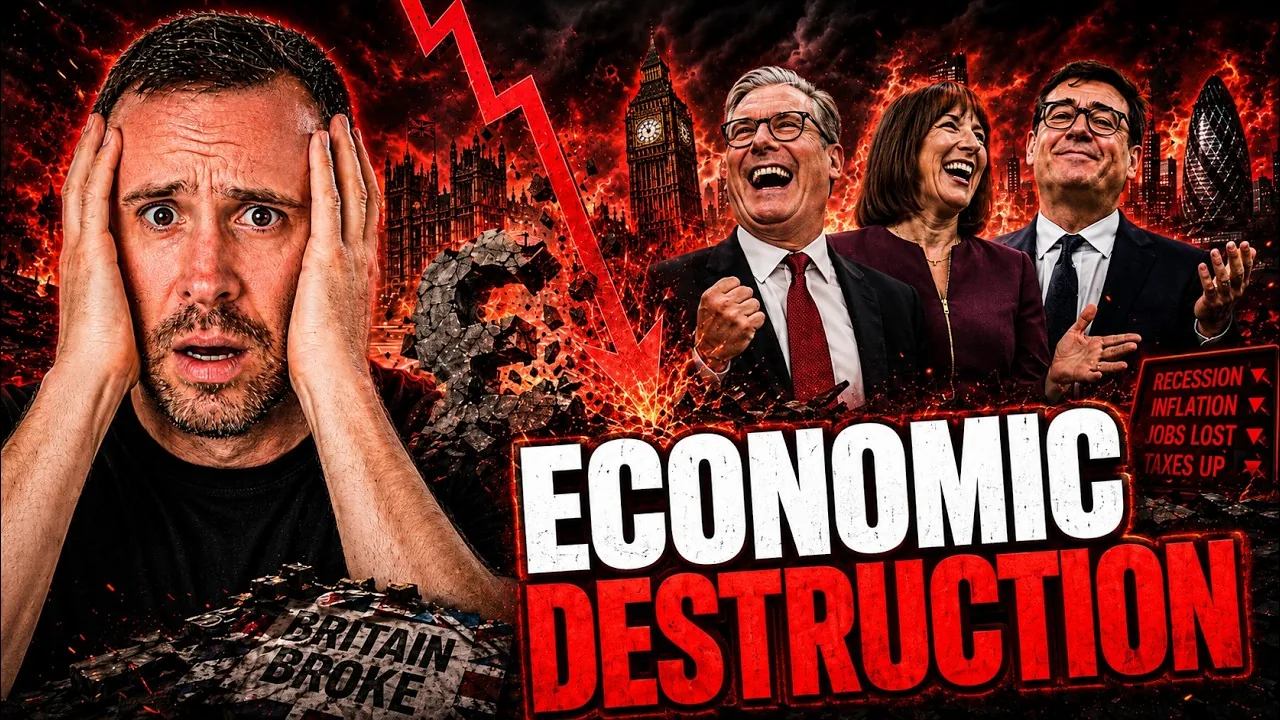
I worry that Britain’s answer to weak growth has become too predictable: more tax, more spending and more pressure on the people expected to fund it. As a business owner and property investor, I think that risks making investment less attractive at precisely the time we need more of it.
That was the argument in my video published on 2 July 2026. It was a strong criticism of Labour’s economic direction and of proposals for further taxes on property and wealth. It was also my political judgement, not a claim that one party created every problem Britain faces.
The Conservatives had years to address weak productivity, difficult housing costs and pressure on public services. In my view, they left serious problems unresolved. My concern is that repeating a high-tax, low-growth approach won’t fix those problems simply because a different party is doing it.
You can watch my original economic commentary on YouTube. Here I separate the official figures available around that discussion from my interpretation of what they mean for investors.
Why the jobs market worried me
Employment is central to this argument. Businesses need customers who can spend, households need dependable income and the government needs a productive economy to support its tax base.
The June 2026 labour-market release reported that payrolled employment fell by 138,000 between April 2025 and April 2026. It also showed regular pay growth of 5.1% in the public sector and 2.9% in the private sector for February to April 2026.
One correction to the spoken video is useful. I referred to unemployment at 5%, up 0.4 percentage points annually. The published June release puts the February-to-April estimate at 4.9%, up 0.3 percentage points over the year. It was down over the latest quarter. Those distinctions matter when describing the direction of the data.
The ONS June 2026 labour-market bulletin also advises caution with short-term movements and survey uncertainty. I take the combination of indicators seriously, but I don’t think one monthly number can explain the whole economy.
My judgement is that making employment more expensive in a soft jobs market risks discouraging hiring. That is an economic argument about incentives. The employment figures alone cannot prove how much of a change was caused by a particular tax decision.
Businesses have to respond to the costs they face
A business cannot ignore a higher wage bill, tax bill or financing cost. It has to find the money somewhere. That might mean lower profits, higher prices, fewer new roles, reduced investment or a change in the way it operates.
Not every employer responds in the same way, and some will absorb costs successfully. But I don’t accept the idea that a cost placed on a business has no wider consequences simply because the business is the one legally paying it.
When I talk about the private sector as the engine of the economy, I mean that sustainable growth needs people creating products, services, jobs and investment. A government can support that process, but it also depends on the resources the economy generates.
My frustration is with policies that seem to treat productive activity mainly as a source of additional revenue. At some point, the people being asked to invest more need a reason to believe the return will justify the risk.
Public services matter, and so does the way we fund them
I’m not arguing that we don’t need nurses, teachers, police officers or the other people providing essential services. We plainly do. The question is how to provide good services sustainably while maintaining a strong economy around them.
In the video, I compared public- and private-sector pay and questioned the balance. Headline comparisons need care because the sectors contain different occupations, qualifications and working patterns. A difference in average or median pay is not automatically a comparison of identical jobs.
The same care applies to pay growth. The timing of awards can affect a measured annual rate. A single release doesn’t tell you the full story of recruitment difficulties, past pay restraint or the value of a particular role.
Even allowing for that, I think it is reasonable to ask whether spending decisions are matched by productivity, service improvement and an affordable funding plan. My objection is not to essential workers being paid. It is to treating a larger bill as though it were automatically a better outcome.
Welfare needs a sustainable foundation
A civilised country should support people who need help. Disability, ill health, unemployment and difficult personal circumstances are real, and I don’t want that lost in an argument about the total bill.
The government tables discussed in the video forecast social-security expenditure in Great Britain of £322.6 billion for 2025–26. That is a broad category, including pensioner support as well as working-age benefits. It should not be described as though the whole amount were unemployment benefit.
My concern is about the relationship between that expenditure and the economy funding it. If fewer people are working, employers are less willing to expand and investment slows, financing commitments becomes harder.
I want a system that provides support where it is needed and makes participation in work worthwhile where it is possible. Those aims require attention to health, skills, childcare and the practical barriers people face, as well as the incentives created by taxes and benefits.
Simply pointing at a large spending total doesn’t answer those questions. But neither does dismissing every concern about affordability as hostility towards people who need support.
Debt reduces the room for easy answers
The May 2026 public-finance release put public-sector net debt at an estimated 95.1% of GDP. In the video, I also discussed borrowing of £43.3 billion in the financial year to May, rather than £43.3 billion in May alone.
The distinction between a stock of debt and a flow of borrowing matters. Debt is the accumulated position; borrowing adds to it over a period. Both measures can be revised as information improves.
My point was that the country had limited room to assume every difficult choice could be postponed. More borrowing has financing consequences, while more tax can influence the behaviour of households and businesses.
There is no cost-free option. My preference is to put more weight on improving growth and the conditions for investment rather than repeatedly expecting a narrow group of taxpayers to carry a larger burden.
That is a policy preference. People can disagree about the best balance between taxes, spending and borrowing without disagreeing that the arithmetic eventually has to work.
Why property-tax proposals concern me
I discussed Andy Burnham and proposals to replace council tax and stamp duty with an annual charge linked to property value. A rate around 0.5% was part of the scenario considered in the video.
This was a discussion of proposals and reported ideas, not a description of a new nationwide tax already in force. Any actual policy would need to specify the rate, the liable person, what existing taxes it replaced and how exemptions or deferrals worked.
I accept that there are arguments for reform. Council-tax valuations are old, and transaction taxes can discourage moving. Saying the current system has weaknesses is not the same as saying every proposed replacement would be better.
An annual property-value charge could affect cash-poor owners of valuable homes, change buyers’ budgets and alter the relative attractiveness of different areas. Those effects deserve proper analysis before the policy is presented as an easy source of revenue.
At 0.5%, a £200,000 property implies £1,000 a year, while a £1 million property implies £5,000. Whether that is an increase or decrease depends on the full design and the taxes removed. The arithmetic illustrates exposure; it doesn’t tell you the final bill under an unimplemented proposal.
Landlords respond to incentives too
If the cost or risk of providing rental property increases, investors reassess the return. Some accept less profit. Some improve operations. Some decide not to buy another property, and others sell.
I believe that making rental investment less attractive can reduce supply over time and put pressure on rents where demand remains strong. But a landlord cannot automatically pass every extra cost to a tenant. Local affordability, competition and the legal framework still constrain what can be charged.
That distinction matters. My argument is about the direction of incentives across the market, not a promise that increasing one landlord’s tax bill mechanically produces an identical increase in rent.
It also helps explain why a property can be sold by one investor and bought by another. Different borrowing, tax positions and purchase prices can produce different outcomes from the same building. I’ve discussed that in my article on landlords selling to other landlords.
What this means for my investment decisions
Political frustration isn’t an investment strategy. I still need to assess properties commercially rather than letting my opinion of a government make the decision for me.
I want rent that supports the borrowing and realistic operating costs. I want a purchase price grounded in comparable sales. I want cash reserves and enough margin to cope with changes rather than a plan that only works under the most favourable tax and interest-rate assumptions.
Ownership structure is part of that assessment, but it isn’t a universal solution. A company can change the tax treatment while adding costs and administration. Taking money out creates another set of considerations. My personal-name versus limited-company comparison explains how I think about that choice.
I would also distinguish a policy announcement from speculation and implementation. Reacting to every political headline can lead to unnecessary decisions, while ignoring a confirmed change can leave too little time to prepare.
My concern is the direction of travel
I want more people to have the opportunity to build businesses, own assets and become less dependent on a wage alone. Property has been one route to doing that in my own life, which is why changes to the investment environment matter to me.
My criticism of Labour’s approach is that I think it risks making ambition and ownership more expensive without solving the underlying growth problem. Others will see the trade-offs differently. The useful debate is about what the policies actually do, who pays and how people respond.
For my own decisions, the answer remains disciplined investing rather than waiting for politics to become perfect. If you’d like to talk about your property position, book a free 30-minute call with me. You can also explore Starter Club or read about Done For You.