Opportunity Cost in Investing: Why I Sold My Car
February 19, 2022
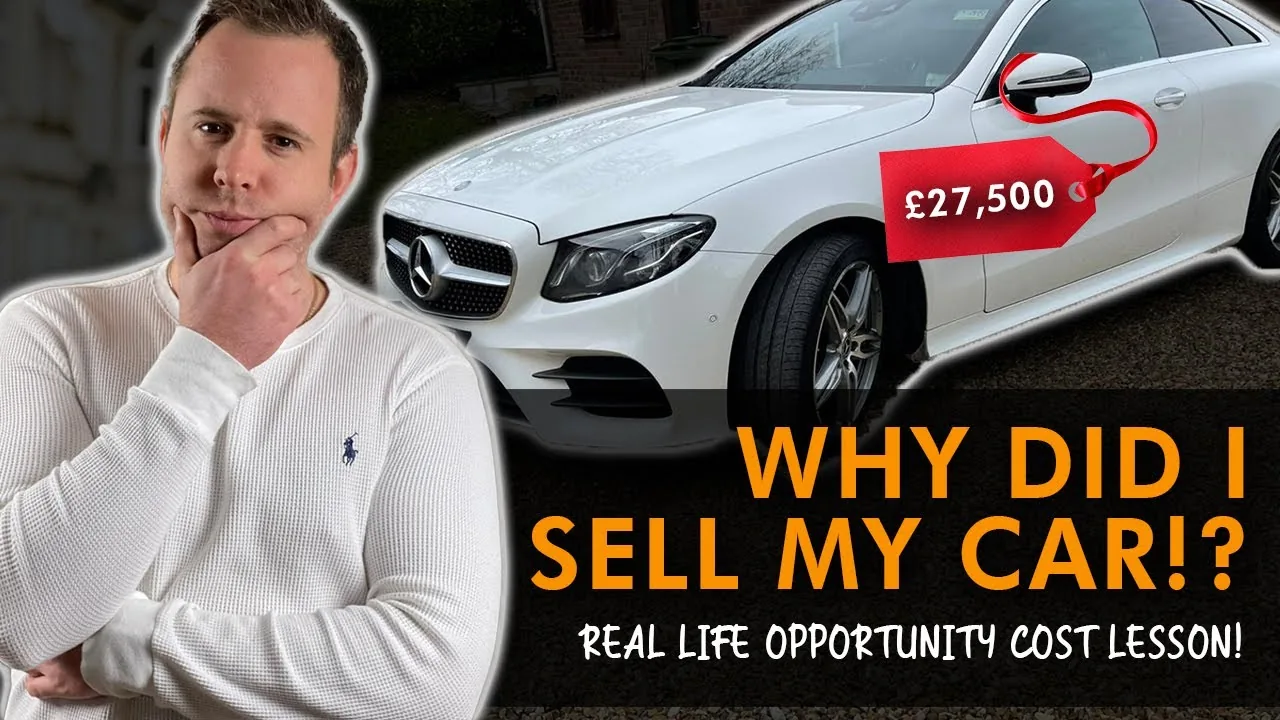
Opportunity cost is what you give up when you choose to use your money one way rather than another. It sounds like a textbook idea until you look at something you own and ask a very practical question: if I had its cash value today, would I buy it again?
That question led me to sell my Mercedes in February 2022. I liked the car. I wasn’t forced to sell it because of a financial emergency. But my life had changed, I barely drove it and I could see better uses for the money and monthly payments tied up in it.
The lesson wasn’t that nobody should own a nice car. It was that something can have been a reasonable purchase in the past and no longer make sense in your present circumstances. Recognising that gives you a choice about what happens next.
You can watch the original video about selling my car for £27,500 to see the decision and the discussion with my wife.
Why a car I enjoyed stopped fitting my life
The car was a 2017 Mercedes E-Class coupé. I enjoyed it, including the interior, and remembered how I felt when I first bought it. The problem wasn’t that I had suddenly decided it was a bad car.
When I checked how much I’d used it, I’d driven only about 375 miles in roughly nine months. I was busy with work, and our family circumstances had changed. We had three children and a fourth on the way when I recorded the video.
The larger family car was the one we tended to take, including when I was going out to film and collecting the children afterwards. The coupé no longer fitted the way we actually travelled, however much I liked the idea of owning it.
That is a useful distinction. The version of your life that justified buying something may not be the life you’re living now. I had to look at the actual usage rather than the enjoyment I remembered from the purchase.
The question that made the decision clearer
I asked myself whether, if I had around £28,000 in the bank, I would go out and buy that car again. The answer was no. Once I put it that way, keeping it became harder to justify.
Owning something already can make it feel like the default choice. Selling it feels like taking action, while keeping it feels like doing nothing. Financially, though, keeping it is still a choice about where your money remains committed.
The question helped me look at that choice afresh. I wasn’t deciding whether the car had ever made me happy. I was deciding whether it deserved that amount of capital and those ongoing costs from that point onwards.
I think that’s why the exercise is useful. It doesn’t require a complicated forecast or a perfect investment alternative. It starts by asking whether the existing use of money still fits your priorities.
How I arrived at the £27,500 sale
I initially looked at an online car-buying service out of curiosity and saw a figure around £26,000. After a conversation, I thought the eventual offer could be lower, so I looked more closely at comparable cars being advertised.
That led me to an asking price of £28,000. I made a straightforward video showing the vehicle and listed it. I didn’t try to turn it into an elaborate production; I wanted a potential buyer to understand what was available.
The early calls included traders trying to negotiate the price down. After a couple of those conversations, I changed how I handled enquiries and focused on finding out whether the caller genuinely wanted the car and could complete the purchase.
I eventually sold it for £27,500, accepting a £500 reduction from my asking price. In the video I described the sale happening within about twenty-four hours of listing. That’s what happened in that particular transaction, not a typical timetable I would promise someone else.
The sale price wasn’t all available to invest
One of the most important details is that there was outstanding finance of about £15,000. Selling for £27,500 didn’t leave me with £27,500 of new, uncommitted investment money.
On the rounded figures, £27,500 less £15,000 is £12,500 before any difference in the actual settlement amount or sale costs. In the video I described the amount left as somewhere around £12,000. That is the relevant scale of released cash.
The transaction also removed a monthly finance payment of about £600. Insurance, servicing and maintenance could create further savings, although I didn’t present a complete audited annual running-cost calculation in the video.
I separate those benefits: cash released after settling the finance, and future spending avoided. Adding the gross sale proceeds to the ongoing savings while ignoring the debt repayment would exaggerate what the decision achieved.
Monthly commitments can matter as much as the lump sum
A £600 monthly payment is £7,200 over twelve months. Removing that commitment can change the amount available for saving, investing or simply making the household finances more comfortable.
That doesn’t mean every pound automatically becomes an investment contribution. The money has to be directed deliberately. Otherwise it can disappear into other spending without producing the benefit you intended when you made the sale.
Nor should a saving be confused with an investment return. Avoiding an expense improves cash flow, but it isn’t the same as earning a guaranteed return on a new asset. What you do with the freed money introduces its own choices and risks.
For me, the attraction was having more flexibility. I had property opportunities in mind and wanted to continue putting money into index funds. Those were intended uses discussed in the video, not a claim that this particular sale later produced a specific investment result.
Looking around the garage made the idea more practical
During the video, my wife and I applied the same question to other things in the garage. We discussed an electric scooter, a pizza oven and my golf clubs.
The scooter had suited a previous routine but wasn’t being used after we moved. The pizza oven had been bought years earlier and hadn’t even come out of its box. My wife pointed out the golf clubs, which I hadn’t used since before lockdown.
I had more emotional attachment to the clubs. That made them a useful test of the question: if I had their likely resale value in cash, would I buy them again while I wasn’t playing? My answer was no.
We estimated that the items could together raise more than £1,000. That was an estimate during the conversation, not evidence that all those items were subsequently sold for those amounts. The completed transaction documented in the video was the car sale.
Emotional value belongs in the decision too
I don’t think every unused possession has to be sold or every pleasure justified by a financial return. Something can be worth keeping because it genuinely matters to you, even if it doesn’t generate income.
The issue is being honest about that value. Am I enjoying the thing now, likely to use it soon, or mainly attached to the idea of the person I was when I bought it? Those can lead to different decisions.
My golf clubs made that tension obvious. I liked them and remembered playing well with them. At the same time, my current work and family life left little time for golf. Both things could be true.
I’d rather acknowledge the emotional part than pretend every decision is a spreadsheet exercise. Once it’s visible, I can decide whether the enjoyment or attachment is worth the money and space involved.
Apply the same thinking to property decisions
The underlying question can also be useful when reviewing an investment property: if I had the net proceeds available today, would I buy this asset on its current numbers and terms?
That doesn’t mean selling is automatically the answer if I hesitate. Property has substantial transaction costs, possible tax consequences and practical complications. A sale and replacement purchase can consume a meaningful part of the apparent benefit.
It does mean I should examine why I’m holding it. Is the rent sensible relative to costs? Does the location still fit the strategy? Is the work involved justified by the likely return? Am I keeping it because it serves the plan or because selling feels like admitting the original decision was imperfect?
My property investment planning article is a useful starting point for that wider review. A clear objective makes it easier to judge whether an existing asset still contributes to what you’re trying to achieve.
Don’t replace one weak decision with another
Selling an underused item creates an opportunity to use the money differently. It doesn’t make the next investment a good one. I still need to investigate the opportunity, understand the risks and keep enough accessible cash for other commitments.
The FCA’s guide to investment risk and returns explains why the prospect of a higher return comes with uncertainty. A projected investment gain shouldn’t be treated as money already earned when comparing it with keeping or selling something.
If property is the intended next step, I’d look at the full costs and the actual cash required. My guide to buy-to-let mortgages explains some of the financing considerations that sit beyond the deposit itself.
The useful habit is to make both decisions properly: whether to release the money, and what to do with it afterwards. They are connected, but one doesn’t settle the other.
Ask the question about what you own today
My car sale was a personal example of changing circumstances, rather than a rule about what somebody else should drive. The car had become expensive relative to the use I was getting from it. Selling gave me cash after the finance settlement and reduced my monthly commitments.
You might reach a different conclusion about your own possessions. The value is in asking honestly. If you wouldn’t buy something again today, it’s worth understanding why you’re still choosing to keep the money tied up in it.
If you’d like to discuss how your available capital fits into a property plan, book a free 30-minute call. You can also explore the Starter Club or find out about Done For You.