Rightmove House Price Index September 2026: Are Prices Recovering?
September 20, 2026
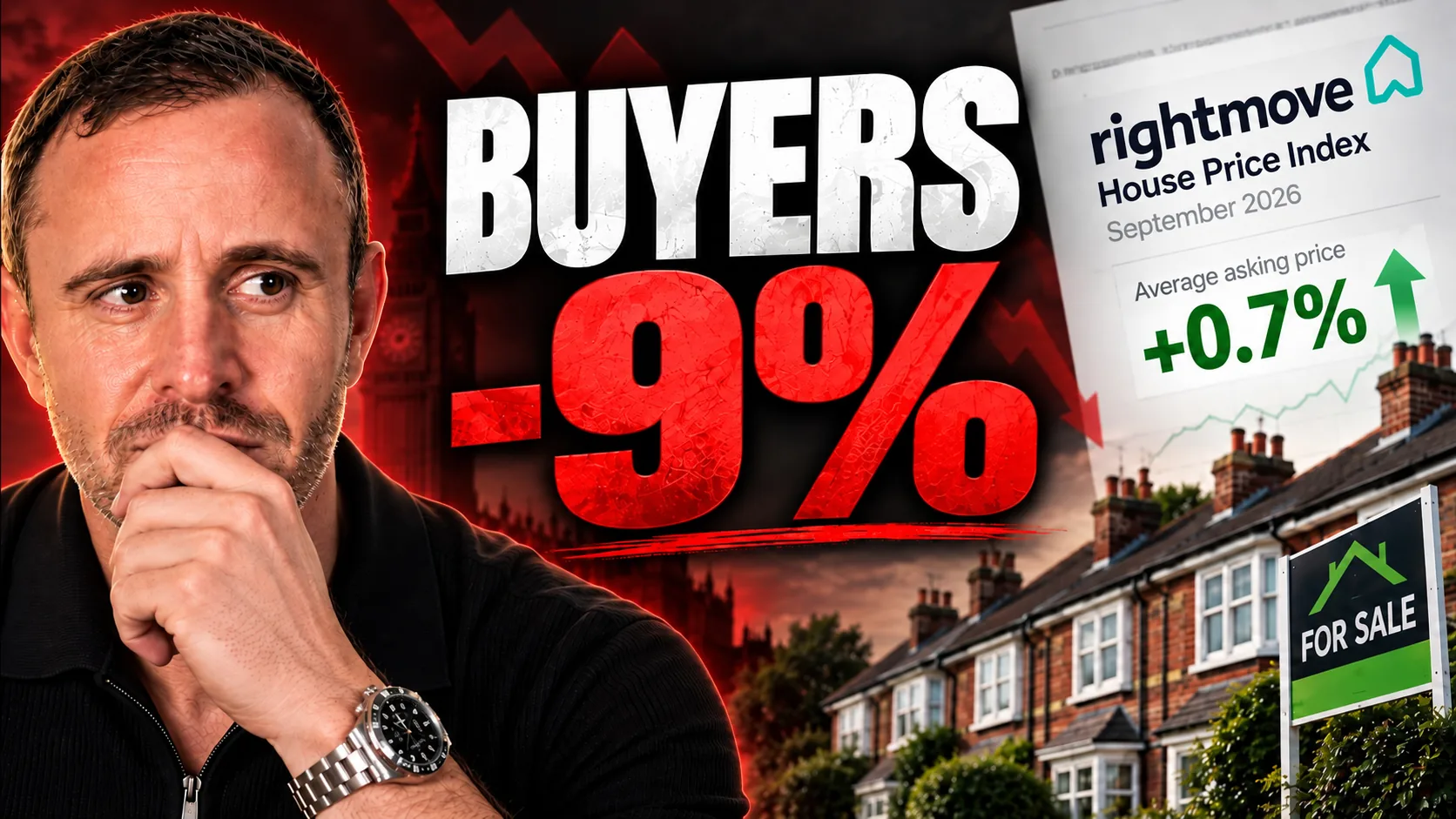
The Rightmove House Price Index for September 2026 shows average asking prices rising by 0.7% to £367,440. That’s the first monthly increase since May and a little stronger than the usual September rise. On its own, it sounds like encouraging news for anyone trying to sell a property.
But I don’t think it means sellers have suddenly regained control of the market. Buyer enquiries are lower than a year ago, there are plenty of homes competing for attention, and mortgage costs have moved higher again. A better month after a weak summer is welcome, but it isn’t automatically the start of a strong recovery.
I’ve been investing in UK property for around 15 years and own more than £3.5 million worth of property. When I read a report like this, I’m interested in what it tells me about negotiating power, realistic prices and the numbers behind an individual purchase. Here’s my reading of September’s update.
You can also watch my Rightmove September index video on YouTube.
What happened to asking prices in September?
Rightmove reports that the average asking price of a newly listed home rose by £2,441, or 0.7%, to £367,440. The ten-year average September increase is 0.5%, so this month’s rise is slightly stronger than the usual seasonal pattern.
That seasonal context matters. People come back from summer holidays, revisit their moving plans and start looking again. An autumn improvement in activity isn’t surprising, and I wouldn’t dismiss a positive figure simply because it arrives at a time when prices often pick up.
However, look at what came before it. The report’s monthly series shows falls of 0.6% in June, 1% in July and 2% in August. Even after the September increase, asking prices are 0.8% below a year earlier. We’ve had a better September after a weak summer, rather than evidence that all the earlier pressure has disappeared.
If you read my August 2026 asking-price update, this is the next part of that story. The direction changed for one month, but buyers and sellers still need to understand the conditions underneath the national average.
Asking prices are not completed sale prices
Rightmove is measuring the prices at which sellers bring homes to the market. That is useful information about expectations and current competition, but it isn’t the amount those homes will necessarily achieve when a sale completes.
A seller can ask more in September without a buyer agreeing to pay it. Equally, a property can be sensibly priced from the beginning and attract interest quickly. The headline average doesn’t tell us which of those situations applies to the particular house we’re looking at.
For comparison, the official UK House Price Index summary for July 2026 reports transaction-based prices for an earlier period. It is a different measure, with its own coverage and revisions. I wouldn’t place its average beside Rightmove’s and treat the gap as a discount available on an ordinary purchase.
The practical point is straightforward: I use an asking-price report to understand the market, then investigate the value of the actual property. Neither a national index nor an ambitious listing price replaces comparable evidence.
More choice gives buyers more room to negotiate
The part of the September report that interests me most is the balance between supply and demand. Rightmove says the number of homes available for sale is at a twelve-year high for this time of year, while buyer enquiries are 9% below the level a year earlier.
The report also shows average stock of around 65 properties per agent. There’s a detail worth keeping clear: that stock measure includes homes under offer or sold subject to contract. It shouldn’t be read as 65 entirely unsold properties immediately available from every individual branch.
Even with that distinction, the broader picture is of sellers competing for buyers who have plenty to consider. A buyer can compare more alternatives and be more selective about the price, condition and compromises involved in a purchase.
Imagine there are 20 similar houses available. If one seller wants £30,000 more than the others without a convincing reason, I don’t have to spend weeks arguing with them. I can look at the other properties instead. The existence of alternatives changes the conversation before anyone makes an offer.
That doesn’t mean every seller is desperate or every offer will be accepted. Some people can wait. Others have a deadline, an onward move or another reason to value a reliable transaction. A market with more stock gives me a better chance of finding the situation that suits my approach.
What the report’s 74% figure means for sellers
Rightmove says 74% of the homes that have sold so far this year did not need a subsequent asking-price reduction. It presents this as evidence of the importance of getting the initial price right.
I think that makes sense, but the statistic needs reading in the right direction. It doesn’t mean that 74% of every property listed at its original price will sell. It describes the homes that sold, rather than giving every new seller a guaranteed success rate.
For someone selling now, I’d focus on what a buyer sees when comparing the available options. Does the asking price make sense against similar homes? Is there a reason to choose this one? Does the presentation support the price, or is the seller relying on an emotional valuation that the buyer doesn’t share?
Pricing realistically from the start is about attracting the right attention while the listing is fresh. Starting high and assuming there will always be time to reduce later can leave a property competing with newer listings. In this market, buyers don’t necessarily need to wait for an overpriced seller to become realistic.
That still doesn’t mean accepting the first low offer. It means being honest about the evidence and the alternatives. A seller’s preferred number and an achievable number can be different.
Why London and Scotland tell different stories
The regional contrast is striking. Rightmove reports that 91% of homes for sale in Scotland are finding a buyer, compared with 42% in London. The average asking price in Scotland is approximately £207,000, with annual growth of 4.2% and an average of 33 days to find a buyer.
In London, the average is approximately £658,000, asking prices are 2.6% lower than a year earlier, and the average time to find a buyer is 78 days. Those figures describe very different market conditions beneath a single national headline.
The time-to-buyer figure is also different from the time required to complete a transaction. Finding someone who agrees to buy is one stage; getting through the legal and mortgage process is another. I wouldn’t tell a Scottish seller that the report promises a completed move in 33 days.
My view is that affordability helps explain a large part of the contrast. More expensive property usually requires a larger deposit, a larger mortgage or both. When borrowing becomes more expensive, buyers at the edge of their budgets have to reconsider what they can afford.
Local conditions and different selling systems also matter, so I wouldn’t use the percentages alone to declare one entire region a good investment and another a bad one. I want to understand the area, the property and the demand for it. My article on whether I would invest in London property explores that investment decision in more detail.
Higher mortgage costs are still restricting buyers
The September report puts the average two-year fixed mortgage rate at 5.29%, compared with 5.09% a month earlier and about 4.25% before the Middle East conflict. These are the report’s market measures, rather than a quote for your particular mortgage or a buy-to-let product I can obtain today.
Rightmove also estimates that the monthly payment on a new mortgage is around £180 higher than before the conflict. That is about £2,160 over a year. The effect on an individual borrower depends on the loan size, term, deposit and rate, so it isn’t a universal £180 increase for every homeowner.
For a household already close to its budget, the available choices become uncomfortable. Find a bigger deposit, buy a cheaper property or wait. If enough buyers choose one of those options, sellers have to work harder to attract the people who can still proceed.
This is why I wouldn’t treat September’s asking-price rise as proof that affordability has improved. The amount a seller wants and the monthly payment a buyer can support have to meet somewhere. Higher borrowing costs can keep that gap wide even during a seasonal bounce.
I’ve covered the latest central-bank backdrop in my September 2026 mortgage-rate update. For a purchase decision, though, I’d use current lender quotes and the actual costs of the deal.
Why I like this sort of market as an investor
I’m normally looking to buy around 5% to 10% below what I believe is genuine market value. More properties to choose from and fewer competing buyers can make that easier to pursue than a market where every sensible listing immediately attracts several strong offers.
That’s different from asking for 10% off whatever number happens to be on the advert. If a house is overpriced to begin with, a reduction might only bring it back to fair value. I need a sensible valuation before the apparent discount means anything.
In the video, I use the example of a £150,000 property where I might be interested at £135,000. Plenty of sellers may say no, and that’s fine. I’m looking for a deal where the owner values certainty and getting the transaction done more than holding out for the last £10,000 or £15,000.
I can’t promise that every market will offer that opportunity, or that my first offer will find it. The advantage of more choice is that I can keep looking rather than convincing myself that I must buy the first acceptable house at any price.
My approach to buying property below market value goes into the reasoning. The discount needs to be real, and the property still needs to be something I’m happy to own.
The deal has to work at today’s rates
Higher borrowing costs affect me as well as the homeowner competing for a property. A quieter market doesn’t make that expense disappear. It makes buying at the right price more important because I need enough margin after the mortgage and other costs.
I want to know the achievable rent, the cost of management, the likely maintenance and the allowance for empty periods. If the investment only looks attractive after assuming cheaper mortgages or a large rent increase, I need to question the purchase rather than rely on a favourable forecast.
My reading of September is therefore cautiously practical. Sellers have more competition, buyers have more choice, and borrowing is expensive. A 0.7% increase in new asking prices doesn’t cancel those facts. I’ll keep looking for an okay house on an okay street that I can buy at a genuinely good price.
If you want to discuss how that approach fits your own budget and goals, book a free 20-minute strategy call. You can also explore the Starter Club or Done For You service. The report gives us context; the individual deal still has to earn its place in the plan.