Buy-to-Let Mortgages Explained: Deposits, Rent Cover and Costs
July 1, 2026
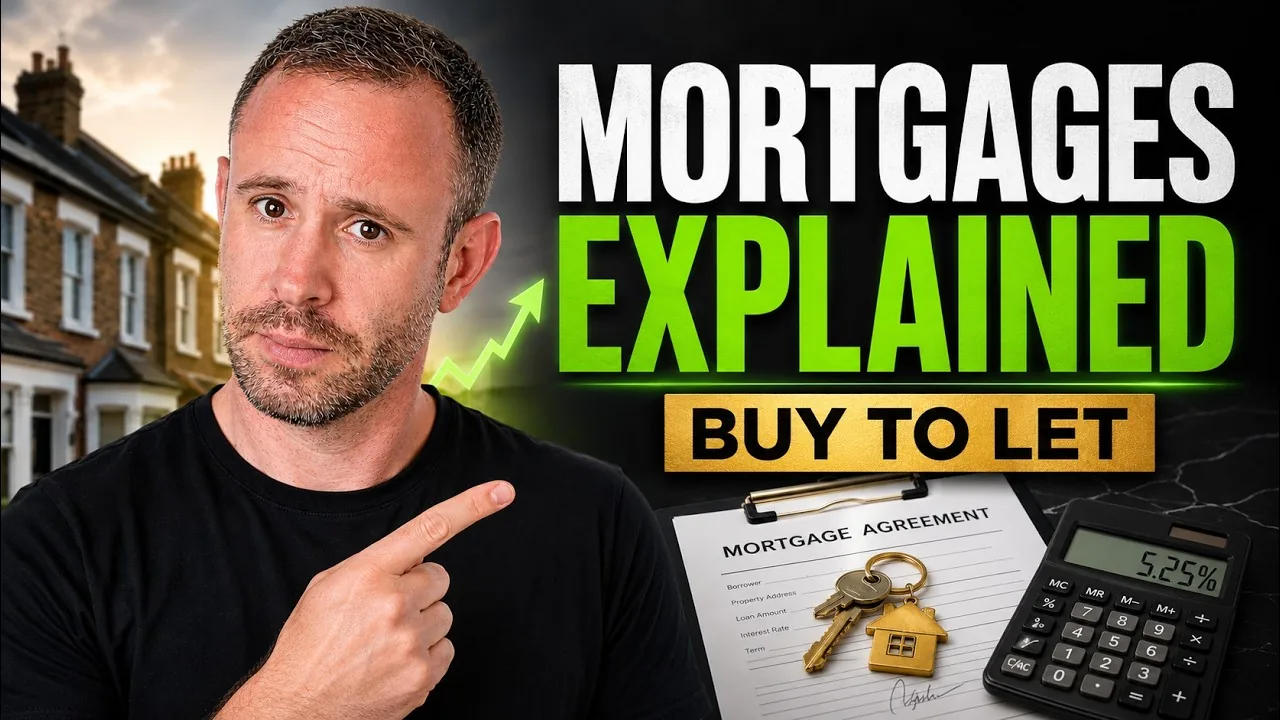
A buy-to-let mortgage looks simple until you try to arrange one. You find a property, provide a deposit and borrow the rest. But the lender also wants to know whether the property and its rent can support the debt.
That is the part beginners can overlook. Having the deposit is important, but it doesn’t automatically make a particular purchase mortgageable at the amount you want to borrow.
In my video published on 1 July 2026, I explained the process using my experience of a portfolio worth around £3.5 million with almost £2 million of mortgages. I regularly arrange or review borrowing, and the biggest lesson is to understand the complete deal rather than fixating on the advertised interest rate.
You can watch my original buy-to-let mortgage guide on YouTube. Here are the moving parts I would want clear before making a serious offer.
How buy-to-let borrowing differs from a home mortgage
A residential mortgage is primarily arranged around living in the property and the borrower’s affordability. Buy-to-let borrowing is intended for a property being rented out, so rental income plays a much larger role in the assessment.
The key question is whether the expected rent is sufficient to support the borrowing under the lender’s rules. Your own position still matters: lenders have criteria covering income, credit history, age, experience and other commitments. It isn’t literally a case of ignoring the borrower.
The property matters too. Its condition, tenure, use and valuation can affect the lender’s willingness to finance it. A normal single let, HMO and unusual property may require different products and criteria.
That is why I would talk to a suitable broker before becoming attached to a house. Understanding the likely financing limits helps you look at properties that fit, rather than trying to force a mortgage around a purchase you have already decided to make.
Use 25% as a starting deposit assumption
For initial planning, I tend to use a 25% deposit. On a £200,000 purchase, that is £50,000, with a £150,000 loan at 75% loan-to-value.
You may see lenders offering different limits. The available borrowing depends on the product, property, rental assessment and borrower. A nominal 75% maximum doesn’t mean every application will receive 75%.
The deposit also isn’t the full cash requirement. You need to allow for buying tax, legal costs, mortgage fees, any valuation or survey costs and necessary work. Product fees can be significant, so a general allowance should be replaced with actual quotes before committing.
Then keep a reserve. I would not complete a rental purchase with no money left simply because the deposit and fees just fit. An empty period or repair can arrive immediately, while the mortgage still needs paying.
For a broader starting-budget discussion, read how much money I would allow to start property investing.
Rent cover explains why a deposit may not be enough
Lenders commonly compare rent with stressed mortgage interest using an interest coverage ratio, often called ICR. The aim is to allow some room beyond the interest bill rather than lending on a deal that only just covers today’s payment.
In the video, I discussed thresholds such as 125% or 145%. The actual requirement varies with the lender, product, tax position and other factors. The stress rate can also differ from the rate you initially pay.
Suppose a £150,000 loan is assessed at an illustrative 6% interest rate. That is £9,000 a year, or £750 a month. At 125% cover, the required rent would be £937.50 a month. At 145%, it would be £1,087.50.
Those are examples of the calculation, not a mortgage quotation. They show why the same rent can support different loan amounts under different assessment rules.
The Bank of England’s explanation of buy-to-let underwriting and affordability describes how these ratios and stress tests work. Your broker must establish the specific lender’s current criteria for your application.
Passing the lender’s test doesn’t prove the investment is profitable for you. You still need to account for operating costs, tax and reserves. The bank is assessing its lending risk; you are assessing the whole business.
Interest-only preserves cash flow but leaves the debt
I generally use interest-only borrowing because I value cash flow and flexibility. The monthly payment services interest rather than gradually reducing the loan balance.
If I borrow £150,000 and make only the required interest payments, I still owe £150,000 later. That amount needs to be repaid at the end of the term. Selling or refinancing may be part of a plan, but neither should be treated as guaranteed on favourable terms.
The attraction is that more monthly cash remains available for reserves, maintenance, tax and reinvestment. That can be useful when building a portfolio. It also requires discipline, because retaining cash is not the same as using it productively.
A repayment mortgage gradually reduces the balance, providing a clearer route to paying off that particular loan. The trade-off is a larger monthly payment and less cash available for other purposes.
In the video, I used a family-house example to explain how a fixed amount of debt can become less significant over decades of inflation and asset growth. That is an illustration of purchasing power, not a reason to ignore the repayment obligation or assume property values always rise.
I have a separate interest-only versus repayment comparison if you want to work through that choice more fully.
Understand the tax point behind repayment
A repayment mortgage includes both interest and capital. Paying back the capital is not normally an expense you deduct when calculating rental profit. You are reducing a debt, rather than paying a running cost of the rental business.
That is the point behind my comment that repayment can use money on which tax is still due. It does not mean the act of repaying capital creates a separate tax charge by itself.
The treatment of mortgage interest is different for individuals and companies, and the final result depends on your circumstances. I would have an accountant model the cash flow after tax rather than comparing mortgage payments alone.
A product that leaves more cash this month may have a different long-term outcome from one that reduces debt faster. The right comparison includes your wider goals and ability to manage the risk.
Personal ownership or a limited company?
There isn’t one answer for every investor. Personal ownership can be simpler administratively and may offer different borrowing costs. A limited company can be more suitable for some investors building and reinvesting within a portfolio.
Individual residential landlords face restrictions on finance-cost relief, while companies generally treat qualifying interest as a business expense under the applicable rules. That difference can be important, particularly for higher-rate taxpayers.
But the company route also brings accounts, administration and potentially different mortgage pricing. Corporation tax and the tax consequences of taking money out must be considered together. Looking only at the first layer can make the comparison misleading.
I would not say that company mortgages are always a fixed percentage more expensive. Products and fees vary. Compare actual offers and the overall tax position rather than relying on a rule of thumb from an older video.
Think about what you are trying to build: a small supplementary income, a larger reinvested portfolio or something else. Then obtain advice before buying. Changing ownership later can create costs that a little planning might have avoided.
The lowest rate is not always the cheapest mortgage
This is one of the most useful lessons from my own borrowing. A lower advertised rate can be outweighed by a large arrangement fee or other costs, particularly over a relatively short fixed period.
I would compare product fees, valuation and legal costs, early repayment charges, the length of the deal and what happens afterwards. If a fee is added to the loan, it increases the borrowing and may attract interest too.
A product transfer with the existing lender can sometimes be more economical than moving, even if the headline rate is a little higher. Other times moving is worthwhile. I have found both the rate and the surrounding costs need to be considered commercially.
The intended holding period matters. If you expect to sell, refinance or carry out work soon, early repayment charges and product flexibility can materially affect the result. A mortgage is part of the investment plan, not a separate competition to find the smallest percentage.
Loan-to-value and valuation can change your options
Loan-to-value is the debt divided by the property’s value. A £150,000 mortgage against a £200,000 property is 75% LTV.
If the property increases in value while the debt stays unchanged, LTV falls. That may improve the range or pricing of available products, although the lender’s valuation and criteria determine the actual offer.
When refinancing, I would check whether an updated valuation could improve the options rather than automatically continuing with an old figure. But I wouldn’t assume my own estimate is the one the lender will use.
The lender is taking risk against its assessment of the security. If it values the property below the price you’ve agreed, the available loan may be lower and you may need more cash or a different negotiation.
That can be disappointing, but it is also useful information. I would examine why the valuation differs rather than treating it simply as an obstacle to a deal I want to complete.
The five mistakes I would avoid
The first is speaking to a broker too late. Establish the likely finance before investing too much time or emotion in a purchase.
The second is comparing rates without fees and restrictions. A mortgage should be assessed over the period you expect to use it, including likely exit costs.
The third is misunderstanding LTV. More equity can improve resilience and potentially product choice, while borrowing more against growth increases exposure again.
The fourth is assuming the lender must accept your valuation. It won’t necessarily do so, and the cash required can change as a result.
The fifth is leaving no reserve after completion. A mortgage payment is a commitment even when the property is empty or needs work.
I would also avoid basing the deal on a prediction of lower rates. The property should work with the finance actually available and survive a less favourable scenario.
Get the borrowing right before buying
A buy-to-let mortgage becomes easier to understand once you separate deposit, rental cover, repayment structure, ownership and total cost. None should be decided in isolation from the property and your broader plan.
If you’d like to discuss the investment side of your position, book a free 30-minute call with me. You can also explore Starter Club or read about Done For You. Use a qualified broker and accountant for the mortgage and tax advice specific to you.