Bitcoin’s July 2026 Crash: Why I Wasn’t Buying the Dip
July 23, 2026
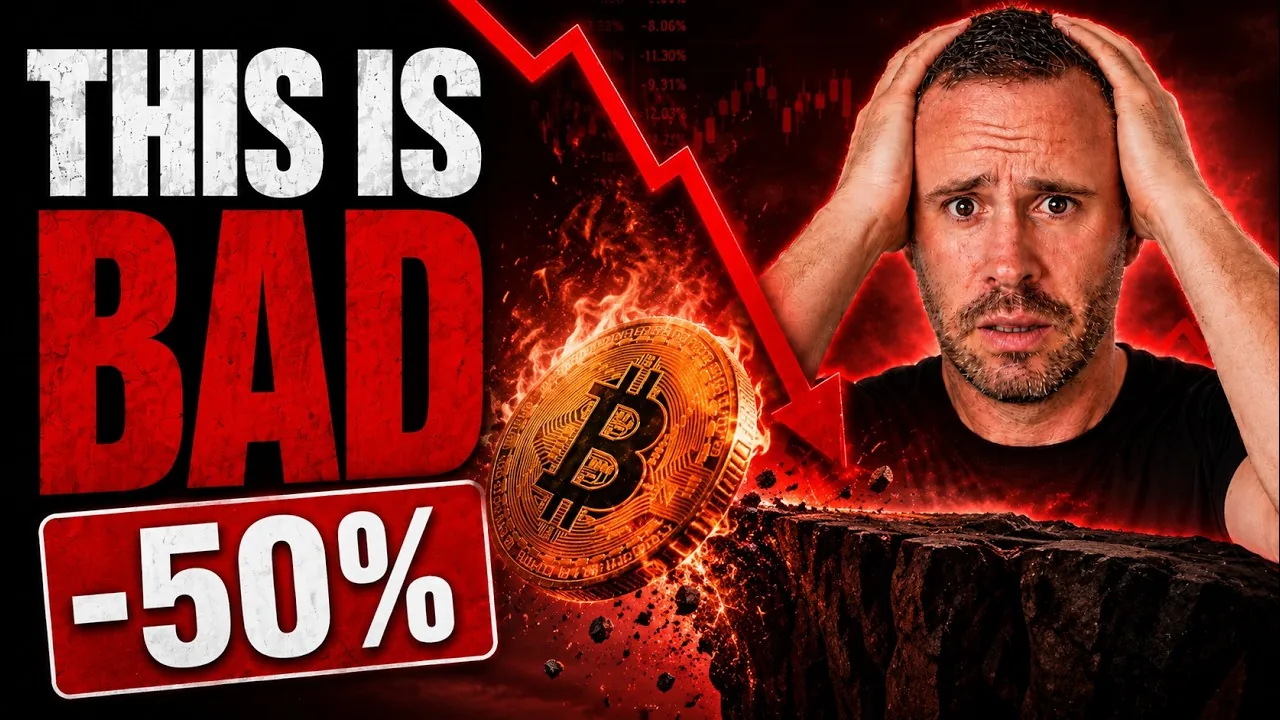
A Bitcoin price crash makes people ask whether they should buy the dip. I think there is a question to answer before that: what job would Bitcoin do in your financial life, and could your plan survive if you were completely wrong about it?
I recorded my video on 9 July 2026 and published it on 23 July. In the recording, I referred to Bitcoin at roughly $63,000 against an October 2025 peak just above $126,000. Those were the figures behind my discussion of a fall of around half. They are the recording’s historical reference points, not a live price quote or a claim about the publication-day closing price.
My position in that video was straightforward: I wasn’t buying Bitcoin. I’ve built businesses and a property portfolio, and those remain the foundations I understand best. That doesn’t require me to want Bitcoin to fail. It means I don’t have to buy something simply because its price has fallen sharply.
You can also watch my Bitcoin crash analysis on YouTube.
A 50% fall is more than an uncomfortable headline
If an investment falls from 100 to 50, half its value has gone. To return from 50 to 100, it needs to rise by 100%, not 50%. That arithmetic is simple, but it matters when somebody describes a very large loss as a temporary inconvenience.
In the video I used £10,000 falling to £5,000 to make the scale tangible. For a UK investor in an asset quoted in dollars, the actual sterling outcome also depends on exchange-rate movements and dealing costs. The example illustrates a halving, rather than an exact return for every buyer.
A lower price may make something more attractive, but it doesn’t establish fair value by itself. An asset can be much cheaper than its peak and still fall considerably further. The previous high isn’t a guarantee of where the price must return.
That is why I separate the size of the fall from the decision to invest. A dramatic chart gets attention. A sensible decision requires an explanation of value, risk, time horizon and how the investment fits alongside everything else you own.
Why I questioned the safe-haven argument
The first issue I raised was Bitcoin’s behaviour when investors become nervous. It is often described as digital gold: scarce, independent of a central bank and potentially protective when confidence in conventional money weakens.
My concern is that scarcity alone doesn’t make an asset a dependable shelter during a crisis. If holders sell it when they need cash or want to reduce risk, the price can fall alongside other risky investments. That is the behaviour I was questioning in the recording.
I also suggested that institutional participation could connect Bitcoin more closely to the wider investment market. Large investors can hold it beside shares, bonds and other assets, then reduce several positions together when their appetite for risk changes.
That is my interpretation of the market, not a claim that Bitcoin follows technology shares in a fixed relationship. Correlations change. What matters to me is whether an asset performs the role I expect when conditions become difficult, rather than only when enthusiasm is high.
Interest rates change the alternatives
My second point concerned the price of money. When cash offers very little, investors may be more willing to take substantial risk in search of a return. When lower-risk alternatives offer meaningful income, speculative investments face stronger competition for capital.
Bitcoin itself pays no rent, dividend or business earnings. To make money from holding it directly, you generally need someone to pay more for it later. That makes confidence and future demand particularly important to its investment case.
I prefer being able to assess an asset’s underlying income. With a property, I can investigate the rent, running costs, condition and demand. With a business, I can look at what it sells and whether it earns a profit. Neither is risk-free, but those features give me something concrete to analyse.
The point isn’t that a non-income-producing asset can never be valuable. It is that I need a different way of judging it, and I’m less comfortable making that judgement. I don’t think investors need to become experts in every market to build wealth.
ETF access works in both directions
The third issue was money moving through exchange-traded funds. Spot Bitcoin products made exposure easier for investors who didn’t want to manage a crypto wallet themselves. Easier access can attract demand, but it also makes reducing exposure straightforward.
In a spot fund, creations and redemptions can affect the assets held, depending on the product’s arrangements. Trading existing fund shares between investors is not automatically the same as new money entering or leaving the fund. That distinction matters when discussing ETF flows.
The concern I raised was net withdrawals during a period of weak confidence. Institutional access doesn’t mean that institutions will hold regardless of price, alternatives or changes in their investment mandate.
I discussed a reduction in Citi’s forecasts in the video, but the important lesson doesn’t depend on adopting a bank’s price target. Forecasts change as assumptions about demand, regulation and the economy change. They should not become a substitute for an investor’s own assessment of risk.
I don’t treat bank forecasts as gospel. The same institutions whose involvement is presented as a reason to be permanently optimistic can reassess the opportunity and move their money elsewhere. Easier access creates a route out of the investment as well as a route into it.
Good news can already be reflected in the price
My fourth point was about expectations. The investment story had included ETF approvals, the halving, greater institutional involvement and the prospect of a friendlier policy environment. Once widely anticipated events happen, a market may need a fresh reason for additional buyers to arrive.
That doesn’t mean the developments have no lasting value. It means the price may already have incorporated a great deal of optimism about them. Something can be positive for an asset’s long-term prospects without producing an immediate price rise.
In the recording, I felt Bitcoin lacked a sufficiently powerful new catalyst. That was an opinion about that moment. Lower borrowing costs, renewed investment flows or policy changes could alter sentiment, but none would give me a dependable timetable for a recovery.
This is a useful lesson beyond crypto. If my entire reason for buying is a story everyone already knows, I should ask what I believe the market has missed. Repeating a persuasive narrative isn’t the same as understanding the price I’m paying.
Scarcity is real, but so is uncertainty
My fifth concern returned to the digital-gold argument. I questioned whether investors were treating Bitcoin as a dependable refuge or as a scarce asset whose price still depended heavily on their willingness to speculate.
The opposing argument deserves a fair hearing. Bitcoin has a programmed supply limit of 21 million coins and can be transferred across borders without a central issuer. Supporters see those characteristics as valuable in a world where conventional money supplies can expand.
There is one clarification to the video’s wording: Bitcoin is not reliably untraceable. Transactions are recorded on a public blockchain. Addresses are pseudonymous, but activity can be analysed and addresses can sometimes be connected to identities. Scarcity, decentralisation and anonymity are different claims.
I understand why people value the network and its limited supply. I also understand the preference for productive assets associated with investors such as Warren Buffett. For me, the difficult part is translating collective belief in a scarce digital asset into a valuation I can defend.
A corporate Bitcoin holding isn’t a normal trading account
I also discussed Strategy, the company associated with Michael Saylor. In the recording I used rounded figures of approximately 847,000 Bitcoin and an average purchase price of $75,650 to illustrate what a lower market price could mean.
Using those inputs and $63,000 per coin gives a difference of roughly $10.7 billion. That calculation checks mathematically, but it remains an illustration using the figures quoted in the video. I’m not presenting it as an independently verified company balance sheet at publication or as the company’s current position.
An unrealised decline of that kind is not automatically a demand from a broker to liquidate the entire holding. A company funded through equity and debt has different obligations from a trader using a conventional leveraged crypto account.
The questions are about cash requirements, financing terms, future access to funding and what management might choose or need to do. A share investor also takes company-specific risks alongside Bitcoin exposure. I wouldn’t treat buying a treasury company as identical to simply owning the underlying coin.
Why position size matters more to me than a target price
Bitcoin has recovered from severe falls in previous cycles. That helps explain the conviction of long-term holders, but it cannot establish that another recovery must follow this one. Survival so far and certainty about the future are different things.
If I wanted exposure, I would size it so that a total loss couldn’t destroy the rest of my plan. I wouldn’t use money needed for essential bills, a property purchase or an emergency reserve simply because somebody described the price as a once-in-a-lifetime opportunity.
The FCA’s guidance on investing in crypto is clear about the possibility of losing everything invested. It also explains risks beyond price movements, including problems with firms and cyberattacks. Understanding what you own includes understanding where and how it is held.
A small speculative position can have a different role from the foundation of someone’s financial future. My own preference remains assets whose income and economics I can assess. My property versus index funds comparison explains how I weigh two of those alternatives.
The decision I’m comfortable making
I don’t need to predict that Bitcoin will reach a million dollars or become worthless. Both claims go further than I can justify. I can recognise the potential upside while deciding that it isn’t necessary for my own strategy.
The position I set out in July was that I wasn’t buying. If your view differs, the useful exercise is to explain why you want exposure, what could invalidate your reasoning and how much you could lose without derailing your life.
Before choosing another investment, I would also work through a clear property investment plan if property is the route you’re considering. The asset should serve your goals, rather than the latest headline choosing your goals for you.
If you want to discuss whether property fits your wider plans, book a free property strategy call. It is a conversation about property education and your next steps, not a Bitcoin trading recommendation.